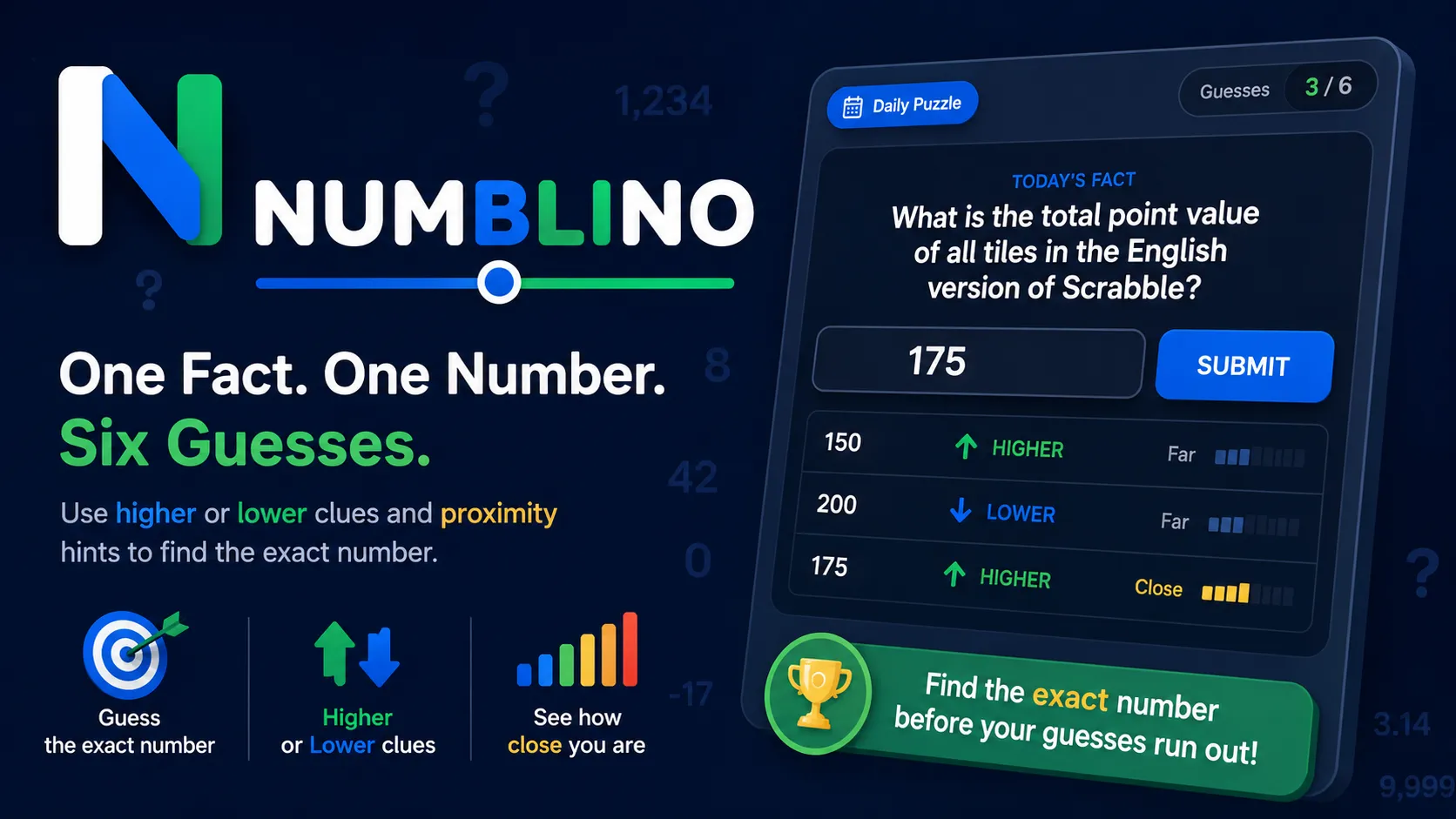

What is Numblino?
Numblino is a daily estimation game that turns an obscure fact into a numerical showdown. You receive a question such as the number of days a famous structure stood, the total value of a set of game pieces, or the quantity of something found around the world—and must guess the exact answer.
The opening guess tests your trivia instincts. After that, the hunt becomes a tense process of narrowing the range: every attempt tells you whether the target is higher or lower and indicates how close you are. You have only six guesses, so a reckless estimate can leave you fighting through an enormous numerical wilderness.
Numblino Game Rules (The Catch / The Trap)
One fact, one hidden number: Numblino presents a single factual prompt. The answer is a number rather than a word, place, or multiple-choice option.
Six guesses maximum: Each submitted number consumes one attempt. Once all six guesses are gone, the answer escapes.
Follow the direction: A wrong guess reveals whether the correct number is higher or lower.
Your guess: 500 → Target is HIGHER
Your guess: 2,000 → Target is LOWER
Watch the proximity feedback: Numblino also indicates how close each estimate is, helping you judge whether to make a dramatic leap or a smaller adjustment.
The exact answer wins: Being extremely close is useful, but it does not finish the puzzle. You MUST land on the correct value before the final attempt.
Different number formats can appear: The input controls support whole numbers, decimals, and negative values when a question requires them.
A new challenge appears daily, while the archive lets you revisit earlier Numblino questions.
How To Play Numblino?
Suppose the prompt is: “What is the total point value of all tiles in the English version of Scrabble?”
Make an informed opening estimate
- Player Guesses:
150 - Game Response: The answer is higher.
- What You Learn: Your starting range must move above 150.
- Player Guesses:
Test the opposite boundary
- Player Guesses:
200 - Game Response: The answer is lower.
- What You Learn: The target is now trapped between 150 and 200.
- Player Guesses:
Use the closeness clue
- Player Guesses:
175 - Game Response: Higher—and noticeably close.
- Next Constraint: Focus on the narrow upper part of the remaining range.
- Player Guesses:
Strike at the hidden number
- Player Guesses:
187 - Result: Correct. The number has nowhere left to hide.
- Player Guesses:
Numblino Strategy & Tips
Start with a sensible estimate rather than a random extreme. Your first guess should establish a useful scale: tens, hundreds, thousands, or millions.
After receiving higher-or-lower feedback, choose guesses that divide the remaining range efficiently. The proximity indicator can justify moving away from a strict midpoint when your previous attempt was already close.
Pay attention to wording and units. “Per year,” “as of a specific date,” “worldwide,” and “recognized by the United Nations” can completely change the expected magnitude of an answer.