
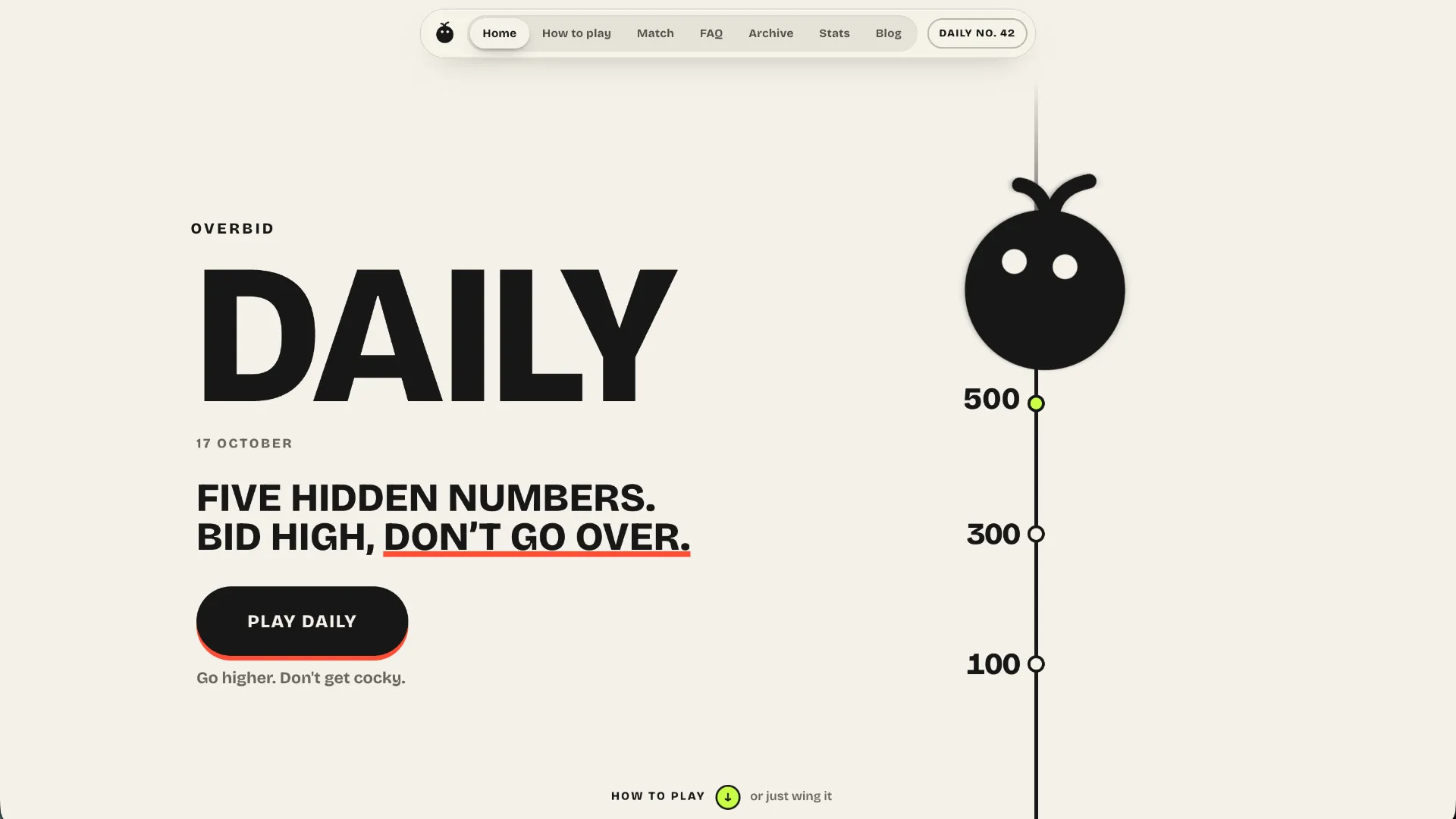
What Is Overbid?
Overbid is a free daily number-estimation and trivia game where the goal is simple: bid as close as possible to a hidden numerical answer without going over.
Every day, Overbid presents six questions involving surprising quantities, measurements, and general knowledge. Rather than simply typing an answer, players must decide how aggressively to bid, when to raise their estimates, and when to stop before risking everything.
For example, imagine being asked how many tennis balls could fit inside a shipping container. You probably do not know the exact answer, but you can use reasonable estimates and logical thinking to decide how high to bid.
The closer your final bid is to the correct answer, the more points you can earn. However, a single bid that exceeds the answer makes your score for that round zero.
The game combines numerical estimation, trivia knowledge, and risk management into a quick daily challenge. It can be played alone or compared with friends through shared challenges.
Overbid Rules: How the Bidding Works
Overbid differs from traditional trivia games because you must choose your bidding strategy before seeing the question.
Each round follows several important rules:
- Six daily questions: Complete six numerical challenges in each daily game.
- Choose your bids first: Select whether you want one, two, or three bids before the question is revealed.
- Fewer bids mean bigger multipliers: Choosing fewer opportunities to bid increases your potential scoring multiplier.
- Bid below or equal to the answer: Your bid must not exceed the hidden correct value.
- Raise your bids: If you selected multiple bids, subsequent bids must be higher than your previous bid.
- Bank your points: Stop bidding to preserve your current qualifying bid instead of risking another increase.
- Overbidding means zero: If any bid exceeds the correct answer, you earn no points for that question.
- No live proximity clues: You do not discover exactly how close your estimate is during the round. The correct answer is revealed after the round ends.
The central challenge is deciding whether an additional increase is worth the risk. A cautious bid can secure points, but a higher bid might dramatically improve your score.
How to Play Overbid
- Open the daily game. Visit playoverbid.com and begin today's six-question challenge. No account is required.
- Choose your bid allowance. Before revealing the next question, select one, two, or three bids. One bid offers the highest multiplier, while three bids provide more chances to increase your estimate.
- Read the question and estimate the number. Use your general knowledge, approximate calculations, or educated guesses to identify a reasonable number below the hidden answer.
- Submit, raise, or bank. Enter your first bid. If you have additional bids available, decide whether to increase your number or bank your current bid. Remember that bidding over the answer results in zero points for the round.
- Reveal your result and continue. After the round ends, see the correct answer and your points. Repeat the process for all six questions to complete the daily game.
Example: When Should You Stop Bidding?
Suppose a hypothetical question has a correct numerical answer of 1,000.
You choose two bids, giving you a scoring multiplier of ×1.4.
Your first bid is 600. It is below the correct answer, so it is a qualifying estimate.
You decide to take another chance and raise your bid to 850.
Because 850 is still below 1,000, your new bid qualifies and earns more points than the original estimate.
Now consider three possible outcomes:
| Final bid | Correct answer | Result |
|---|---|---|
| 600 | 1,000 | Safe, but relatively low score |
| 850 | 1,000 | Better score because the estimate is closer |
| 1,050 | 1,000 | Overbid: zero points |
A final bid of 850 with a ×1.4 multiplier earns approximately 860 points under the game's scoring formula.
This demonstrates Overbid's central risk: raising your bid improves your potential reward, but exceeding the answer eliminates your points for that question.
The numbers above are illustrative examples, not answers to an actual daily puzzle.
Overbid Scoring and Multipliers
Overbid rewards both accuracy and confidence. Players receive a larger multiplier when they commit to fewer bidding opportunities.
| Bids selected | Score multiplier | Strategy |
|---|---|---|
| 1 bid | ×2.0 | Highest potential reward, no chance to revise |
| 2 bids | ×1.4 | Balanced approach with one possible increase |
| 3 bids | ×1.0 | More flexibility, but no multiplier bonus |
For a qualifying bid, the scoring formula is:
Score = 1,000 × (Bid ÷ Correct Answer)³ × Multiplier
This formula means that accuracy matters significantly. A bid close to the correct answer can score much better than a very conservative estimate.
For example, bidding 90% of the correct answer receives a substantially higher base score than bidding only 50% of it.
However, a bid above the correct answer receives zero points, regardless of how close it was.
There is no single universally best bidding strategy. Success depends on how confidently you can estimate each quantity and how much risk you are willing to accept.
Tips and Strategies to Score Higher
1. Choose Your Bid Count Carefully
You must select your number of bids before seeing the question. A single bid offers twice the base score, but it gives you only one opportunity to commit to a number. Selecting two or three bids provides more flexibility at the cost of a smaller multiplier.
2. Break Large Numbers Into Smaller Estimates
When asked about a large quantity, use approximate calculations rather than relying on intuition alone.
For a question involving objects fitting inside a container, for example, think about the dimensions of the container, the approximate size of each object, and the space lost between packed objects.
Even rough calculations can produce a more defensible estimate.
3. Remember That You Receive No Proximity Feedback
Unlike higher-or-lower guessing games, Overbid does not reveal whether your current estimate is close to the hidden answer during the round.
An additional bid is therefore a judgment call rather than a guaranteed improvement. You can raise your number, but you cannot confirm that the new bid remains safe until the answer is revealed.
4. Bank When the Risk Becomes Too High
If your estimate already seems reasonably close to the likely answer, banking can be better than raising again. A smaller guaranteed qualifying score is more valuable than losing the entire round to an overbid.
5. Use Familiar Reference Points
Build estimates from facts you already know, such as common distances, population sizes, object dimensions, or everyday quantities.
For example, if a question concerns the number of items in a large space, estimate how many would fit in a smaller section and then scale your calculation upward.
6. Think About Your Total Daily Score
Overbid contains six questions, so one risky round is only part of your total performance. A consistent series of reasonable bids may outperform an aggressive strategy that repeatedly scores zero.
Daily Challenges, Past Puzzles, and Friends
Overbid releases a new set of six questions every day, making it suitable for a short daily gaming routine.
The game also allows players to revisit previous daily puzzles. This is particularly useful if you enjoy practicing numerical estimation or want more than the current day's six questions.
Players can share challenge links with friends so they can attempt the same questions and compare their results.
This adds a competitive element without requiring everyone to sit together or complete the questions simultaneously.
Is Overbid Free to Play?
Yes. Overbid is free to play directly in a web browser at playoverbid.com.
There is no software installation or account registration required to begin playing. Its short six-question format makes it convenient for quick sessions on a computer or mobile browser.
Who Should Play Overbid?
Overbid is particularly appealing to players who enjoy:
- Estimation games: Making educated guesses about large or surprising quantities.
- Trivia challenges: Using general knowledge to reason about unfamiliar questions.
- Risk-and-reward decisions: Choosing between a safe result and a potentially higher score.
- Daily browser games: Returning for a short new challenge each day.
- Friendly competition: Comparing scores with other players attempting the same questions.
Unlike conventional multiple-choice trivia games, Overbid asks players to construct their own numerical estimates and decide how much confidence to place in them.
Conclusion
Overbid combines the curiosity of trivia with the tension of an auction-style bidding game. Every question presents a choice between playing it safe and pushing your estimate closer to an unknown number.
With six daily questions, adjustable bidding multipliers, and a strict penalty for going over, it rewards both numerical intuition and smart risk management.
Play Overbid free at playoverbid.com and see how close you can get without bidding too high.