
What Is Paintiquity?
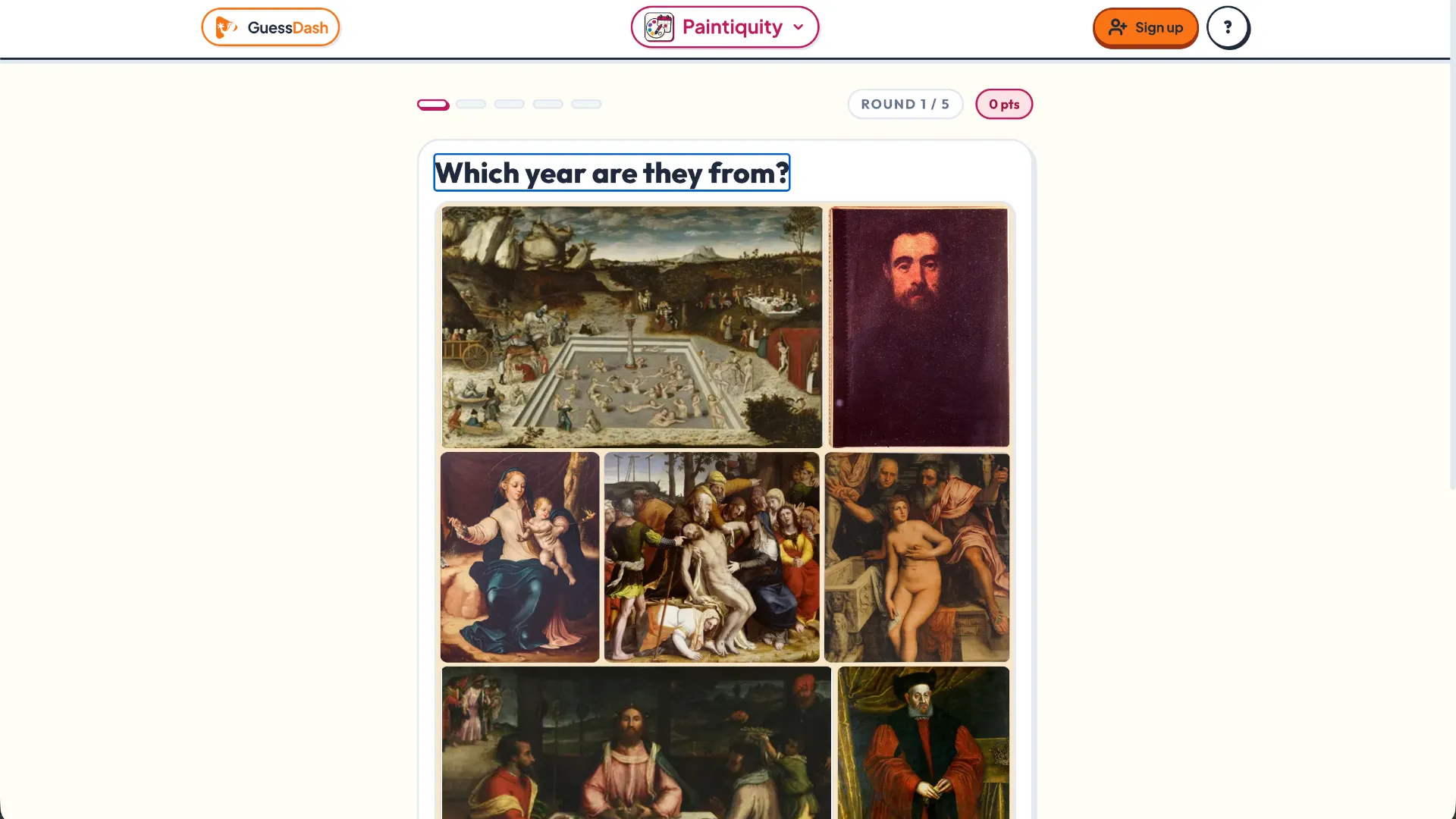
Paintiquity is a free daily art history guessing game where players examine a gallery of paintings and estimate the year in which they were created. Instead of identifying one famous painting or naming its artist, you study several artworks displayed together and try to discover the single year they all share.
The central question is simple: What year were all these paintings created?
Each daily game contains five rounds. Every round presents a mosaic of real paintings, and your task is to choose their shared creation year using a slider covering 1200 to 2020.
The challenge rewards visual observation, historical knowledge, and an understanding of how artistic styles have evolved. Clothing, architecture, subject matter, composition, brushwork, and materials can all provide clues about when an artwork was made.
Paintiquity is developed by GuessDash, an independent collection of daily games about geography, history, art, prices, and real-world data.
Unlike traditional multiple-choice art quizzes, Paintiquity asks you to estimate an actual year. You do not need to know every artist's name, but recognizing the historical period behind a group of paintings can significantly improve your guesses.
Paintiquity Rules and Core Mechanics
Paintiquity revolves around a gallery-based year-guessing mechanic. Several paintings appear together, and all of them share the same creation year.
The essential rules are:
- Five rounds per daily game: Each round features a different gallery of paintings.
- One shared year: All paintings within a gallery correspond to the same year.
- Historical guessing: Choose a year between 1200 and 2020.
- Interactive slider: Move the slider to select an approximate year.
- Precise adjustments: Use the minus and plus controls beside the year field to refine your selection.
- Submit your answer: Select Submit year to confirm your guess and continue.
- Earn points: The game tracks your results across the five rounds, rewarding more accurate estimates.
The Main Twist: Guess a Gallery, Not One Painting
Most art recognition games present one artwork and ask players to identify its creator, title, or historical period.
Paintiquity takes a different approach. It provides multiple paintings from the same year, allowing you to compare their visual characteristics.
One painting might contain recognizable clothing or architecture. Another might offer clues through brushwork, composition, or the development of a particular artistic movement.
Together, these paintings provide several opportunities to estimate the same date.
This also makes the game more interesting than simply identifying one artistic style. Different artists working in the same year could produce dramatically different paintings, so you need to consider the complete gallery rather than assuming every artwork belongs to an identical movement.
How to Play Paintiquity
Paintiquity is played directly in a browser, and the current daily puzzle does not require registration.
- Open the game. Visit Paintiquity on GuessDash. The game introduces its mechanics with a short tutorial explaining how to examine paintings and submit a year.
- Study the gallery. Look at the mosaic of paintings displayed on the screen. Consider their artistic styles, subjects, clothing, architecture, materials, and overall historical appearance.
- Open individual paintings. Select a painting to enlarge it and inspect details that may be difficult to see in the gallery view. Pay particular attention to recognizable historical clues.
- Choose and submit a year. Move the year slider between 1200 and 2020, then use the minus and plus buttons for precise adjustments. When satisfied, select Submit year.
- Complete all five rounds. Continue examining new galleries and submitting your estimates. Follow the points counter to track your performance throughout the daily challenge.
The interface displays your current round out of five and a running points total, making it easy to follow your progress.
Paintiquity Example: Dating a Gallery of Paintings
Imagine a hypothetical Paintiquity round showing several paintings with the following features:
- A landscape painted using loose, visible brushstrokes.
- An outdoor scene emphasizing natural light and atmospheric color.
- A portrait featuring clothing associated with the late nineteenth century.
- A city scene with industrial-era buildings and street activity.
These clues might suggest that the paintings were created during the nineteenth century, potentially around the rise of Impressionism.
You might initially estimate 1880.
After comparing the clothing, painting techniques, and urban environment, you might refine your estimate to 1875.
You would then select 1875 using the year control and submit your answer.
This is an illustrative example rather than an actual Paintiquity gallery. Its purpose is to show how several paintings can provide overlapping clues about a historical period.
The important skill is not memorizing one particular date. It is recognizing how visual details can help narrow an artwork's likely creation period.
Understanding the Year Range
Paintiquity asks players to choose a year between 1200 and 2020, covering more than eight centuries of art history.
That broad range makes the game accessible to people with different levels of historical knowledge while leaving plenty of room for difficult questions.
| Historical Period | Approximate Dates | Useful Visual Clues |
|---|---|---|
| Medieval and early Renaissance art | 1200–1450 | Religious imagery, stylized figures, gold backgrounds, limited naturalistic perspective |
| Renaissance | 1400–1600 | Realistic anatomy, linear perspective, classical subjects, balanced composition |
| Baroque | 1600–1750 | Dramatic lighting, movement, strong contrast, elaborate compositions |
| Rococo and Neoclassicism | 1700–1830 | Decorative elegance, pastel colors, classical themes, formal portraits |
| Romanticism and Realism | 1800–1880 | Emotional landscapes, historical scenes, ordinary subjects, social observation |
| Impressionism and Post-Impressionism | 1860–1910 | Visible brushwork, modern life, experimentation with light and color |
| Early modern art | 1900–1950 | Cubism, abstraction, Expressionism, unconventional perspectives |
| Postwar and contemporary art | 1945–2020 | Pop Art, conceptual approaches, new media, diverse styles and subjects |
These dates overlap because artistic movements develop gradually and often coexist. The table is a reference for estimating periods, not a strict classification system.
For example, an academic painter could produce a highly traditional work in the same year that another artist experimented with abstraction.
Paintiquity Scoring and Feedback
Paintiquity displays a running points total throughout its five-round daily challenge.
According to GuessDash's general scoring guidance, closer estimates earn more points in most of its games. Paintiquity is built around that historical estimation challenge.
The practical goal is to minimize the difference between your selected year and the shared creation year of the paintings.
For example, if the correct year were 1885:
- A guess of 1884 would be one year away.
- A guess of 1880 would be five years away.
- A guess of 1860 would be 25 years away.
- A guess of 1750 would be 135 years away.
The closer estimate is generally the more desirable result.
The game's interface maintains a visible points counter and five-round progress indicator. Its exact Paintiquity-specific point formula should be checked using the question-mark help control in the current game rather than assuming a particular fixed deduction per year.
Unlike a game that asks you to identify a painting from several answer choices, Paintiquity rewards estimating a continuous historical value.
Paintiquity Strategy Tips
1. Examine the Entire Gallery First
Do not immediately choose a year after recognizing one painting style.
Look across the complete mosaic. Several artworks may provide clues that reinforce or contradict your initial impression.
A recognizable building, piece of clothing, or artistic technique in one painting could help date the entire gallery.
2. Open Paintings to Inspect Details
The game allows you to enlarge individual works.
Use this feature to examine brushstrokes, clothing, architecture, subject matter, and other details that may not be obvious in thumbnail view.
A painting that looks generally historical at a small size may reveal a specific artistic technique or period detail when enlarged.
3. Recognize Major Artistic Movements
Learning the broad characteristics of Renaissance, Baroque, Romantic, Impressionist, and modern art can help narrow the possible date range.
You do not need to memorize hundreds of artists. Even recognizing whether a work is more likely from the seventeenth century or the nineteenth century can substantially improve your estimate.
4. Look at Clothing and Architecture
Fashion, buildings, furniture, and urban environments can be valuable historical clues.
A portrait featuring nineteenth-century clothing suggests a different period from one depicting Renaissance court attire.
However, historical costume paintings and deliberate references to earlier styles can be misleading. Use multiple clues before committing.
5. Study Brushwork and Painting Techniques
Painting techniques changed significantly across different periods.
Smooth, carefully blended surfaces may suggest one tradition, while loose brushwork, fragmented forms, or deliberately flattened perspective may suggest others.
These clues can help identify an artistic movement, which in turn narrows the likely creation dates.
6. Identify One Strong Historical Anchor
Try to find the painting that provides the clearest evidence of its period.
Perhaps it resembles a recognizable artistic movement, includes distinctive architecture, or depicts a subject closely associated with a particular era.
Use that painting as an anchor, then compare the remaining works to determine whether your estimate makes sense.
7. Avoid Assuming Every Painting Has the Same Style
Paintiquity galleries group paintings by creation year, not necessarily by identical style.
A single year can contain works by established academic painters, experimental artists, portrait specialists, and landscape painters.
If one painting looks older than another, consider whether the difference reflects artistic tradition rather than an actual gap in creation dates.
8. Narrow the Century Before the Year
The game's slider covers 1200 to 2020, so guessing an exact date immediately can be difficult.
Use a two-stage approach:
- Estimate the broad historical period or century.
- Refine the decade and then select your preferred year.
For instance, identifying a group as late nineteenth century is more useful than immediately guessing a random year across the entire available range.
9. Use the Plus and Minus Buttons
Once the slider is near your preferred year, use the adjacent controls to adjust it precisely.
This is especially helpful when you believe a painting belongs to a narrow period and want to avoid accidentally submitting a year several points away from your intended selection.
10. Learn From the Historical Context
Treat each gallery as an opportunity to improve your visual understanding of art history.
After completing a challenge, reflect on which visual clues influenced your estimates. Over time, recognizing historical patterns can become easier, even when the artists are unfamiliar.
Are the Paintings Real?
Yes. Paintiquity uses real artworks rather than fictional images created solely for the game.
GuessDash states that its paintings are sourced from Wikimedia Commons, a repository containing images and historical information about artworks from museums, institutions, and other collections.
The developer also checks puzzles before publication.
One notable detail is that Paintiquity excludes paintings that have the year visibly written on them, since a displayed date would reveal the answer without requiring any historical reasoning.
This helps preserve the intended challenge: dating paintings through visual evidence rather than finding a printed year.
As with historical art records generally, creation dates may sometimes depend on museum catalogues or scholarly attribution. The game uses the dates associated with its selected source records.
Is Paintiquity a Daily Game?
Yes. Paintiquity is part of GuessDash's collection of daily browser puzzles.
New puzzles are released at midnight Amsterdam time, according to the official GuessDash FAQ. This means the reset time can shift relative to your location when daylight saving time begins or ends in the Netherlands.
Everyone receives the same puzzles for a given day, allowing players to compare results with friends.
Each daily Paintiquity game contains five rounds, and the site displays the progress and points earned during the current edition.
GuessDash also offers an account-based archive system for revisiting puzzles from earlier dates.
Can You Play Previous Paintiquity Puzzles?
Yes. GuessDash supports replaying earlier daily puzzles through its account system.
After creating a free account and completing a game, the Replay feature on the results card provides access to a calendar of past challenges.
The account also allows you to synchronize scores and trophies across devices, add friends, and organize favorite games on the GuessDash homepage.
You do not need an account to play today's Paintiquity puzzle. Guest results remain stored in the browser used to play.
Is Paintiquity Free to Play?
Yes. Paintiquity is free to play at guessdash.com/paintiquity.
GuessDash states that all its games are free, contain no advertisements, and have nothing to purchase.
The current daily challenge can be played without creating an account or downloading an application.
A free account is optional for players who want cross-device progress, access to previous puzzles, and social features.
The game runs directly through a web browser and uses straightforward controls for selecting paintings, adjusting a year, and submitting an answer.
Paintiquity vs. Other Art and History Games
Paintiquity combines art appreciation with historical estimation, setting it apart from conventional art trivia.
| Game | Main Objective | Key Difference |
|---|---|---|
| Paintiquity | Guess the common creation year of a gallery of paintings | Uses multiple artworks as evidence for one historical date |
| Artle | Identify an artist from examples of their artwork | Focuses on artist recognition rather than creation year |
| TimeGuessr | Estimate when and where historical photographs were taken | Combines historical dating with geographical location |
| Yeardle | Guess a historical year using clues | Focuses on historical facts and events rather than paintings |
| Google Arts & Culture games | Explore interactive art and culture challenges | Offers a broader variety of artistic and cultural activities |
Paintiquity's main advantage for art history enthusiasts is the ability to compare several works that share one date.
Instead of recognizing a famous painting, you must develop a historical estimate from multiple visual sources.
This makes it appealing to players who enjoy art but are not necessarily familiar with every painting's title or artist.
Who Should Play Paintiquity?
Paintiquity is especially suitable for players who enjoy learning from historical images and interpreting visual clues.
It is a good choice for:
- Art history enthusiasts who want to test their understanding of artistic periods and styles.
- History game fans who enjoy estimating dates and placing visual evidence in chronological context.
- Daily puzzle players looking for a short browser game with a fresh challenge every day.
- Museum visitors who enjoy examining paintings and identifying historical details.
- Visual thinkers who like spotting patterns in color, composition, clothing, and architecture.
- Casual players seeking a free game that does not require registration.
You do not need formal art history training to enjoy Paintiquity. Basic knowledge of major artistic movements provides a useful starting point, and the gallery format encourages learning through comparison.
Who Created Paintiquity?
Paintiquity was developed by GuessDash, an independent gaming website created by a solo developer in the Netherlands.
According to the official About page, GuessDash is a one-person project developed during spare time alongside a regular job.
The website focuses on short daily games based on real-world information, including geography, history, art, population statistics, auction prices, and historical records.
Paintiquity appears in the site's History & Art collection alongside games such as Bygonation, Datropolis, Deckanno, and Sortanno.
The developer also publishes guides about art history games and recommends studying clothing, perspective, materials, brushwork, and composition when estimating the dates of paintings.
For more information, see the GuessDash About page and official FAQ.
Frequently Asked Questions
What is the goal of Paintiquity?
Guess the year shared by all the paintings displayed in each gallery. The challenge is to use visual and historical clues to estimate their creation date as accurately as possible.
How many rounds are in Paintiquity?
Each daily game contains five gallery rounds.
What years can you guess?
The year selector covers 1200 through 2020.
Do all paintings in a gallery share the same year?
Yes. Each gallery contains paintings associated with one common creation year.
Can you enlarge the paintings?
Yes. Select an individual painting to open a larger view and examine its details.
How do you enter a year?
Use the slider to choose a year, refine the selection with the minus and plus controls, and select Submit year.
Does Paintiquity require an account?
No. Today's daily challenge can be played as a guest. A free account is available for saved progress, previous puzzles, and additional social features.
When does Paintiquity reset?
New GuessDash daily puzzles appear at midnight Amsterdam time.
Are the paintings AI-generated?
Paintiquity uses real paintings from source collections, with GuessDash identifying Wikimedia Commons as its source for artwork images.
Can you replay previous puzzles?
Yes. GuessDash offers an archive calendar for signed-in players through the Replay feature.
Is Paintiquity free?
Yes. Paintiquity and the other GuessDash games are free, with no advertisements or purchases required according to the developer.
Conclusion
Paintiquity offers an engaging twist on traditional art history quizzes by asking players to identify the shared creation year of an entire gallery rather than recognize a single famous artwork.
Its five-round daily format encourages close observation, comparison, and historical reasoning. From Renaissance compositions to modern painting techniques, every gallery provides an opportunity to explore how art has evolved over centuries.
The interactive year slider makes the game accessible, while the broad 1200–2020 timeline provides enough difficulty to challenge even experienced art enthusiasts.
With real paintings, free browser access, and a fresh challenge every day, Paintiquity is an excellent choice for players who enjoy combining visual puzzles with historical knowledge.
Ready to date the masterpieces? Visit Paintiquity, explore today's five galleries, and see how accurately you can identify the years behind the paintings.