
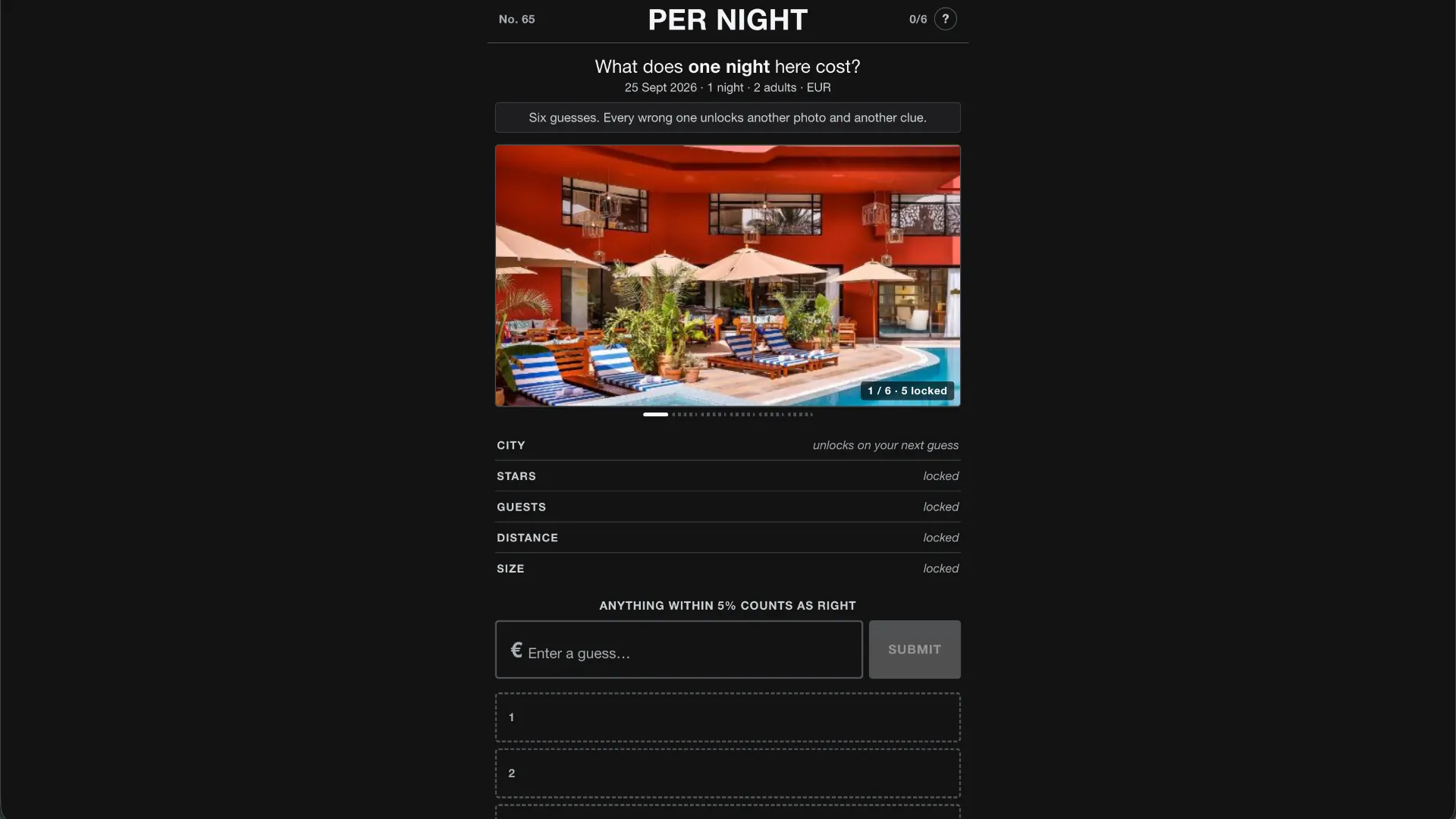
What Is Per Night?
Per Night is a free browser-based daily guessing game that challenges players to estimate the cost of staying at a real hotel for one night. Instead of identifying a country, solving a word puzzle, or answering trivia questions, you must work out how much a hotel room actually costs.
Every daily puzzle features one real hotel and a room rate sourced from Booking.com. You begin with limited visual information and have six attempts to guess the price. Each incorrect guess reveals additional information, helping you narrow down the hotel's location, quality, and likely price range.
The objective is not necessarily to guess the exact amount. Any estimate within 5% of the actual nightly rate counts as a correct answer.
Per Night combines travel knowledge, visual deduction, price estimation, and higher-or-lower feedback into a short daily challenge.
Per Night Game Rules
The rules are straightforward, but reaching the correct price can require careful reasoning.
- One real hotel per day: Each daily challenge features a different hotel to evaluate.
- Six attempts: Players have up to six guesses to identify the nightly rate.
- 5% winning tolerance: Your estimate counts as correct when it falls within 5% of the actual price.
- Progressive photo reveals: Each incorrect guess unlocks another hotel photograph.
- Additional hotel clues: Incorrect guesses also reveal information about the property, including clues such as its city, star rating, guest information, distance, and size.
- Higher-or-lower feedback: An upward arrow indicates that the actual rate is higher than your guess. A downward arrow indicates that the actual rate is lower.
- Color-coded proximity: Feedback colors indicate whether a guess is close, getting warmer, or far from the target.
- Fixed reference price: The answer is based on a Booking.com price snapshot from the date displayed in the puzzle, rather than a live rate that changes during play.
The game displays the relevant booking conditions, including the date, stay length, guest count, and currency. These details matter because hotel prices can vary substantially depending on when and for whom a room is booked.
How to Play Per Night
- Open today's hotel: Visit Per Night and start the daily puzzle. Examine the first hotel photograph and check the displayed booking date, currency, and reservation details.
- Make your first estimate: Think about the property's apparent quality, amenities, and likely market position. Enter your estimated nightly room rate in the price field.
- Read the feedback: After submitting your guess, check the directional arrow and color feedback. If the arrow points upward, the correct price is higher. If it points downward, you should consider a lower amount.
- Study the new clues: An incorrect guess reveals another photograph and additional hotel information. Use these details to refine your understanding of the property's location, category, and price level.
- Narrow down the price: Continue adjusting your estimates using the feedback. Win by getting within 5% of the actual rate before your six attempts are exhausted.
Example: Guessing a Hotel's Nightly Rate
Imagine a hypothetical Per Night puzzle featuring an elegant hotel with modern rooms and a rooftop swimming pool.
The displayed booking conditions are one night for two adults, with prices shown in euros.
Your first estimate might be €150.
| Attempt | Your Guess | Example Feedback | What It Means |
|---|---|---|---|
| 1 | €150 | Higher ↑ | The real nightly rate exceeds €150. |
| 2 | €250 | Lower ↓ | The real rate is below €250. |
| 3 | €200 | Higher ↑ | The real rate is between €200 and €250. |
| 4 | €220 | Correct | The guess is within 5% of the target. |
Suppose the actual hotel price is €225.
A guess of €220 differs from the answer by approximately 2.2%, making it a winning estimate.
For a €225 room, the acceptable range is €213.75 to €236.25, inclusive.
This example is illustrative rather than an actual Per Night puzzle. The real game also reveals new photographs and hotel clues after incorrect attempts, giving you more than numerical feedback to work with.
Understanding Per Night's Clues
Hotel Photographs
The first image gives you an initial impression of the property. You might see a stylish bedroom, an impressive building exterior, or another part of the hotel.
Additional photographs appear after incorrect guesses, potentially revealing details that change your estimate.
Look for features such as room design, building condition, pools, views, restaurants, and the overall standard of the property. Remember that attractive photography does not automatically mean a hotel is expensive.
City and Location
The city can dramatically change the expected nightly rate.
A hotel that appears luxurious may be relatively affordable in one destination but exceptionally expensive in another. Once the city clue becomes available, reconsider your estimate using the local hotel market rather than relying on appearance alone.
Star Rating
A hotel's star rating provides another reference point for its market position.
However, stars are not a direct pricing formula. A centrally located three-star property during a busy period can cost more than a five-star hotel in a less expensive destination.
Guest, Distance, and Size Information
Per Night also includes clues labeled for guests, distance, and size.
These additional details can help you understand the property's characteristics and positioning. Treat them as supporting evidence rather than exact predictors of the nightly rate.
Higher-or-Lower Arrows
Directional feedback is among the most useful clues because it establishes whether your estimate is above or below the target.
If €180 produces an upward arrow and €260 produces a downward arrow, you know the answer lies between those two amounts.
Each subsequent guess can narrow that interval.
Color Feedback
Per Night also uses color to communicate how close your guess is to the actual rate.
The game distinguishes between correct guesses, close guesses, warmer guesses, and guesses that are far away. Only the within-5% condition is explicitly established as the winning threshold; the other proximity labels should be treated as qualitative guidance.
Per Night Strategy and Tips
1. Start With a Reasonable Price Range
Before making your first guess, decide whether the hotel looks like a budget, mid-range, upscale, or luxury property.
Think about the visible room quality, amenities, and booking conditions. An informed starting estimate makes the later higher-or-lower feedback more useful.
2. Use Numerical Feedback Systematically
Once you have guesses on both sides of the actual price, you can establish a range containing the answer.
For example, if €120 is too low and €300 is too high, the actual price falls between those amounts.
A midpoint estimate of €210 can help narrow the interval efficiently. As more photographs and hotel clues become available, adjust your approach if they provide stronger evidence about the property's likely value.
3. Remember That Hotel Prices Depend on Dates
Hotel prices are not fixed throughout the year.
Weekends, major events, holidays, tourist seasons, and local demand can influence nightly rates. A price that seems unreasonable during a quiet period may be entirely plausible during a popular travel weekend.
Always consider the date shown in the puzzle.
4. Do Not Judge Luxury by Appearance Alone
A beautifully furnished room does not necessarily belong to an expensive property.
Some boutique hotels use attractive interiors to compete at moderate prices. Conversely, established luxury properties may charge substantial premiums for their location, service, reputation, or exclusivity rather than their visible room design.
Use photographs as clues, not definitive evidence.
5. Make the Most of All Six Attempts
Every incorrect guess unlocks more information, so early misses are not necessarily wasted.
Instead of making several nearly identical guesses, choose estimates that help establish meaningful price boundaries. Combine those boundaries with the newly revealed hotel information to improve your later attempts.
6. Aim for the 5% Window
You do not need to identify the exact Booking.com price to succeed.
If the hotel costs €200, any estimate from €190 to €210 satisfies the game's 5% requirement.
This makes it especially important to narrow the range sufficiently rather than spending your final attempts chasing an exact number.
Per Night vs Other Daily Guessing Games
Per Night belongs to the family of browser games that challenge players to estimate real-world values.
| Game | Main Challenge | Core Skill |
|---|---|---|
| Per Night | Guess a real hotel's nightly rate | Hotel pricing intuition and deduction |
| Housle | Estimate a property's asking price | Real estate valuation |
| Listed | Guess the selling price of a property | Property market intuition |
| Zonday | Guess the price of an Amazon item | Consumer product pricing knowledge |
| Size It Up | Estimate an object's size | Visual scale estimation |
Per Night stands out by focusing specifically on travel accommodation and by gradually revealing hotel photographs and property details after incorrect guesses.
The combination of real booking-price snapshots and numerical feedback makes each puzzle feel like a miniature hotel valuation challenge.
Is Per Night Free to Play?
Yes. Per Night is accessible as a free browser game through its official website.
The main daily challenge can be played directly online without installing a separate application.
Although the game uses hotel prices sourced from Booking.com, it is a guessing game rather than a hotel booking service. The displayed rates are historical snapshots selected for the puzzles and should not be interpreted as current booking offers.
Frequently Asked Questions
What is Per Night?
Per Night is a daily hotel price-guessing game. Players examine photographs and progressively revealed clues to estimate the cost of staying at a real hotel for one night.
How many guesses do you get in Per Night?
You have six guesses to identify the nightly hotel rate within the accepted tolerance.
How close does your guess need to be?
Any estimate within 5% of the actual hotel price is considered correct.
What happens after a wrong guess?
The game reveals another hotel photograph and an additional clue. You also receive directional and color-coded feedback to help refine your next estimate.
Where do the hotel prices come from?
The official game states that its rates come from Booking.com. Each price is recorded for the booking date displayed in the puzzle and frozen so the answer does not change while you play.
Does Per Night use real hotels?
Yes. Each daily puzzle features a real hotel and a corresponding room-rate snapshot.
What does the upward arrow mean?
An upward arrow means the actual hotel price is higher than your submitted estimate. A downward arrow means the actual price is lower.
Are the prices live hotel rates?
No. Per Night uses fixed price snapshots rather than live booking queries. This keeps the puzzle answer consistent even when hotel availability or current room rates change.
Is Per Night a daily game?
Yes. Its core format features one real hotel per day, with six attempts to estimate the featured room rate.
Do you need to know about hotels to play?
No. Familiarity with hotel pricing can help, but the game's visual clues, directional feedback, and progressively revealed information make it approachable without specialist knowledge.
Who Should Play Per Night?
Per Night is particularly suitable for players who enjoy travel, price guessing, hotel photography, numerical deduction, and short daily challenges.
It offers an interesting alternative to traditional Wordle-style puzzles because every guess concerns a real-world price rather than a hidden word.
The six-attempt limit creates a meaningful challenge, while the 5% winning tolerance makes the objective achievable without identifying the exact booking rate.
Conclusion
Per Night transforms hotel pricing into an engaging daily guessing puzzle. With real hotels, fixed Booking.com price snapshots, progressively revealed photographs, and higher-or-lower clues, each round tests how accurately you can judge the value of an overnight stay.
The strongest approach combines realistic starting estimates with careful numerical deduction and attention to the hotel's location, quality, and booking conditions.
Think you know what a hotel room should cost? Play Per Night and see whether you can guess today's rate within 5% in six attempts or fewer.