
What Is Prompetitor?
Prompetitor is a free browser-based visual challenge game where players compete to recreate real artwork using AI-generated images. Instead of drawing with a mouse or painting on a canvas, you write a description of what you see and let an AI image generator interpret your words.
The objective is simple: describe the original artwork so accurately that the AI-generated recreation looks as close to it as possible.
Each round gives you 90 seconds to observe the reference image and write a natural-language prompt. After submission, the game generates an image based on your description and evaluates how closely it resembles the original.
Your final score combines visual similarity with a small speed bonus. In other words, being descriptive matters more than simply typing quickly, although submitting earlier can provide an advantage when results are close.
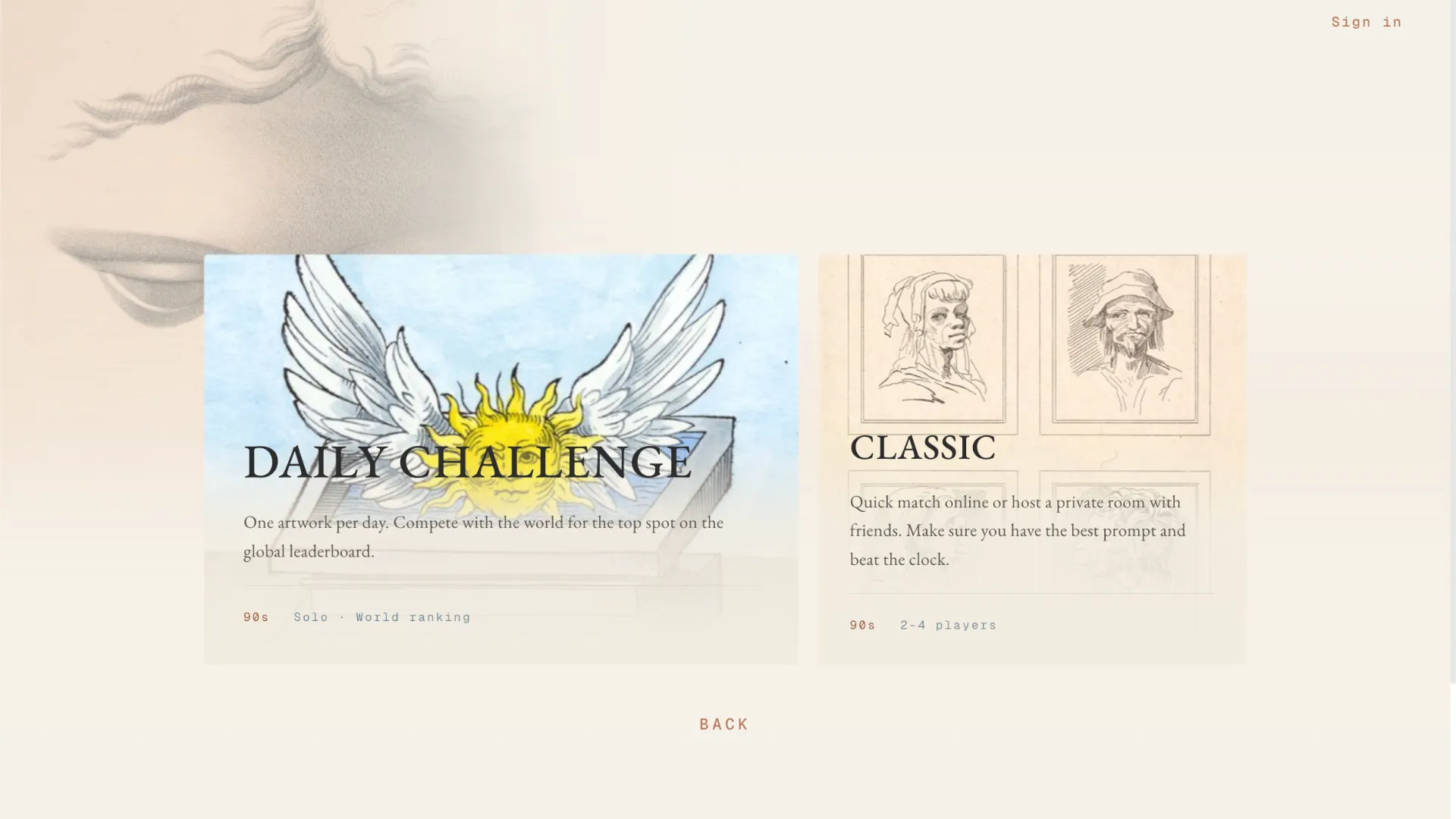
Prompetitor offers two main playable modes: Daily Challenge and Classic multiplayer. The daily mode lets everyone compete against the same artwork on a global leaderboard, while Classic allows two to four players to compete in real time.
The game is built around actual human-created artwork rather than randomly generated reference images. Its collection includes public-domain masterpieces, licensed photography, and original works submitted by verified artists.
Prompetitor is particularly appealing to players who enjoy art, creative writing, visual observation, AI-generated imagery, and competitive browser games.
How Does Prompetitor Work?
Prompetitor combines three activities into one challenge: observing an image, translating its visual details into language, and comparing an AI-generated recreation with the original.
Every round follows the same basic concept:
- The game presents an existing artwork or photograph.
- You examine its subject, composition, colors, lighting, and visual style.
- You write a prompt describing the image within a 90-second time limit.
- An AI image model generates a new image from your submitted prompt.
- The game calculates an automated visual similarity score and includes a small bonus for faster submission.
You do not directly control the resulting image. The AI interprets your words, so your description must communicate the most important visual details clearly.
The Core Twist: Words Replace Drawing Tools
Unlike conventional drawing games, Prompetitor does not ask you to reproduce an image by hand.
Your challenge is to describe the original artwork so precisely that an AI model can reconstruct its defining characteristics.
For example, identifying an image as a landscape may be technically correct but insufficient. The original might contain a small white lighthouse on the left, a stormy ocean in the foreground, orange sunlight near the horizon, and dark clouds covering most of the sky.
A prompt that captures these details will usually provide the image generator with more useful guidance than a vague description such as 'a beautiful coastal landscape.'
The challenge rewards observation, specificity, and the ability to communicate visual information efficiently.
How to Play Prompetitor
Prompetitor runs directly in a web browser. You do not need illustration software, art supplies, or experience with image-generation tools.
- Open Prompetitor and choose a game mode. Visit Prompetitor and select Play. Choose Daily Challenge for a solo competition against the global leaderboard, or Classic to compete against other players.
- Study the reference artwork. When the round begins, inspect the original image carefully. Identify the main subject, background, composition, colors, lighting, perspective, and artistic style. The round provides 90 seconds for observation and prompt writing.
- Write your image prompt. Enter a natural-language description of the artwork. Focus on what is visible and where important objects appear. Include distinctive characteristics that an image model can use to recreate the scene.
- Submit before the timer expires. Finish your description and submit it while time remains. The game sends your prompt to an AI image model, which generates a new image based on your instructions.
- Review your result and score. Compare the AI-generated image with the original artwork. The game evaluates their visual similarity and adds a small speed bonus. In Daily Challenge, your score determines your position on the day's global leaderboard. In Classic, the highest-scoring player wins the round.
The entire creative part of a round takes 90 seconds, although image generation and scoring can require additional processing time afterward.
Prompetitor Game Modes
Prompetitor currently has two main playable modes, with additional variations planned for future releases.
Daily Challenge
Daily Challenge is a solo competition in which players worldwide attempt to recreate the same artwork.
- One featured artwork per day.
- A 90-second prompt-writing challenge.
- AI-generated recreation from your submitted description.
- Automated scoring based on visual similarity and speed.
- Global leaderboard ranking for the day's artwork.
Because everyone receives the same reference image, the daily challenge provides a direct comparison of how effectively different players describe the same visual subject.
A difficult artwork might contain several overlapping objects, subtle lighting, or an unusual artistic technique. Recognizing and describing these details can make the difference between an average result and a leaderboard-leading score.
Daily Challenge is a good starting point for new players because it offers a straightforward introduction to the game's central mechanic.
Classic Multiplayer
Classic is Prompetitor's real-time competitive mode for two to four players.
Players can join quick online matches or host private rooms with friends. Each participant receives the same 90-second challenge and attempts to produce the closest AI-generated recreation.
After prompts are submitted and evaluated, the game compares the resulting scores. The participant with the highest total score wins the round.
Classic is particularly entertaining because different players may notice completely different details in the same artwork.
One person might focus on realistic lighting, another on precise object placement, and another on matching the original's artistic style. Their prompts can produce dramatically different AI-generated images.
Flux Mode — Coming Soon
Flux is a planned multiplayer variation that introduces random restrictions to the standard Classic format.
The developer has described possible twists such as reducing the available time or restricting prompts to only five words.
These limitations would force players to prioritize the most important visual information rather than relying on long descriptions.
Flux is listed as an upcoming mode, not a currently available challenge.
Exploration Mode — Coming Soon
Exploration is another planned multiplayer variation.
Its proposed mechanic involves choosing a different image model for each match, allowing players to discover how various AI generators interpret the same prompt.
This would add another layer of unpredictability because two models can produce substantially different compositions from identical descriptions.
Exploration is still described as a future feature.
Prompetitor Scoring Explained
Prompetitor evaluates submissions using automated visual similarity scoring combined with a smaller speed bonus.
The scoring process begins after an AI model generates an image from your prompt. The game then compares that result with the original reference artwork.
Visual Similarity
Visual similarity is the primary component of the score.
A successful recreation should resemble the original in important ways, such as:
- Main subjects and recognizable objects.
- Overall composition and placement of important elements.
- Dominant colors and visual atmosphere.
- Lighting and contrast.
- Background details and scenery.
- Artistic medium or photographic appearance.
These are useful characteristics to describe when playing, rather than a published breakdown of the scoring algorithm. Prompetitor does not disclose a fixed weighting for each individual feature.
Speed Bonus
Submitting a prompt earlier provides a small additional scoring benefit.
This creates a trade-off between speed and descriptive accuracy. Submitting immediately with an incomplete prompt may save time but produce an image that differs significantly from the reference.
Conversely, spending the entire round polishing minor details may leave insufficient time to submit.
The most effective approach is to identify the artwork's defining characteristics quickly, write a useful description, and submit before the clock runs out.
Why Scores Can Vary
Prompetitor uses third-party AI generation and automated image comparison services. Image generation is not perfectly deterministic, and two similar descriptions may produce different results.
The developer also states that its scoring system and image models are continually being improved.
A high score therefore reflects the game's current automated assessment of the generated recreation, not an absolute measure of artistic skill.
Prompetitor Prompt Example
Imagine a hypothetical reference image showing a lighthouse beside a stormy sea at sunset.
The artwork contains a tall white lighthouse near the left edge, dark ocean waves, a narrow orange strip of sunlight along the horizon, and dramatic storm clouds.
A basic prompt might be:
A lighthouse beside the ocean at sunset.
This identifies the general subject but leaves many important details unspecified. The AI might place the lighthouse in the center, generate a calm sea, or create a bright blue sky.
A more descriptive prompt would be:
A tall white lighthouse standing on dark coastal rocks on the left side of the composition, powerful ocean waves crashing in the foreground, dramatic charcoal-gray storm clouds filling the sky, a narrow band of warm orange sunlight along the distant horizon, moody cinematic lighting, wide landscape composition, realistic oil painting with textured brushstrokes.
The improved description communicates several distinct visual properties:
| Detail | Information Given to the AI |
|---|---|
| Subject | Tall white lighthouse |
| Position | Left side of the composition |
| Foreground | Dark rocks and crashing waves |
| Background | Ocean horizon and storm clouds |
| Colors | Charcoal gray, white, and warm orange |
| Lighting | Dramatic sunset illumination |
| Style | Realistic oil painting |
| Composition | Wide landscape scene |
This is an illustrative example, not an actual Prompetitor daily artwork or a guaranteed winning prompt.
The important lesson is that a strong description communicates visual relationships, not simply a list of objects.
Prompetitor Strategy Tips
1. Start With the Main Subject
Identify the artwork's most recognizable subject before describing anything else.
Is it a portrait, landscape, still life, street scene, abstract composition, or architectural photograph?
Establishing the main subject helps the model generate an image with the correct overall identity.
2. Describe Object Placement
Composition can be as important as the objects themselves.
Instead of writing 'a person standing near a tree,' specify whether the person appears on the left or right, whether the tree fills the background, and how much of the frame is occupied by each subject.
Useful positional descriptions include 'centered,' 'left foreground,' 'far background,' 'upper-right corner,' and 'viewed from above.'
3. Match the Artistic Style
A photographic image and an oil painting can depict the same objects while looking completely different.
Look for clues about the original medium or technique. Useful style descriptions might include watercolor, impressionist oil painting, black-and-white photography, pencil illustration, minimalist poster, or photorealistic portrait.
Use the style actually visible in the reference rather than automatically requesting an attractive or cinematic image.
4. Prioritize Dominant Colors
Pay attention to the overall color palette.
A scene dominated by muted greens and warm browns will differ substantially from one rendered in saturated blue and purple, even if the objects match.
Include the two or three most important colors when they strongly define the artwork.
5. Describe Lighting and Mood
Lighting affects how the entire image looks.
Consider whether the scene uses soft daylight, harsh shadows, candlelight, overcast illumination, studio lighting, or a strong directional light source.
Descriptions such as 'warm afternoon sunlight from the right' are more informative than vague phrases like 'beautiful lighting.'
6. Focus on Distinctive Details
Some images contain one or two unusual visual elements that define their identity.
A red umbrella in an otherwise gray street scene, a floating object above a table, or a distinctive expression on a portrait may be especially worth mentioning.
Under time pressure, prioritize these details over minor textures that are unlikely to change the overall recreation.
7. Avoid Overly Generic Prompts
Prompts such as 'beautiful artwork,' 'high quality image,' or 'amazing detailed scene' provide little information about the actual reference.
The objective is not to produce the most attractive image possible. It is to recreate a specific existing artwork.
A precise description of an ordinary scene can be more effective than a highly stylized prompt that introduces details missing from the original.
8. Do Not Invent Unseen Objects
Adding imaginative elements can reduce similarity if those elements are absent from the reference.
For example, if the artwork shows a single person standing in an empty room, introducing additional people, furniture, or decorative objects may cause the generated image to drift away from the target.
Describe what you can actually observe, and avoid adding unnecessary embellishments.
9. Build Your Prompt in Layers
An efficient way to use the 90-second timer is to compose your description in a predictable order:
- Main subject and setting.
- Composition and object positions.
- Important colors and lighting.
- Artistic style or medium.
- Distinctive foreground and background details.
This structure helps prevent a common problem: spending too much time describing one small feature while forgetting the overall scene.
10. Compare Results to Improve
After a round, look closely at the AI-generated recreation and identify the largest differences from the original.
Did the model misunderstand the main subject? Was an important object placed incorrectly? Did the lighting or artistic style change?
Use those observations to decide what information to emphasize in future prompts.
Is Prompetitor Free to Play?
Yes. According to the official pricing page, the Prompetitor game remains free to play.
The website also offers an optional AI image studio called Create. This separate feature uses prepaid credits for image generation, with credit top-ups advertised at $5, $10, and $20.
These purchases are not subscriptions, and the paid Create feature should not be confused with the game's regular competitive rounds.
Prompetitor is accessible through a web browser without installing dedicated software. Guest participation is described in independent game-directory coverage, although signing in may be needed for certain account-linked features.
The game has been undergoing active development and external testing, so available features, account requirements, and scoring behavior may change.
What Makes Prompetitor Different From Other AI Art Games?
Prompetitor is unusual because the goal is not simply to create appealing AI artwork. The target image already exists, and success depends on reproducing it through language.
This creates several meaningful differences from other creative games.
| Game Type | Typical Objective | Prompetitor's Difference |
|---|---|---|
| Drawing games | Draw an object or scene yourself | You describe an existing artwork instead of drawing |
| AI image generators | Produce an image matching your creative idea | You must reproduce a specific reference image |
| Visual guessing games | Identify an object, person, or location | You explain visual details through a complete prompt |
| Art trivia games | Answer questions about artists or artworks | You do not need to identify the artist or painting title |
| Prompt competitions | Create an impressive AI-generated result | Prompetitor emphasizes resemblance to real artwork |
A player can perform well without knowing the artwork's title, the artist's name, or its historical background.
What matters most is the ability to notice visual details and describe them accurately enough for an AI model to reproduce.
Who Should Play Prompetitor?
Prompetitor is particularly suitable for players interested in visual creativity and quick competitive challenges.
It is a good choice for:
- Art enthusiasts who enjoy examining paintings, photography, and visual composition.
- Daily puzzle players looking for a challenge that differs from conventional word and number games.
- Creative writers who enjoy describing scenes and communicating visual ideas through language.
- AI image enthusiasts interested in discovering how text descriptions influence generated results.
- Competitive players who enjoy leaderboards and trying to outperform others.
- Groups of friends looking for short multiplayer challenges with creative results.
- Visual thinkers who enjoy recognizing patterns, colors, textures, and spatial relationships.
You do not need professional artistic training or advanced knowledge of AI prompting to start playing. Careful observation and clear writing are enough to understand the basic challenge.
Frequently Asked Questions
What is the goal of Prompetitor?
The objective is to recreate a real artwork as closely as possible by writing a text prompt for an AI image generator. Your result is scored for visual similarity, with a small speed bonus.
Do you draw the artwork yourself?
No. Prompetitor is not a manual drawing game. You describe the reference image, and an AI model generates the recreation.
How much time do you have?
Daily Challenge and Classic rounds provide a 90-second prompt-writing window. Image generation and scoring happen afterward.
Is Prompetitor a daily game?
Yes. Daily Challenge features one artwork per day, with players competing against the same image on a global leaderboard.
Can I play against friends?
Yes. Classic mode supports two to four players, including private rooms that can be hosted for friends.
How is the winner decided?
The game combines automated visual similarity scoring with a small speed bonus. In Classic matches, the player with the highest total score wins the round.
Are the reference images AI-generated?
No. The developer states that its challenge library uses real artwork, including public-domain masterpieces, licensed photographs, and original pieces from verified artists.
Is artistic knowledge required?
No. Understanding artistic styles may help, but the main requirement is to observe the reference carefully and describe its visible characteristics.
Does a longer prompt always score higher?
Not necessarily. A longer prompt can include more useful detail, but it can also introduce incorrect information. Clear descriptions of the main subject, composition, colors, and style are more important than length alone.
Is the AI similarity score perfectly objective?
No. Prompetitor uses automated visual scoring, and the developer continues to refine its models and scoring process. Results should be treated as a game-based comparison rather than a definitive judgment of artistic accuracy.
Are Flux and Exploration available?
Not yet. Both are listed as upcoming multiplayer modes on the official website.
Is Prompetitor free?
Yes. The game is free. The separate Create image studio offers optional paid image-generation credits.
Conclusion
Prompetitor turns AI image generation into a competitive visual observation game. Instead of asking players to create something entirely new, it challenges them to understand an existing artwork and communicate its defining details in only 90 seconds.
The combination of human-created reference images, natural-language prompts, automated similarity scoring, and competitive leaderboards makes each round an interesting test of observation and creativity.
With both a global Daily Challenge and real-time Classic multiplayer, Prompetitor offers a different experience from traditional drawing games, art trivia, and standard AI image generators.
Think you can describe a picture well enough to recreate it? Visit Prompetitor, try the daily challenge, and see how closely your words can match the original artwork.
For additional information about gameplay and scoring, see the official Prompetitor About page.