What is Rackle?
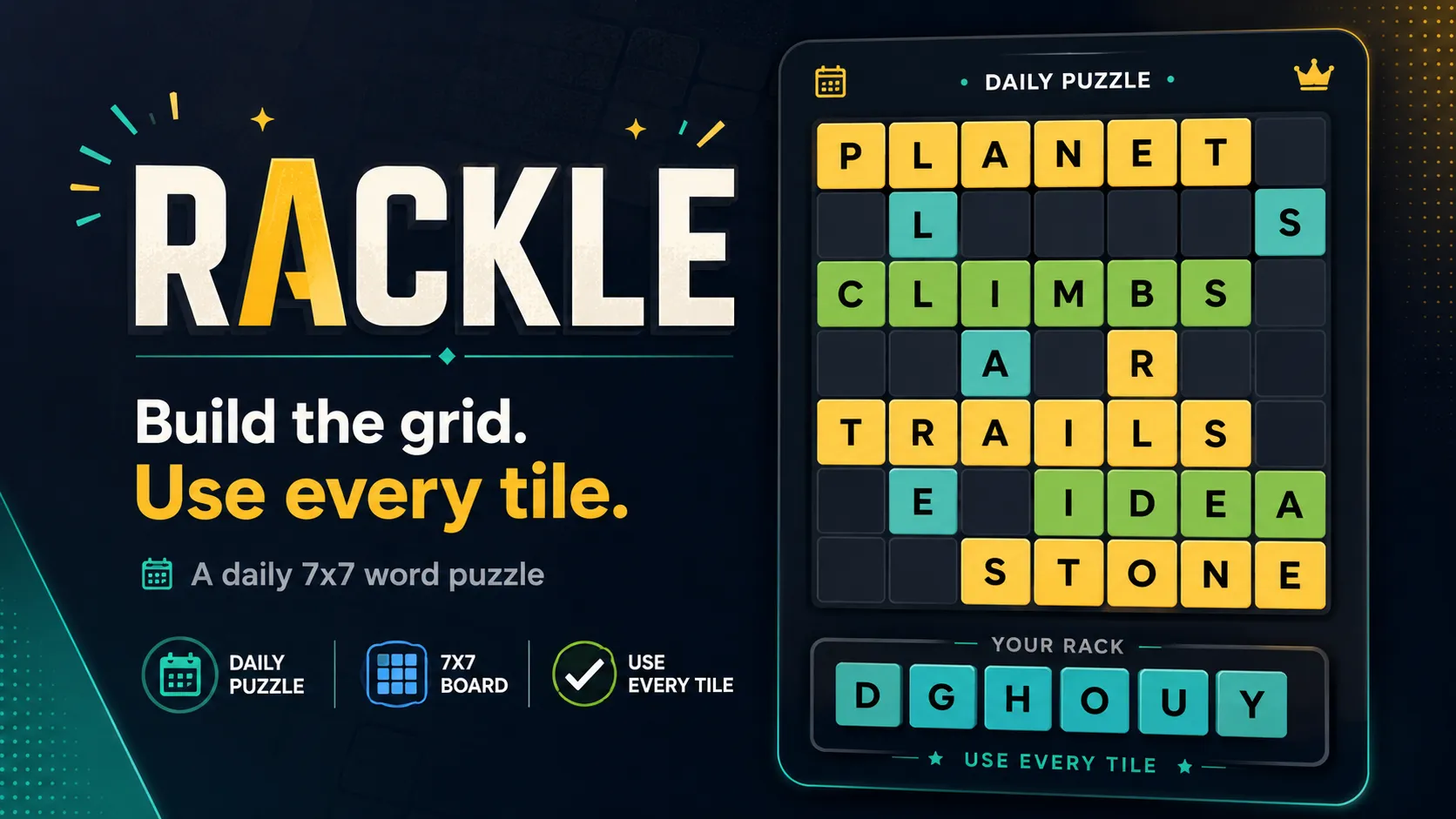
Rackle is a daily word puzzle where the battle starts with one shared rack of letters. Every player gets the same letters each day, but the grid you build can look completely different from someone else’s solution.
The twist is that Rackle is not about guessing one hidden answer. It is about constructing a valid connected word grid on a 7x7 board and using every tile. The puzzle feels calm at first, then slowly turns into a delicious little trap: every letter you place creates new possibilities, new crossings, and new ways to accidentally block yourself.
Rackle Game Rules (The Catch / The Trap)
The catch in Rackle is that every tile must earn its place. You are not just making one word — you are building a connected grid where the letters need to work together.
- Same daily rack: Everyone receives the same set of letters for the day.
- 7x7 board: You place tiles onto a compact square grid.
- Use every tile: The main goal is to fit the full rack onto the board.
- Build valid words: Your placed letters must form accepted words.
- One connected grid: The board should grow as one linked word structure, not scattered islands.
- Words need 3+ letters: Tiny two-letter joins do not count as real word progress.
- Placement matters: A great word can still be a bad move if it traps future letters.
Visual idea:
R A C K
A
L E
A good Rackle grid feels like a mini crossword you forged from a limited pile of letters. Every crossing can save space — or ruin the whole board.
How To Play Rackle?
Study the daily rack
Player Sees: A row of letters waiting below the board.
What This Means: These are your ingredients, and every single one must be used.Place your first anchor word
Player Builds:R A C K
Game Response: The word sits on the 7x7 board as your starting structure.
What You Learn: Long, flexible words can create useful connection points.Cross into new words
Player Adds:A L Ecrossing through theA
Game Response: The grid becomes more compact and connected.
Next Constraint: Any new word path must still be valid.Keep checking the shape
Player Notices: A lonelyQorZis still unused.
Next Move: Make room before the board becomes too crowded.
What This Means: Hard letters should be planned early, not dumped at the end.Use every tile to finish
Final Goal: All letters are placed, connected, and forming valid words.
Result: The rack is empty, the grid survives, and today’s Rackle is complete.
Strategy & Tips
Start with a flexible anchor word. A word with common letters like A, E, R, S, T, or L gives you more crossing options later.
Do not spend all easy vowels too quickly. Vowels are the glue of Rackle, and running out of them can leave your final consonants stranded.
Plan around awkward letters early. If your rack includes letters like Q, X, J, or Z, build a home for them before the board gets locked up.
Compact grids are usually safer. Crossings help you use space efficiently, and on a 7x7 board, messy sprawl can become the enemy very fast.
When stuck, rebuild from a different anchor. Rackle often has many possible solutions, so one bad layout does not mean the rack is impossible — it just means your current grid has betrayed you.