What Is Sling?
Sling is a free daily physics-prediction game that challenges your ability to anticipate how moving objects behave. Instead of solving equations or answering trivia questions, you watch a visual setup, predict what will happen next, and discover how accurate your intuition really is.
Each daily game features five different motion challenges involving cannonballs, strings, gears, bouncing balls, and colliding objects. You must commit to your prediction before the actual movement plays out.
The idea is simple: look at a physical situation and predict its outcome. Where will a cannonball land? Which direction will the final gear turn? Where will two moving dots meet?
After you make your prediction, Sling plays the animation and shows how close your answer was. There are no second attempts during the daily challenge, making every decision count.
Created as part of the Yuki Games collection, Sling combines spatial reasoning, physics intuition, and visual estimation into a short daily challenge that takes approximately a minute to complete.
The Five Daily Physics Challenges
Sling's daily gauntlet consists of five different types of motion-prediction puzzles.
| Challenge | What You Predict | Main Skill |
|---|---|---|
| Cannonball | Where a launched cannonball will land | Trajectory estimation |
| Cut String | Where an object moves after its string is cut | Motion and momentum |
| Spinning Gears | Which direction the final gear rotates | Mechanical reasoning |
| One Bounce | Where a ball lands after bouncing once | Reflection and spatial prediction |
| Gliding Dots | Where two moving dots will collide | Relative motion and timing |
Each challenge focuses on a different physical behavior, so the game tests more than one kind of intuition.
The cannonball round asks you to estimate a curved trajectory. The gear challenge requires you to understand how connected rotations affect one another. The collision round tests whether you can mentally project two moving objects toward their meeting point.
Unlike conventional puzzle games that allow repeated experiments, Sling requires you to predict first and observe the result afterward.
How to Play Sling
- Open today's gauntlet. Visit Sling in your browser and start the daily challenge. Everyone receives the same five rounds for that date.
- Examine the visual setup. Study the objects, their positions, and the movement suggested by the scene. Determine what the round is asking you to predict.
- Make your prediction. Tap or click the location where you believe an object will land or collide, or select the appropriate motion direction when the round asks for a directional answer.
- Watch the physics play out. After committing your prediction, the actual motion is animated. Compare what you expected with what happened and see how accurately you predicted the result.
- Complete all five rounds. Continue through the daily gauntlet, review your performance, and copy your five-square result trail to compare with friends.
Each daily round gives you one prediction, so you cannot repeatedly adjust your answer after seeing the animation.
Example: Predicting a Cannonball's Landing Position
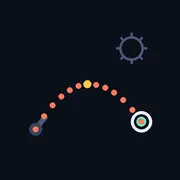
Imagine a cannon pointing upward at an angle, with an open area extending to the right.
Your challenge is to tap the location where the cannonball will land.
You can reason through the situation in three stages:
1. Initial launch: The cannonball moves forward and upward from the cannon, following the direction of its initial velocity.
2. Curved flight: Gravity pulls the cannonball downward, gradually changing its vertical movement while it continues moving horizontally.
3. Landing: The cannonball reaches the ground at the end of its trajectory.
Suppose you expect the ball to travel roughly three-quarters of the way across the visible play area. You tap that position and commit your prediction.
The game then animates the shot, revealing where the ball actually lands. If your selected position is close to the true landing point, you receive a better result than if your guess is far away.
The challenge is not to fire the cannon yourself. It is to anticipate the outcome of the motion before seeing it.
This is an illustrative example of Sling's cannonball mechanic rather than a recreation of a specific daily puzzle.
Understanding the Other Motion Challenges
Cut String: Predict the Direction of Motion
A moving object attached to a string may change its path when the connection is cut.
The important concept is momentum. Once released, an object initially continues in the direction it was moving at the instant of release, rather than automatically traveling directly away from its original anchor point.
Watch the object's movement and consider its instantaneous direction before choosing your prediction.
Spinning Gears: Follow the Rotation
The gear challenge asks you to work out which way the last gear in a connected system rotates.
When two ordinary external gears mesh, they rotate in opposite directions. Following the sequence of connections helps you determine the final rotation.
For example, if the first of three connected gears turns clockwise, the second turns counterclockwise and the third turns clockwise.
One Bounce: Anticipate the Rebound
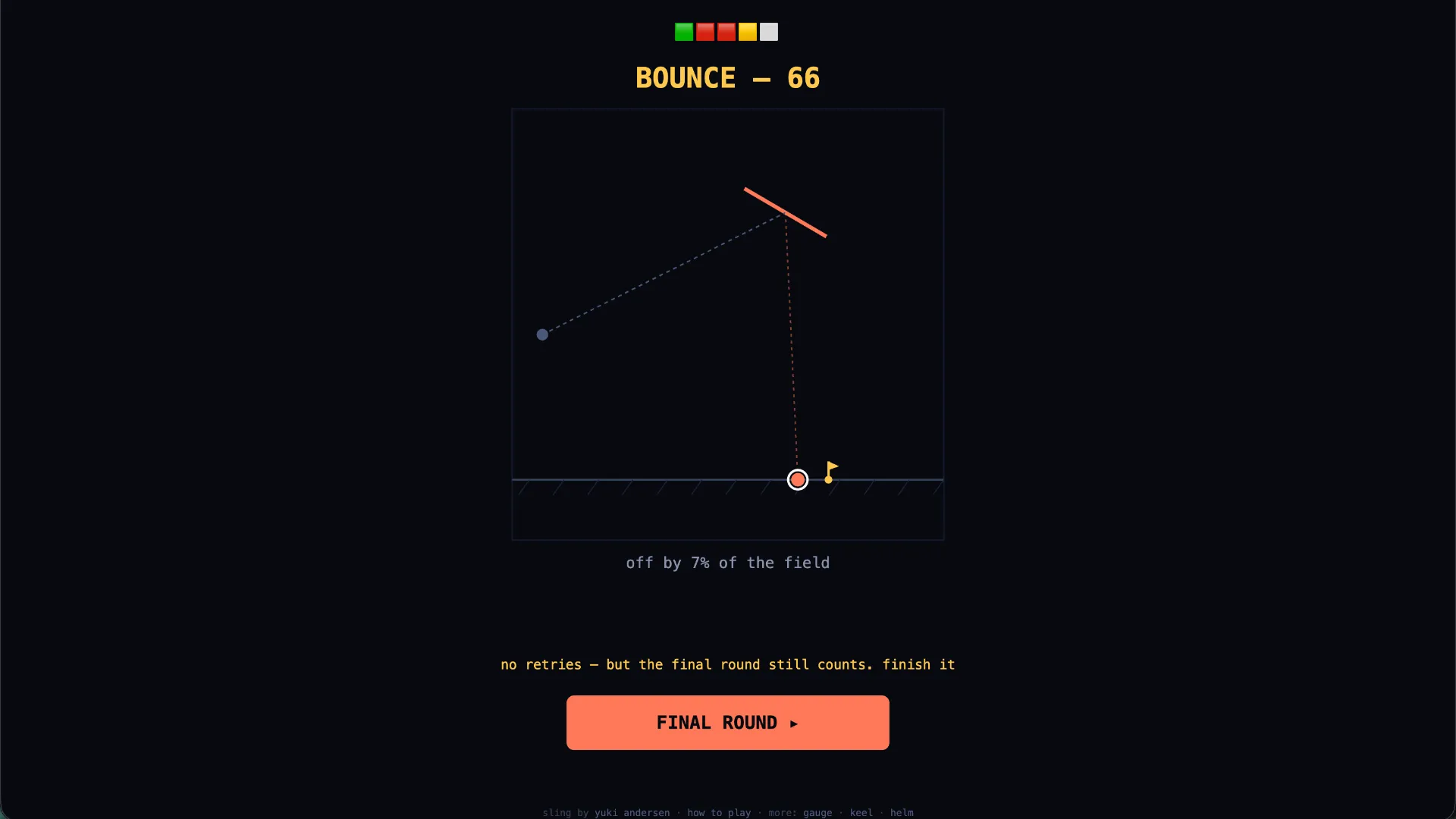
The bouncing-ball challenge asks where a ball will land after one bounce.
Consider the ball's incoming direction, the surface it strikes, and the resulting change in movement. A bounce changes the vertical component of the motion, while the horizontal component may continue.
Avoid assuming that a ball will simply reverse its entire trajectory.
Gliding Dots: Find the Meeting Point
In this round, two dots move toward a possible collision.
To predict their meeting point, consider both direction and speed. The objects must reach the same location at the same time to collide.
Looking only at where their paths cross is not always enough; timing matters too.
Sling Scoring and Results
Sling evaluates how accurately you predict the outcomes of its motion challenges.
After committing a prediction, the game reveals the actual movement and your performance for that round.
The daily result can be represented as a sequence of five colored squares:
- 🟩 Green: You called it accurately.
- 🟨 Yellow: Your prediction was close.
- 🟥 Red: Your prediction was substantially off.
The five-square result trail represents your performance across the five daily challenges and can be copied to share with friends.
For example, a hypothetical daily result might look like this:
🟩🟨🟩🟥🟩
This represents three accurate predictions, one close result, and one inaccurate result.
These squares summarize motion-prediction accuracy. They are not Wordle-style letter clues.
Practice Mode and the 12-Level Difficulty Ladder
Sling offers more than the daily five-round challenge. Its practice mode allows you to continue playing without waiting for tomorrow's puzzle.
Practice provides two ways to improve:
- Mixed practice: Play an endless selection of challenges covering all five physics skills.
- Focused drills: Choose one specific type of prediction and concentrate on improving that skill.
Individual drills progress through a 12-level difficulty ladder, allowing players to encounter increasingly demanding situations as they practice.
This makes practice mode useful whether you struggle with cannonball trajectories, gear directions, collision timing, or bouncing objects.
Because practice rounds are repeatable, they are a good place to experiment and develop a more accurate sense of how objects move.
XP, Ranks, and Progression
Sling also includes an experience and ranking system that rewards continued play.
Every completed round awards XP equal to its score. As you accumulate experience, you progress through a 12-rank ladder, beginning with Wild Guess and advancing through increasingly accomplished titles such as Trajector and Ballistician toward Dead Eye.
The progression system gives players a longer-term goal beyond the daily puzzle.
Even when a prediction is inaccurate, reviewing the resulting animation can help improve your performance in future rounds.
Tips and Strategies for Sling
1. Think About Velocity, Not Just Position
Where an object is located does not necessarily reveal where it will go.
Pay attention to its movement direction, especially in challenges involving a cut string or moving dots. Momentum often determines the object's immediate path.
2. Visualize the Entire Trajectory
For cannonballs and bouncing objects, imagine a continuous path instead of drawing a straight line between the starting point and the target.
Gravity and collisions can change the direction of travel during the animation.
3. Count Gear Connections
For simple chains of externally meshing gears, every connection reverses the rotation direction.
Rather than trying to mentally animate the entire mechanism at once, trace the connections one by one.
4. Account for Both Objects in a Collision
When two dots approach one another, estimate how far each travels during the same interval.
A faster object generally covers more distance than a slower one before they meet. The intersection of their paths matters only if they arrive there simultaneously.
5. Avoid Overthinking Simple Rounds
Sling is designed around quick decisions. You do not need to perform detailed physics calculations to make reasonable predictions.
Start with the basic physical principle, estimate the likely result, and commit when you have a clear answer.
6. Use Focused Practice Drills
If one type of challenge repeatedly lowers your score, practice that skill separately.
Repeating similar situations helps build intuition for common patterns, such as how trajectories curve or how different gear arrangements affect rotation.
Sling vs. Traditional Physics Games
Many physics-based browser games ask players to launch objects, adjust forces, manipulate obstacles, or guide characters toward a destination.
Sling takes a different approach: the physics happens automatically after you make your prediction.
| Feature | Sling | Typical Physics Puzzle Game |
|---|---|---|
| Main objective | Predict motion accurately | Control or manipulate objects |
| Interaction | Tap a position or choose a motion outcome | Aim, drag, launch, or adjust objects |
| Feedback | Actual motion plays after prediction | Motion responds to player actions |
| Daily mode | Five shared challenges | Varies by game |
| Practice | Endless rounds and focused drills | Usually level-based |
| Main skill | Physics intuition and spatial reasoning | Physics manipulation and problem-solving |
This distinction makes Sling especially appealing to players who enjoy thinking about how the physical world works without needing to control a complicated simulation.
Is Sling Free to Play?
Yes. Sling is free to play directly at sling.yukigames.workers.dev.
No account, registration, or installation is required. The game works in modern desktop and mobile browsers, including browsers on Chromebooks.
Players can also add Sling to their device's home screen using the browser's menu for convenient access to the daily challenge.
Who Should Play Sling?
Sling is a good choice for players who enjoy visual puzzles, spatial reasoning, physics challenges, and daily brain teasers.
It is particularly appealing to people who like predicting trajectories, understanding motion, and testing their intuition against simulated outcomes.
The short daily format suits casual players, while the focused practice modes and rank progression provide additional challenges for anyone interested in improving their accuracy.
Unlike vocabulary-heavy games, Sling relies primarily on visual observation and physical reasoning, so its central challenge is easy to understand without extensive reading.
Conclusion
Sling transforms simple physics scenarios into five satisfying daily prediction challenges. From cannonball trajectories and bouncing balls to spinning gears and moving collisions, every round asks you to commit to an outcome before watching it unfold.
With free daily puzzles, endless practice, focused skill drills, XP progression, and shareable results, it offers a distinctive alternative to traditional word and logic games.
Play Sling free online and discover how accurately you can predict what happens next.