
What Is Tic-Tac-Word?
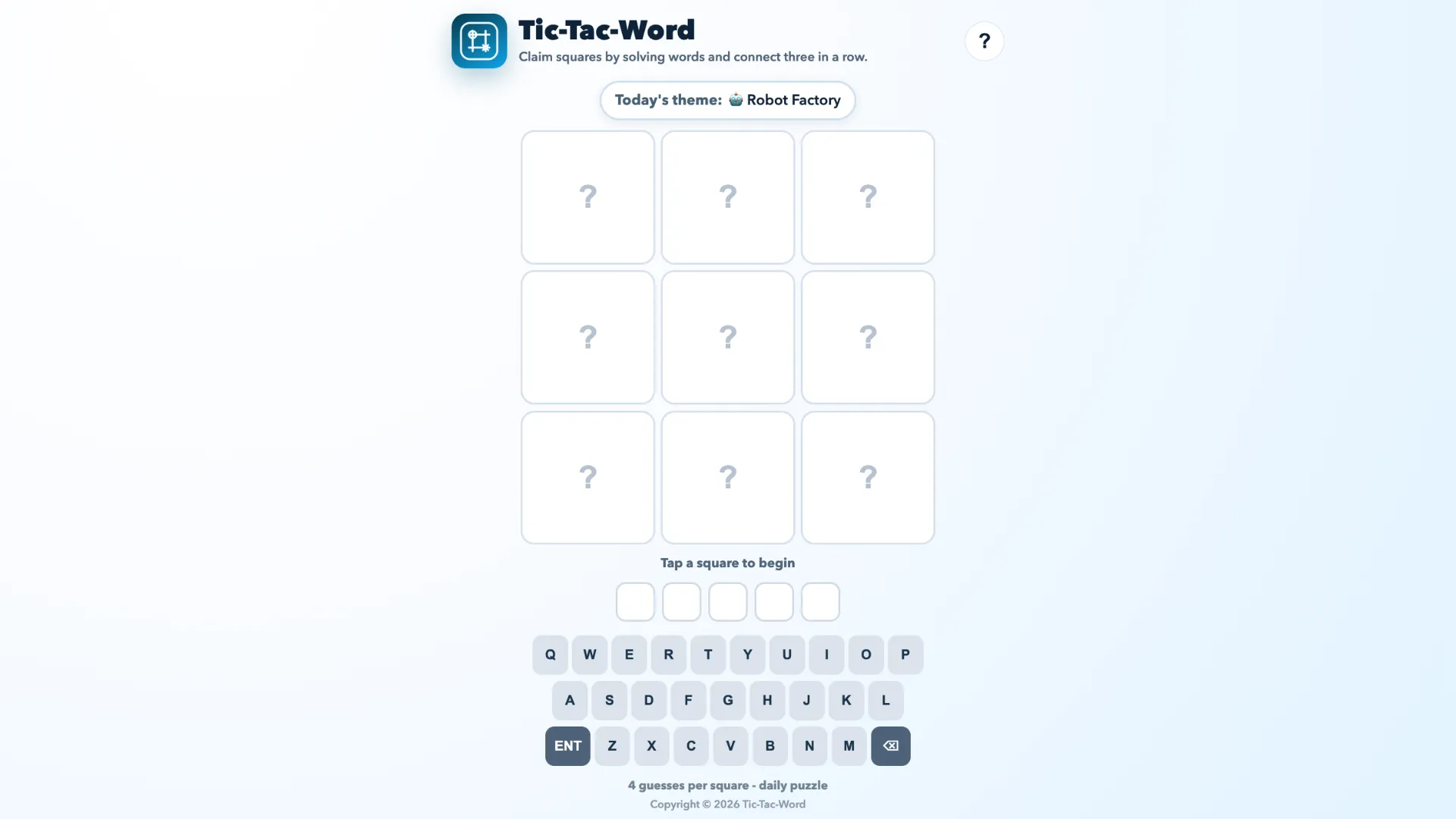
Tic-Tac-Word is a free daily browser puzzle that combines the familiar word-guessing clues of Wordle with the three-in-a-row objective of tic-tac-toe. Instead of simply finding one hidden word, you must solve several words to take control of a 3×3 board.
Each of the nine squares conceals a five-letter word connected to the day's theme. Correctly guessing a word claims its square, bringing you closer to completing a horizontal, vertical, or diagonal line.
The twist is that every square gives you only four guesses. A failed word attempt costs you that position, so both your vocabulary and your choice of squares matter.
Tic-Tac-Word is especially appealing to players who enjoy Wordle but want an additional layer of strategic decision-making. You do not need to solve all nine words: your goal is to claim three squares in a straight line.
Tic-Tac-Word Rules and Core Mechanics
The 3×3 Word Grid
The game presents nine hidden five-letter words arranged in three rows and three columns. All answers relate to a theme displayed at the top of the board.
For example, a theme such as 'Winter Cabin' might suggest words associated with warmth, shelter, and winter activities. The theme provides an extra clue when choosing guesses.
Four Guesses Per Square
Select a square to begin guessing its hidden word. You have a maximum of four attempts to find the correct five-letter answer.
After each guess, the game provides familiar color feedback:
- Green: The letter is correct and in the correct position.
- Yellow: The letter appears in the answer but belongs in a different position.
- Gray: The letter does not appear in the answer.
For a hypothetical example, suppose the hidden word is STOVE and you enter STONE. The S, T, O, and E would be green, while the N would be gray. Changing the fourth letter to V would solve the word.
Claim Three Squares to Win
Solving a hidden word claims its corresponding square. You win when three claimed squares form a straight line:
- Three squares horizontally across a row.
- Three squares vertically down a column.
- Three squares diagonally across the board.
For example, claiming the top-left, center, and bottom-right squares completes a winning diagonal.
Failed Guesses Have Consequences
If you cannot solve a square within four attempts, that square is lost. Lost squares count against you, and if three lost squares form a straight line, the opponent wins.
This creates an interesting strategic trade-off. You must decide which words to attempt while keeping track of both your winning opportunities and dangerous lines of failed squares.
How to Play Tic-Tac-Word
- Open the game. Visit tictacword.com to load the daily puzzle. Look at the theme displayed above the 3×3 grid.
- Choose a square. Tap or click any available square to reveal its word-guessing challenge.
- Enter a five-letter guess. Use the keyboard and submit a word. Examine the green, yellow, and gray clues to narrow down the answer.
- Solve within four attempts. Guess correctly to claim the square. If all four attempts fail, the square is lost.
- Complete your winning line. Choose subsequent squares strategically and try to claim three in a row, column, or diagonal before your lost squares form a line.
Tic-Tac-Word Strategy Tips
Start With the Center
The center square belongs to four possible winning lines: one horizontal, one vertical, and two diagonal. Claiming it gives you more ways to complete three in a row.
Use the Daily Theme
Every answer relates to the theme. Before making a guess, think of five-letter words connected to the displayed subject. Combining thematic clues with letter feedback can help you solve answers within the four-guess limit.
Choose Informative Opening Words
Early guesses containing several different common letters can reveal useful information. Avoid repeating letters already ruled out unless you have a specific reason to test them again.
Plan Your Next Square
Winning is not about claiming the largest number of squares. Two claimed squares in the same line may be more valuable than three scattered across the board.
Look for opportunities to complete a row, column, or diagonal with just one more successful word.
Watch Your Lost Squares
Failed guesses are not harmless. Avoid allowing three lost squares to align, especially when you already have two failures in the same row, column, or diagonal.
Remember the Four-Guess Limit
Unlike standard Wordle, which typically allows six attempts, Tic-Tac-Word gives you only four guesses per square. Each guess should help narrow down the possible answer.
Is Tic-Tac-Word Free to Play?
Yes. Tic-Tac-Word is a free browser-based word puzzle available at tictacword.com. It features a daily themed challenge and can be played without installing an app.
Who Should Play Tic-Tac-Word?
Tic-Tac-Word is a good choice for players who enjoy:
- Wordle-style letter deduction and vocabulary challenges.
- Daily word puzzles with a changing theme.
- Tic-tac-toe and simple grid-based strategy.
- Short browser games that reward careful decisions.
- Puzzles that combine word knowledge with positional planning.
Its biggest attraction is the combination of two familiar mechanics. Word-guessing skill helps you capture individual squares, but board strategy determines which squares are worth pursuing.
Conclusion
Tic-Tac-Word adds a clever strategic challenge to traditional five-letter word guessing. With nine themed words, four attempts per square, and a three-in-a-row victory condition, every guess can influence the outcome of the entire board.
If you enjoy daily word games and want something more tactical than a standard Wordle puzzle, visit Tic-Tac-Word and see whether you can connect three squares before your mistakes catch up with you.