What Is Weighsies?
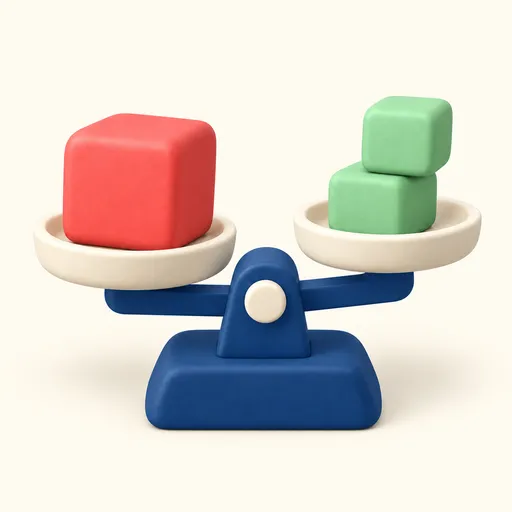
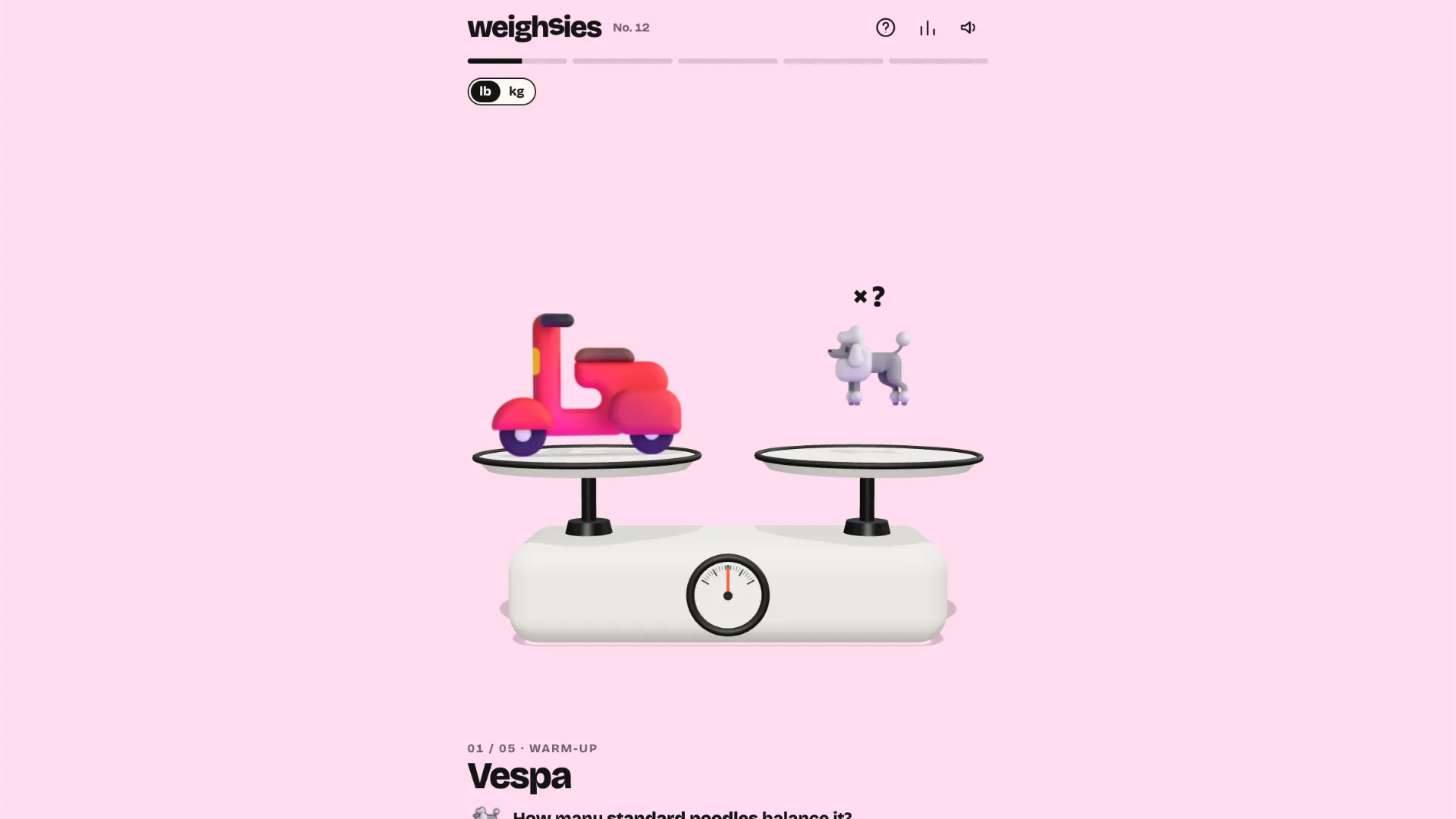
Weighsies is a free daily browser-based estimation game that challenges players to guess how many familiar objects it takes to balance something much heavier on a virtual scale.
The central question is simple: How many of these would weigh as much as that?
Imagine a large object sitting on one side of a balance scale. On the other side, you have something familiar, such as a banana, a cat, or a bowling ball. Your task is to estimate how many copies of the smaller object would be needed to match the heavier object's weight.
The game turns everyday weight comparisons into a surprisingly challenging numerical puzzle. You might have a rough idea of how heavy a banana is, but estimating how many bananas equal the mass of a much larger object requires a different kind of intuition.
Each daily challenge contains five weigh-ins, with one guess per round. After submitting an answer, the game drops your estimated pile of objects onto the scale, animates the result, and reveals the actual weights and the correct balance point.
Weighsies is part of the DLE Club collection associated with independent developer Isaac Audet, alongside Amountle, Halfsies, Stackdle, Puttsies, and Flipsies.
It is designed for short sessions of approximately three minutes, making it an accessible addition to a daily puzzle routine.
How Does Weighsies Work?
Weighsies uses a balance-scale mechanic to turn questions about real-world weight into interactive estimation challenges.
One side of the scale contains a heavier target object. Your goal is to determine how many copies of a familiar reference object would be needed to balance it.
For example, suppose the target object weighs approximately 20 kilograms and the reference object weighs approximately 5 kilograms.
The mathematical relationship is:
20 kg ÷ 5 kg = 4 objects
In this hypothetical example, four reference objects would balance the target.
However, Weighsies does not simply provide both weights and ask you to divide them. The challenge is estimating the relationship from your knowledge of familiar things.
Five Daily Weigh-Ins
Each daily game contains five rounds. You receive one committed guess for each weigh-in, so it is important to consider your estimate before revealing the answer.
The game includes numerical estimation and interactive scale-building mechanics. In number-entry rounds, you type your estimated quantity and select Weigh. Other rounds let you tap objects onto the scale's pan before checking the balance.
The resulting scale animation provides immediate visual feedback, showing whether your proposed collection is lighter or heavier than the target.
The Scale Reveal
After you commit to a guess, the game animates your collection of objects dropping onto the scale.
The scale then adjusts to demonstrate how the chosen quantity compares with the actual weight of the target. The game reveals the relevant weights and the amount needed to balance the scale.
This creates an entertaining moment of discovery. An estimate that initially seems reasonable can turn out to be dramatically too high or too low.
The reveal is also useful for learning. By comparing your guess against the real answer, you can develop a better sense of how everyday objects relate in mass.
How to Play Weighsies
Weighsies runs directly in a web browser and uses simple numerical and tapping controls.
- Open the daily challenge. Visit Weighsies and start today's five-round game. Examine the heavy object and the smaller reference item shown with the balance scale.
- Estimate the weight relationship. Consider how much each object might weigh. Think about how many copies of the reference item would equal the target's total weight.
- Enter or build your guess. In numerical rounds, type the quantity you believe is correct. In interactive scale-building rounds, tap items to add them to the pan. Review your selection before committing because each round allows one guess.
- Select Weigh and watch the scale. Your proposed collection is placed on the scale, which tips or adjusts to illustrate the weight difference. The game reveals the actual weights and the correct balance quantity.
- Complete all five rounds. Continue through the daily comparisons, review your overall performance, and share your results or compare them with other players.
The game is designed around making estimates rather than calculating from complete information. You do not need to know exact object weights to participate.
Weighsies Example: How Many Bananas Equal a Bowling Ball?
Consider a hypothetical comparison between a bowling ball and a banana.
Suppose the game asks how many bananas would have the same total weight as a bowling ball.
For illustration, assume:
- One bowling ball weighs 6 kilograms.
- One banana weighs 120 grams, or 0.12 kilograms.
The estimated balance quantity would be:
6 ÷ 0.12 = 50 bananas
A collection of approximately 50 bananas would therefore match the bowling ball's weight under these assumptions.
Now imagine guessing only 20 bananas.
Your estimated pile would weigh approximately 2.4 kilograms, substantially less than the 6-kilogram bowling ball. The scale would tip toward the heavier bowling ball.
If you guessed 100 bananas, your collection would weigh approximately 12 kilograms, making the banana side heavier.
This is an illustrative example, not a confirmed daily puzzle or a statement about the exact weights used in Weighsies. Real bananas and bowling balls vary in weight.
The example demonstrates the game's core challenge: estimating a numerical relationship between objects whose individual weights you might know only approximately.
The Main Challenge: Understanding Weight Ratios
Weighsies is not primarily about identifying which object is heavier. In its main estimation mechanic, that relationship is already implied by the question.
The difficult part is working out how many times heavier one object is than another.
For instance, recognizing that a household appliance is heavier than a banana is easy. Estimating how many bananas would balance that appliance is much harder.
A correct estimate requires two judgments:
- Approximately how much does the heavier target weigh?
- Approximately how much does one reference item weigh?
You then compare those estimates to produce a quantity.
This is closely related to a Fermi estimation problem, a type of question that uses reasonable approximations to estimate quantities when precise measurements are unavailable.
The game makes that abstract process more enjoyable by visualizing the result with a balance scale and animated objects.
Weighsies Scoring and Results
Weighsies evaluates your estimates against the quantities needed to balance the scale.
Each daily round gives you one committed guess, so you cannot repeatedly adjust your answer after seeing whether the actual quantity is higher or lower.
The central performance measure is how closely your selected quantity matches the correct balance quantity.
For example, suppose the correct answer in a hypothetical round is 80 objects:
| Your Guess | Difference From Answer | Interpretation |
|---|---|---|
| 80 | Exact match | Perfect estimate |
| 75 | 5 objects | Very close |
| 100 | 20 objects | Somewhat high |
| 40 | 40 objects | Half the required quantity |
| 400 | 320 objects | Five times the required quantity |
This table illustrates estimation accuracy rather than the game's exact point formula. Weighsies does not clearly publish a fixed scoring equation in the available gameplay descriptions.
After finishing, players can review their results and compare their performance with other participants. The website includes daily score comparisons and sharing features.
Weighsies also participates in the wider DLE Club competition, where the five core games each contribute up to 100 points toward a combined daily club score out of 500. The club converts game results into a score that considers both individual performance and relative performance against other players.
Weighsies Strategy Tips
1. Estimate the Two Weights Separately
Before guessing the final quantity, estimate the weight of each object independently.
For example, if a target seems to weigh around 30 kilograms and the reference item might weigh approximately 3 kilograms, an initial estimate would be around ten items.
Separating the two estimates reduces the temptation to choose a number based only on visual appearance.
2. Think in Ratios, Not Absolute Sizes
You do not necessarily need an accurate weight in kilograms or pounds.
Sometimes it is enough to recognize that the target is probably ten times, one hundred times, or one thousand times heavier than the reference item.
This approach can provide a useful starting point even when neither object's exact weight is familiar.
3. Use Familiar Weight Benchmarks
Memorizing a few approximate reference weights can make the game easier.
Useful everyday benchmarks might include:
- A liter of water weighs approximately 1 kilogram.
- A medium banana often weighs roughly 100–150 grams, depending on size and whether the peel is included.
- A typical adult domestic cat weighs several kilograms.
- Bowling balls come in standardized weight classes, commonly ranging from 6 to 16 pounds.
These are real-world approximations, not necessarily the exact values assigned to objects within Weighsies.
4. Convert Everything to the Same Unit
If one estimated weight is in grams and the other is in kilograms, convert them before dividing.
For example, 2 kilograms equals 2,000 grams. Dividing 2,000 grams by 100 grams gives 20.
Keeping the units consistent prevents mistakes that could make a guess ten or one thousand times too large.
5. Start With the Order of Magnitude
For especially large comparisons, estimate broadly before refining.
Ask whether the answer is closer to 10, 100, 1,000, or 10,000 objects.
Once you have a plausible range, refine your number using a rough estimate of the objects' individual masses.
6. Watch for Unusual Reference Objects
Some items have a surprisingly high or low weight for their visible size.
A dense metal object may weigh much more than a larger hollow plastic item. Animals, household appliances, sporting equipment, and food items can also vary considerably.
Do not assume that two objects of similar dimensions necessarily weigh about the same.
7. Avoid Excessive Precision
When the underlying weights are uncertain, spending too much time calculating decimal places may not improve your answer.
An estimate based on plausible weights is usually more useful than a mathematically precise calculation based on unrealistic assumptions.
Concentrate on finding a sensible quantity rather than pretending you know every object's exact mass.
8. Learn From Each Reveal
The game's answer reveal provides useful information for future rounds.
If you dramatically underestimate the number of bananas needed to balance a target, consider whether you overestimated the weight of one banana or underestimated the target.
Over time, these comparisons can improve your intuition about everyday weights.
9. Treat Each Round Independently
A previous comparison may provide a useful benchmark, but do not assume every new item has a similar weight.
Use the information gained from earlier weigh-ins while still considering the specific objects shown in each new round.
10. Commit Only When Ready
Because each daily round allows one guess, there is no advantage in submitting a random number and expecting additional higher-or-lower clues before the round ends.
Make your best estimate first, then enjoy the reveal.
Why Is Weighsies Surprisingly Difficult?
People often have an intuitive understanding of relative weight without knowing the actual ratios involved.
Most players immediately recognize that a car is heavier than a cat or a banana. However, translating that judgment into a numerical comparison requires estimating two separate masses.
A small error in either estimate can produce a substantial error in the final quantity.
For example, suppose you estimate that a target weighs 100 kilograms and a reference object weighs 5 kilograms. Your answer would be 20 objects.
If the reference item actually weighs only 2 kilograms, the correct quantity would be 50 objects.
Your calculation was mathematically correct, but the underlying assumption about the smaller object caused the result to be substantially inaccurate.
This is what makes Weighsies more interesting than a simple heavier-or-lighter quiz. You must estimate the magnitude of the difference rather than merely its direction.
Is Weighsies a Daily Game?
Yes. Weighsies provides a new five-round weighing challenge each day.
The daily format gives players a consistent set of comparisons and allows them to compare results against others who attempt the same challenge.
The game's interface includes a numbered daily edition, score comparisons, and information about when the next challenge becomes available.
A typical daily session takes approximately three minutes, although players who enjoy carefully calculating estimates may take longer.
The game is also listed with an unlimited-play option in browser-game directories, offering a way to continue practicing beyond the standard daily challenge. Available modes and controls may change as the recently launched game develops.
Weighsies and DLE Club
Weighsies is one of the five core games featured in DLE Club, a collection of free daily estimation and physics games created by Isaac Audet.
The core lineup includes:
| Game | Main Challenge |
|---|---|
| Amountle | Estimate how many objects are inside a container |
| Halfsies | Cut a 3D object into two equal-weight pieces |
| Stackdle | Build a stack while maintaining balance |
| Puttsies | Complete a series of miniature golf putting challenges |
| Weighsies | Estimate how many objects balance a heavier target |
DLE Club combines results from these five games into a daily competition.
Each game contributes up to 100 club points, with a maximum combined score of 500. Half of a game's club points comes from the player's own result, while the other half reflects how many of that day's players they outperform.
The club also offers leaderboards and friend groups, allowing players to compete across the full collection.
Weighsies fits naturally into this lineup because it emphasizes physical intuition and numerical estimation rather than traditional trivia knowledge.
Weighsies vs. Tilt, Weightle, and Halfsies
Several browser games explore weight and mass, but they present different challenges.
| Game | Main Objective | Core Mechanic |
|---|---|---|
| Weighsies | Estimate how many familiar items balance a heavier object | Enter or build a quantity and watch the scale reveal |
| Tilt | Estimate the quantity of smaller items required to balance a scale | Interactive weight comparisons across daily rounds |
| Weightle | Guess how many smaller items match a target object's weight | Numerical estimation with scale feedback |
| Halfsies | Divide an object into two equal-weight pieces | Position a cutting plane through a 3D object |
| Amountle | Estimate the number of objects in a container | Visual counting and quantity estimation |
Weighsies, Tilt, and Weightle share the idea of comparing a heavy item with a collection of smaller ones.
Halfsies takes a different approach by asking players to divide one object into equal-weight sections. Amountle focuses on estimating how many objects are present rather than comparing their weights.
Players who enjoy Weighsies may therefore find the other games appealing, particularly if they like estimation challenges involving real-world physical quantities.
Is Weighsies Free to Play?
Yes. Weighsies is available as a free browser game at weighsies.dev.
The core daily challenge does not require installing an application or purchasing access.
The associated DLE Club describes its collection as free to play and offers optional ways for players to support the independent developer.
Weighsies also provides daily score comparisons and sharing features for players who want to compare their estimates with friends.
The game's simple numerical and tapping interactions make it approachable without prior experience with estimation puzzles.
Who Created Weighsies?
Weighsies is part of the DLE Club collection credited to independent developer Isaac Audet.
The game was publicly introduced to the Reddit WebGames community in October 2026 by the account u/demars123, which identified itself as the game's creator.
In the announcement, the creator explained that the game places a heavy object on one side of a scale and asks players to estimate the quantity of familiar objects needed to balance it.
The creator also confirmed that the daily game includes five weigh-ins, one guess per round, and an animation showing the player's estimated pile dropping onto the scale before the correct balance is revealed.
Weighsies is a relatively recent addition to the DLE Club collection, appearing alongside other independent games focused on estimation, balance, and physical intuition.
For more information, see the developer's original announcement and the official DLE Club gameplay guide.
Frequently Asked Questions
What is the goal of Weighsies?
Guess how many copies of a familiar reference object would be needed to balance a heavier target on a virtual scale.
How many rounds are in Weighsies?
There are five weigh-ins in each daily challenge, with one committed guess per round.
What kinds of objects appear?
The game uses familiar items such as cats, bananas, and bowling balls, compared against heavier target objects.
How do you submit an answer?
In numerical rounds, type your estimated quantity and select Weigh. Some rounds also allow you to tap items onto the scale before confirming.
What happens after submitting a guess?
Your estimated collection drops onto the scale, and the game reveals how its weight compares with the target. The actual weights and balance quantity are shown.
Can you guess more than once per round?
The daily challenge gives you one committed guess for each weigh-in.
Do you need to know exact weights?
No. Weighsies is an estimation game. Reasonable approximations and familiarity with everyday objects are enough to participate.
Does everyone get the same daily challenge?
The daily game is designed around a shared set of weigh-ins so players can compare their results.
Can you compare scores with friends?
Yes. Weighsies offers daily result comparisons and sharing, while DLE Club provides additional combined leaderboards and friend-group competition.
Is Weighsies part of DLE Club?
Yes. It is one of the five core DLE Club games, alongside Amountle, Halfsies, Stackdle, and Puttsies.
Is Weighsies free?
Yes. The game is free to play in a web browser without a required purchase.
Who made Weighsies?
Weighsies belongs to the DLE Club collection credited to Isaac Audet. The game's creator also introduced it publicly through Reddit in October 2026.
Conclusion
Weighsies turns a deceptively simple question into an entertaining daily estimation challenge: how many familiar objects would it take to balance something much heavier?
Its five-round format rewards numerical intuition, everyday knowledge, and the ability to make reasonable approximations without precise measurements.
The animated balance scale makes each answer reveal satisfying, especially when the actual quantity is dramatically different from your initial estimate.
As part of the DLE Club collection, Weighsies also gives players a way to compare scores with friends and explore related estimation games such as Amountle and Halfsies.
Ready to test your sense of weight? Visit Weighsies, play today's five weigh-ins, and see how close your estimates come to balancing the scale.