
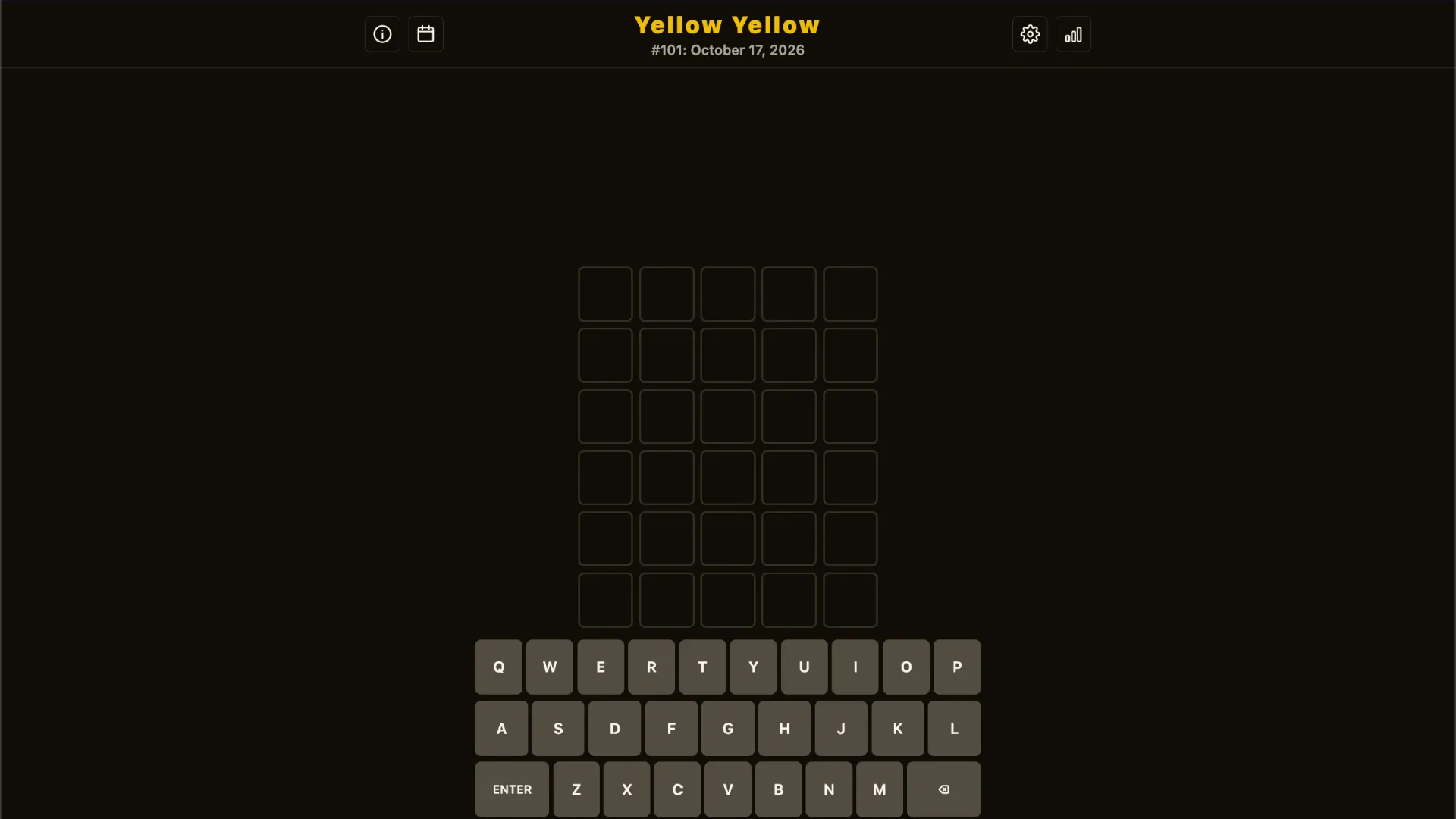
What Is Yellow Yellow?
Yellow Yellow is a free daily word puzzle that turns the familiar Wordle formula upside down. Instead of trying to make every letter green, your goal is to make all five letters yellow.
Each puzzle revolves around a hidden five-letter word. You have six attempts to enter a valid five-letter word that contains exactly the same letters as the secret word, but with every letter in a different position.
That means the winning answer is an anagram of the hidden word, with no letters occupying their original positions.
The game combines familiar Wordle-style clues with an unusual word-rearranging challenge. Finding the hidden word is only part of the puzzle; figuring out how to rearrange its letters into another valid word is what makes Yellow Yellow different.
Yellow Yellow Rules: All Yellow Wins
Yellow Yellow uses the familiar three-color feedback system, but changes what counts as victory.
- Green: The letter appears in the hidden word and is already in its correct position.
- Yellow: The letter appears in the hidden word but belongs in a different position.
- Gray: The letter is not part of the hidden word, or is an extra occurrence beyond the number present in the answer.
In ordinary Wordle, five green tiles mean success. In Yellow Yellow, you are aiming for exactly the opposite positional result: five yellow tiles in a single guess.
You must satisfy two conditions simultaneously:
- Use all five letters from the hidden word, including the correct number of occurrences of any repeated letters.
- Place every letter in a different position from where it appears in the hidden word.
You have six guesses to achieve this combination.
How to Play Yellow Yellow
- Open today's puzzle. Visit Yellow Yellow in your browser to see the five-letter grid and on-screen keyboard.
- Enter your first word. Type a valid five-letter English word and press Enter. Your first guess helps reveal which letters belong to the hidden word and where they appear.
- Read the colored clues. Yellow letters are present but misplaced, green letters occupy their original positions, and gray letters provide information about letters to eliminate.
- Build a new arrangement. Use the clues to identify the hidden word's letters, then look for a valid anagram that moves every letter away from its original position.
- Aim for five yellows. Submit your rearranged word within six attempts. If every tile turns yellow, you win the daily puzzle.
Example: How an All-Yellow Answer Works
Consider a hypothetical puzzle where the hidden word is STARE.
A guess of TEARS would produce the following feedback:
- T: Yellow — the letter is present but in the wrong position.
- E: Yellow — the letter is present but in the wrong position.
- A: Green — the letter is in its original position.
- R: Green — the letter is in its original position.
- S: Yellow — the letter is present but in the wrong position.
The result would be:
TEARS → 🟨🟨🟩🟩🟨
This guess contains all five correct letters, but it does not win because A and R are still in their original positions.
Now consider RATES, another valid anagram of STARE.
RATES → 🟨🟨🟨🟨🟨
Every letter appears in the hidden word, and none occupies its original position. That is a winning Yellow Yellow guess.
This is an illustrative example, not a spoiler for today's puzzle.
Tips and Strategies for Yellow Yellow
1. Discover the Letter Set First
Early guesses should help identify which letters are present in the secret word. A starting word containing several common vowels and consonants can provide useful information before you begin searching for anagrams.
2. Use Green Letters as Positional Warnings
Green tiles reveal exact positions in the secret word. That information is valuable, but your eventual winning guess must move those letters elsewhere. Keep a record of positions that individual letters should avoid.
3. Think in Anagrams, Not Exact Matches
Once you have identified the five letters, stop trying to reproduce the hidden word. Instead, look for other valid English words using the same letters. Rearranging familiar letter pairs or changing the order of syllables may reveal possibilities.
4. Check Every Position
Finding a valid anagram is not enough. Before submitting it, compare each position against the secret word's known positions. Even a single green tile prevents an all-yellow result.
5. Watch for Repeated Letters
If the secret word contains repeated letters, the final answer must use the same number of each letter. Pay attention to gray feedback on extra letter occurrences, and remember that repeated letters can make positional rearrangement more difficult.
6. Make Each Guess Count
With only six attempts, avoid submitting guesses that provide little new information. Try to choose words that either reveal missing letters or test useful alternative arrangements.
Yellow Yellow vs. Wordle
Both games use five-letter words, six guesses, and familiar green, yellow, and gray feedback. The difference is their winning condition.
| Feature | Yellow Yellow | Wordle |
|---|---|---|
| Word length | 5 letters | 5 letters |
| Guess limit | 6 | 6 |
| Feedback | Green, yellow, gray | Green, yellow, gray |
| Winning condition | All five tiles yellow | All five tiles green |
| Main challenge | Find a valid anagram with every letter misplaced | Identify the exact hidden word |
| Puzzle frequency | Daily | Daily |
Yellow Yellow adds a second layer of reasoning to the usual word-guessing process. Even when you know the hidden word, you still need to discover a valid rearrangement that satisfies the all-yellow rule.
Is Yellow Yellow Free to Play?
Yes. Yellow Yellow is a free browser-based daily word puzzle available at yellowyellow.xyz. You can play directly online without installing a separate game.
The daily format makes it a quick addition to a regular word-game routine, particularly for players who enjoy Wordle variations, anagrams, and deduction challenges.
Conclusion
Yellow Yellow takes one of Wordle's most recognizable clues and turns it into the entire objective. The challenge is not simply to discover the hidden word but to rearrange its letters into a valid alternative where every position is wrong.
If ordinary Wordle feels too familiar, play Yellow Yellow and see whether you can turn all five tiles yellow in six guesses.