Meowdoku Rules: How to Play the Official Cat Logic Puzzle
Learn the official Meowdoku rules: place one cat per color region, avoid rows, columns, and diagonal contact, and solve with logic.
Quick Answer
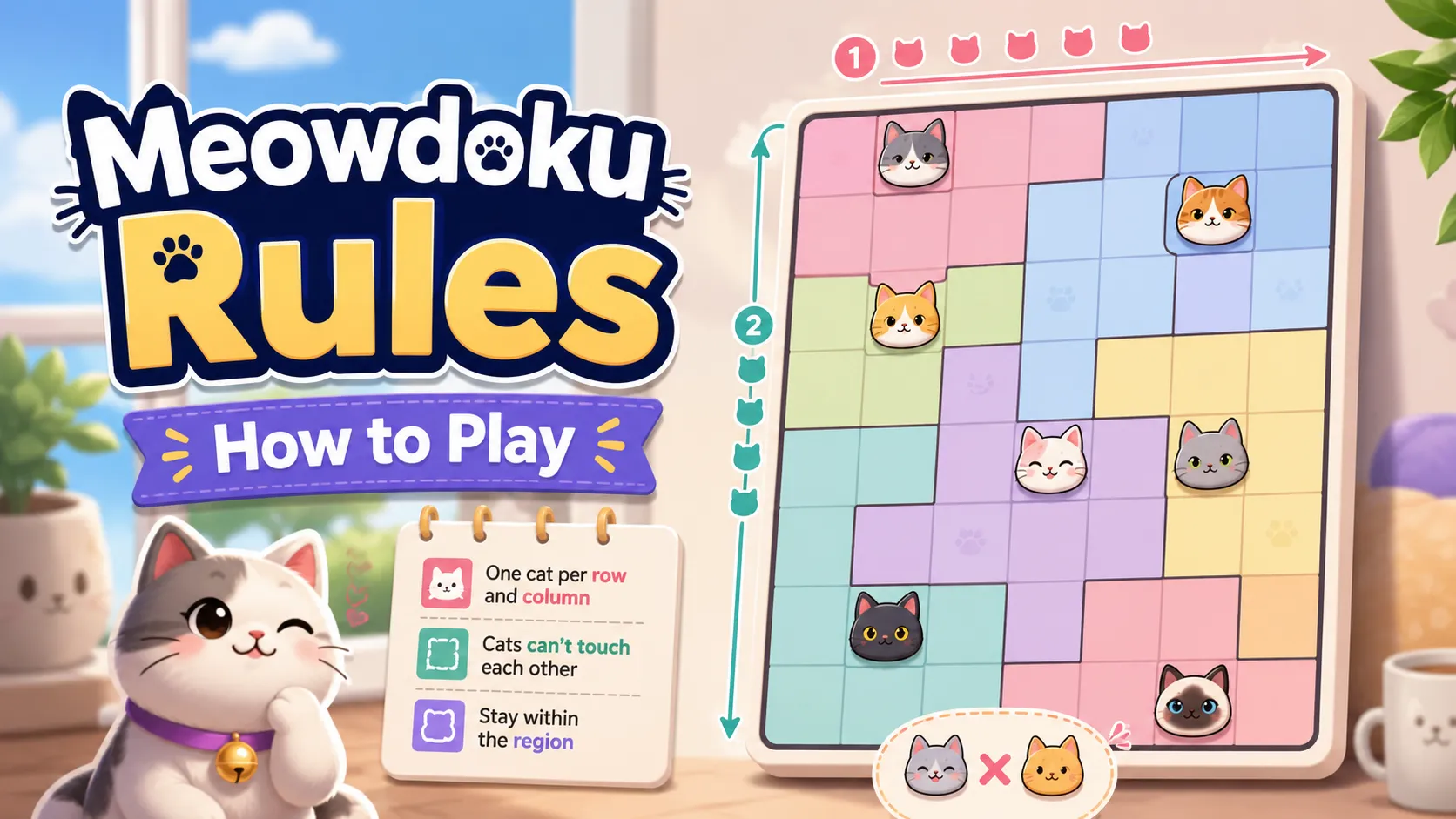
Meowdoku is a cat-themed mobile logic puzzle where you place cats on a colored grid. The official rules are simple: each colored section needs exactly one cat, cats cannot share the same row or column, and cats cannot touch each other, even diagonally. The mobile game also uses a three-heart mistake limit, so guessing is risky. (Google Play)
What Is It?
Meowdoku is the official Oakever Games mobile puzzle listed as Meowdoku: Brain Puzzle Games on Google Play and Meowdoku! on the App Store. It mixes Sudoku-style placement logic with Minesweeper-like deduction, but there are no numbers to fill in. (Google Play)
Instead, every puzzle asks one question: where can each cat safely sit?
The appeal is that the rules are easy to learn, but the deduction can become surprisingly tight. A square may look open at first, but it can be ruled out by its color region, row, column, or nearby cats.
Meowdoku Rules
- One cat per colored section: Every colored region must contain exactly one cat.
- No shared rows: Two cats cannot appear in the same horizontal row.
- No shared columns: Two cats cannot appear in the same vertical column.
- No touching: Cats cannot sit next to each other, including diagonally.
- Double-tap to place a cat: On the mobile version, placing a cat is done by double-tapping a tile.
- Three mistakes only: Wrong placements cost hearts, and you only have three chances before the level fails. (Google Play)
The most important rule is the diagonal rule. Many players remember the row and column restrictions but lose hearts because two cats touch at the corners.
How To Play
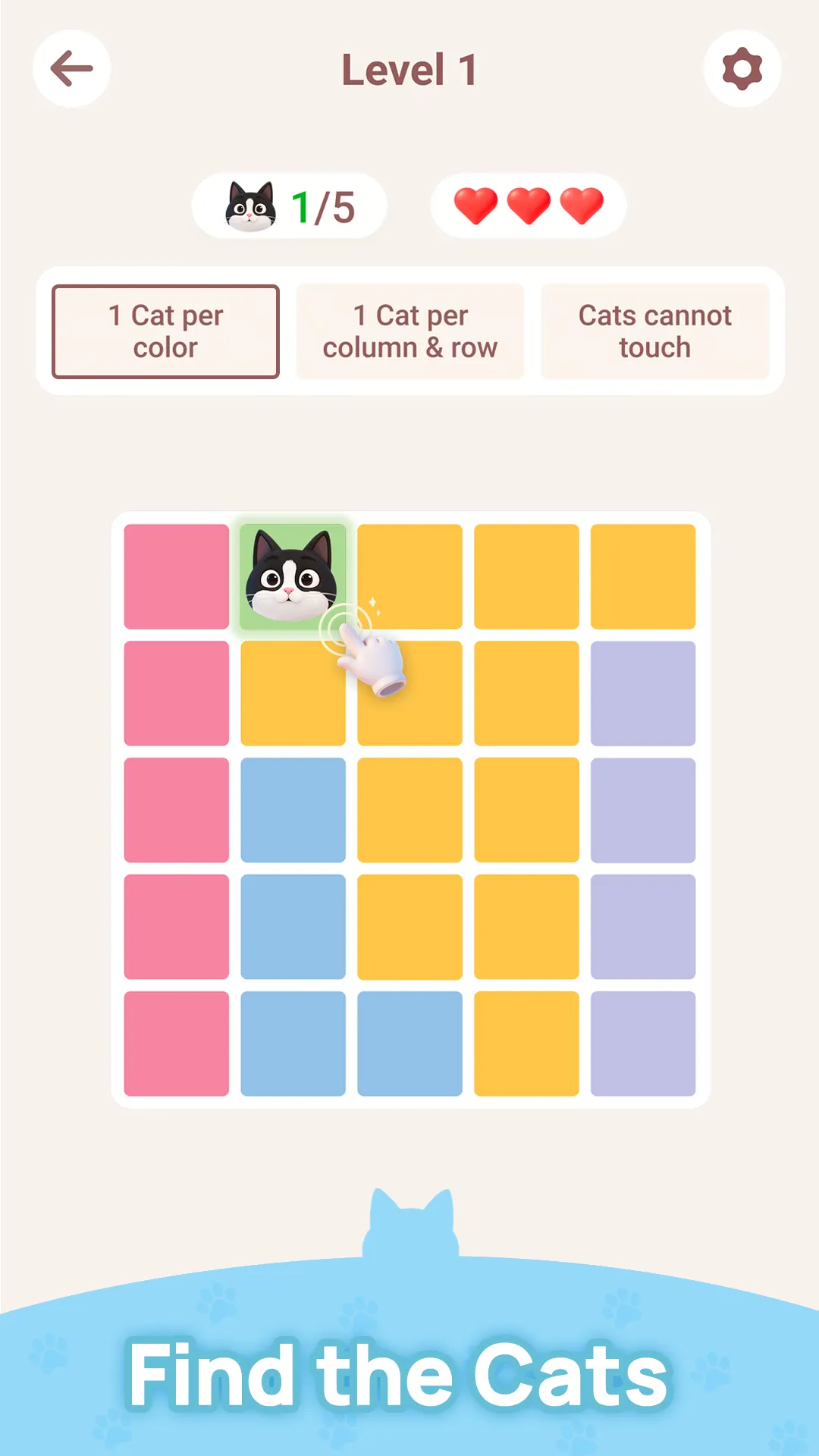
- Scan the colored regions first. Look for small regions or oddly shaped areas with only a few possible cat positions.
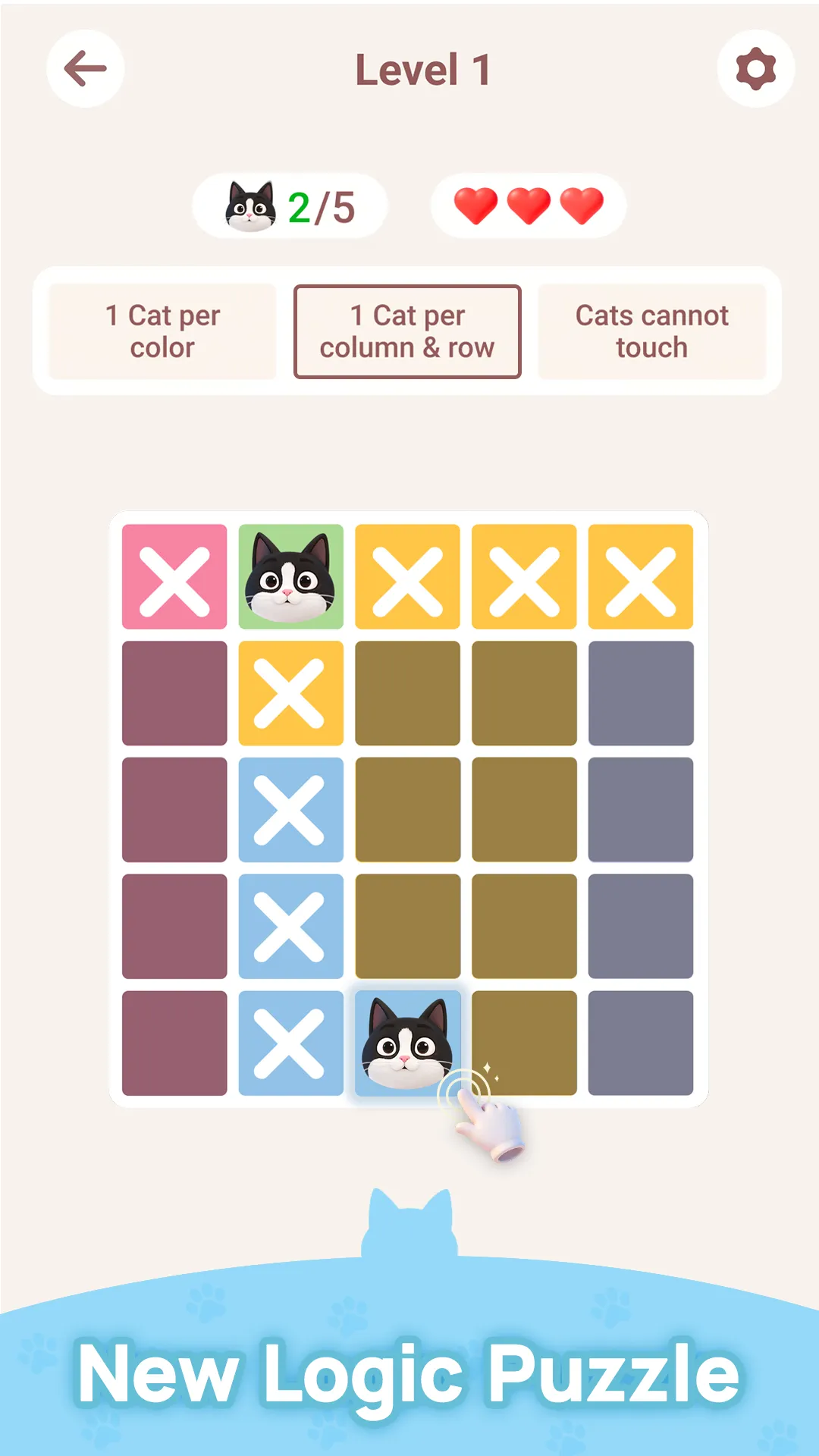 2. Mark impossible tiles mentally. Any tile in a row, column, or adjacent space blocked by another cat is unsafe.
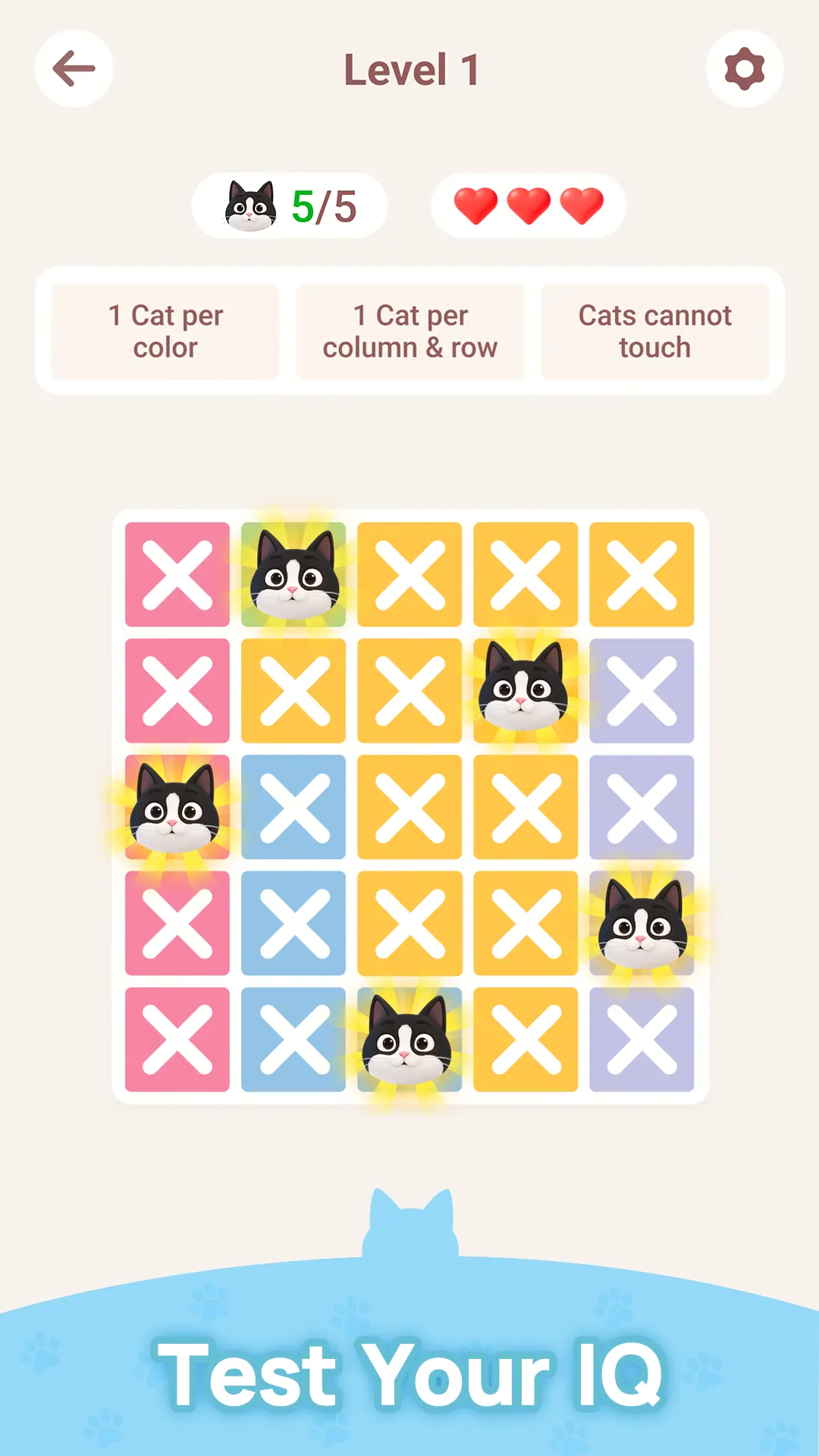 3. Place only when you have a reason. A correct move should be backed by elimination, not a guess.
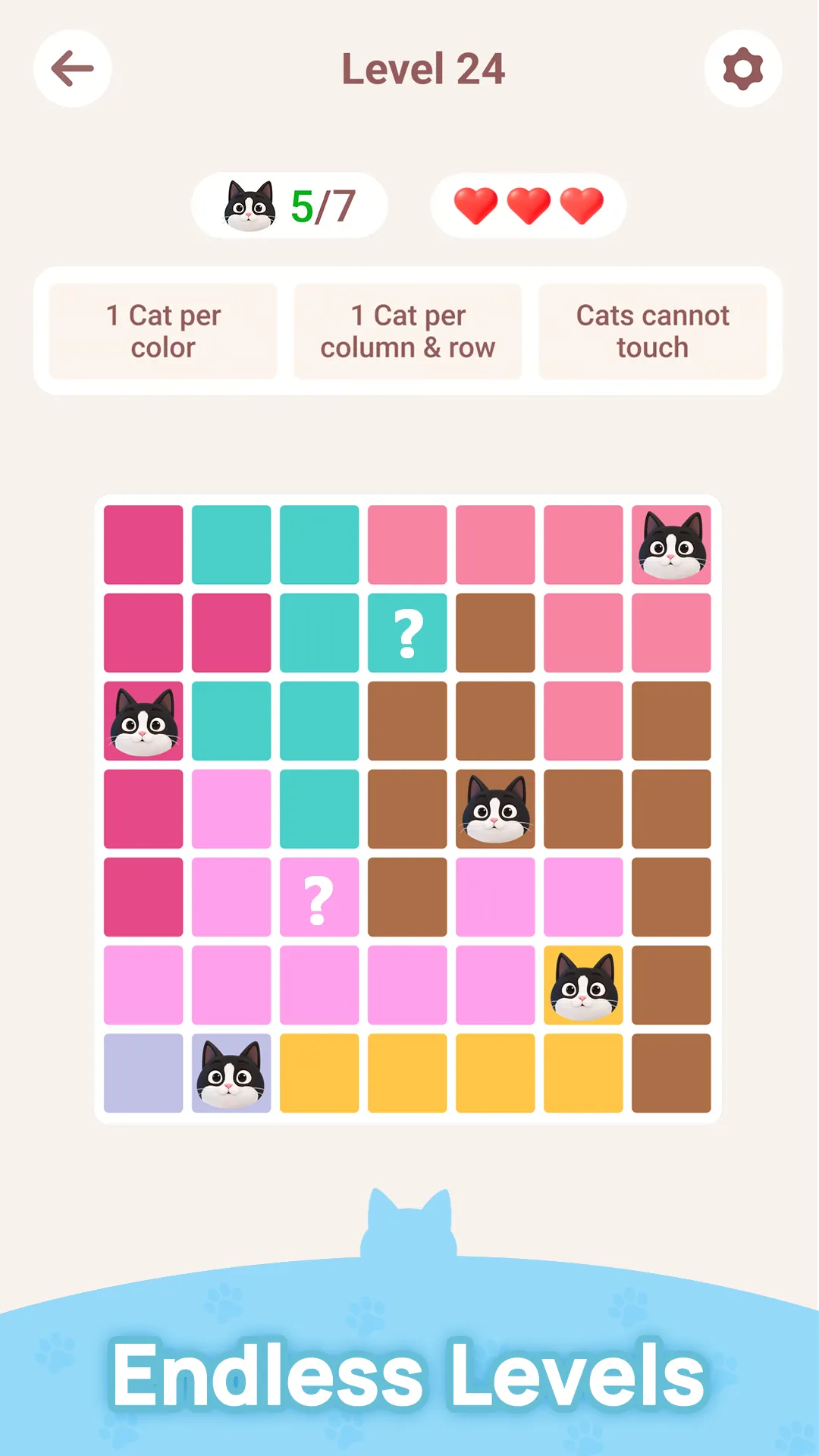 4. Use rows and columns as checkpoints. Once a row or column already has a cat, every other tile in that line is ruled out.
5. Check the eight surrounding tiles. Before placing a cat, confirm that no existing cat touches it vertically, horizontally, or diagonally.
4. Use rows and columns as checkpoints. Once a row or column already has a cat, every other tile in that line is ruled out.
5. Check the eight surrounding tiles. Before placing a cat, confirm that no existing cat touches it vertically, horizontally, or diagonally.
A good Meowdoku move usually comes from narrowing a region down to one legal square. When a region has only one safe tile left, that is your placement.
Tips
- Start with constrained areas. Corners, edges, and tiny color sections often reveal the first safe move.
- Do not rush double-taps. The game uses a heart system, so accidental or guessed placements are costly.
- Think in exclusions. Instead of asking “where can a cat go?”, ask “which tiles are impossible?”
- Recheck diagonals before confirming. Diagonal contact is the easiest rule to overlook.
- Use each cat to unlock the next clue. A placed cat eliminates its row, column, and surrounding tiles, which often makes another region solvable.
Difficulty
Meowdoku starts approachable because the board is visual and the rules are minimal. The challenge increases when larger boards and more complex colored regions force longer deduction chains.
It is easier than classic number Sudoku for beginners because there are no digits or candidates to manage. However, it can still become tricky because every cat affects multiple parts of the board at once.
Who Should Play It?
Meowdoku is best for players who enjoy:
- Logic puzzles without math
- Sudoku-style deduction
- Cat-themed casual games
- Short mobile puzzle sessions
- Games where mistakes matter but levels stay quick
It is not ideal if you want fast reflex gameplay, action mechanics, or a puzzle you can solve by trial and error.
Final Take
Meowdoku works because its rules are clean: one cat per region, no shared rows or columns, and no touching. That gives each puzzle a clear logic loop without making the game feel heavy.
For players who like Sudoku but want something cuter, faster, and more visual, Meowdoku is worth trying. Just remember: every correct cat placement should be proven before you double-tap.