What Is Colorecall?
Colorecall is a browser-based color memory game that tests whether you can remember a specific shade after it disappears. Rather than identifying a color name or choosing from preset swatches, you have to recreate the color yourself from memory.
The challenge sounds simple until the reference vanishes. You may remember that the original was blue, green, warm, cool, dark, or highly saturated, but reproducing the exact shade is much harder.
Colorecall includes short color-memory challenges designed around visual recall rather than color trivia or hexadecimal codes.
The Core Twist
Colorecall separates recognizing a color from remembering a color.
When the reference is visible, small differences between two shades may seem obvious. Once that reference disappears, you have to rely on your memory of properties such as:
- Hue — whether the color leaned more toward blue, green, red, purple, or another part of the spectrum.
- Saturation — whether it looked vivid or muted.
- Brightness — whether you remember it as lighter or darker.
- Overall impression — whether the color felt warm, cool, soft, intense, or neutral.
The game then compares your reconstruction with the original and gives you a result based on how closely the colors match.
Classic and Duo Modes
Colorecall uses more than one format to test color memory.
In a classic-style round, you study a color, wait for it to disappear, and then attempt to recreate that shade from memory.
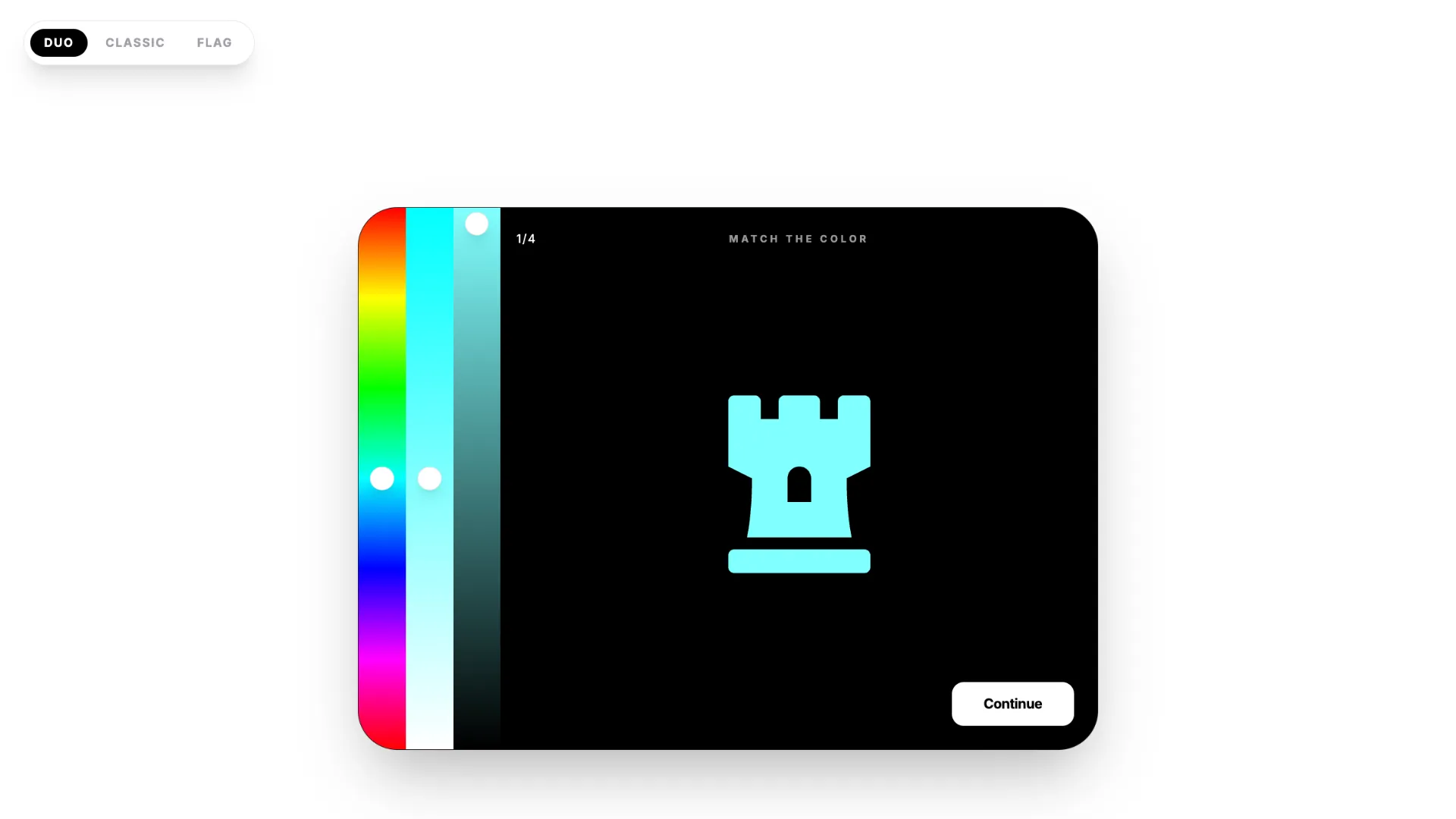
Duo adds an extra memory challenge. Two different shapes appear with different colors. You have a short period to remember both the shades and which shape each shade belongs to. Afterward, one of the shapes returns and you must recreate its original color.
For example:
Study phase:
Circle   → muted teal
Triangle → warm coral

Reference disappears.

Recall phase:
Triangle → ?

Your task: recreate the warm coral.
This means you need to remember both the colors and their associations.
How to Play Colorecall
- Study the reference color. Pay attention to its hue, saturation, and brightness before it disappears.
- Remember the important details. In Duo mode, also remember which color belongs to each shape.
- Recreate the shade. Use the color controls to adjust your answer until it matches the color you remember.
- Submit your choice. The game compares your recreated color with the original and shows how accurately you remembered it.
- Continue through the round. Try to maintain accurate recall across multiple colors and improve your overall performance.
A Realistic Example
Imagine Colorecall shows you a slightly desaturated blue-green shade.
After it disappears, you remember that it was somewhere around teal. Your first instinct might be to choose a bright turquoise, but that only captures the general color family. The original may have been darker, less saturated, and slightly greener.
Instead of remembering only:
Original = teal
Try to remember something more specific:
Hue: blue-green, leaning green
Saturation: medium
Brightness: medium-dark
That gives you more useful information when you recreate the color.
Why Colorecall Is Difficult
Human color memory is less precise than color recognition. It is much easier to compare two shades while both are visible than to reproduce one after it has disappeared.
Colorecall makes that weakness immediately noticeable. A shade you remember as vivid blue may actually have been slightly muted, greener, or darker than you thought.
The difficulty comes from remembering several visual properties at the same time rather than simply identifying the general color family.
Strategy Tips
- Do not memorize only the color name. A label such as blue, green, or purple covers a huge range of shades.
- Break the color into properties. Think about hue, saturation, and brightness separately.
- Notice whether the shade is warm or cool. This can help you place the hue more accurately after the reference disappears.
- Use comparisons in Duo. Remember how the two colors differ from each other, not just what each color looks like individually.
- Associate colors with shapes. A simple mental note such as "circle = dark teal" can make Duo rounds easier to recall.
- Avoid excessive tweaking. Your first strong visual memory may be more reliable than repeatedly changing the color picker after the reference is gone.
Who Will Enjoy Colorecall?
Colorecall is a good fit for players who enjoy visual perception games, color matching, memory challenges, and short browser puzzles.
It may be especially interesting for designers, artists, photographers, and anyone who works with color, but no design knowledge is required. The challenge is based on visual memory rather than knowing RGB values, hexadecimal codes, or formal color theory.