
What Is Guess Mint?
Guess Mint, officially known as Guessmint, is a free daily history guessing game where players identify a real historical coin by determining who issued it and approximately when it was struck.
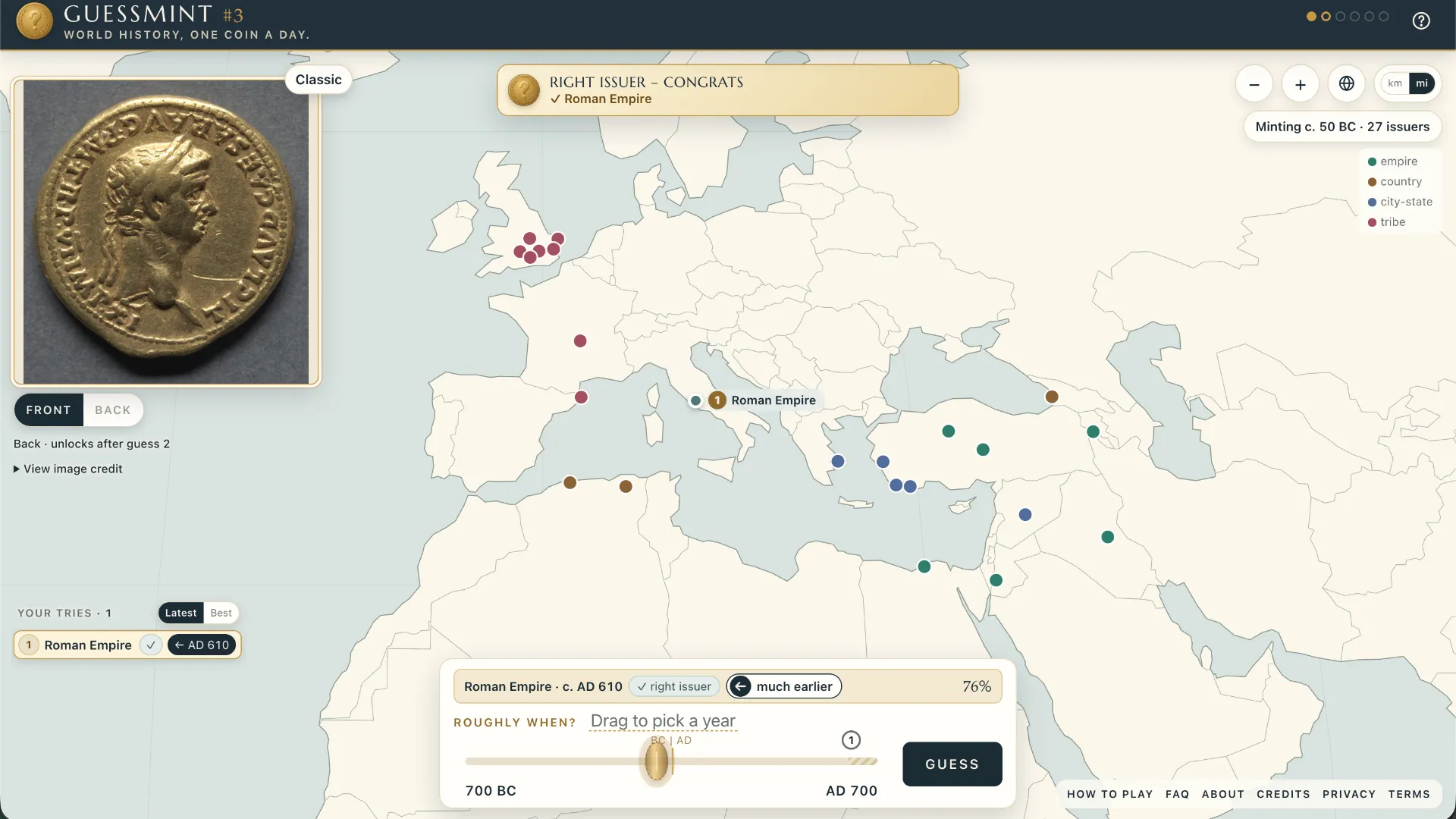
Every day, the game presents a photograph of a mystery coin from a museum or public collection. Players examine its portraits, inscriptions, symbols, and other visual details before making guesses on an interactive historical world map.
Unlike a traditional history quiz, Guess Mint does not simply ask players to recall historical facts. It combines visual investigation, geography, chronological reasoning, and deduction. Every guess provides feedback that helps narrow down the possibilities.
You have six guesses to solve both parts of the mystery:
- Issuer: Identify the historical state, country, empire, city-state, or tribe responsible for issuing the coin.
- Era: Estimate when the coin was struck. An accepted historical date range counts, so the exact year is not required.
The coins span roughly 2,500 years of history, from ancient Greek coinage to coins issued around 1900. A new puzzle appears every day, making Guess Mint an interesting daily challenge for history enthusiasts, coin collectors, and curious puzzle players.
Guess Mint Rules and Core Gameplay
Guess Mint gives players six attempts to identify both the issuer and the historical period of a mystery coin. Each guess combines an issuer selected from the map or search box with a year selected on the timeline.
1. Examine the Historical Coin
At the beginning of each puzzle, you see a photograph of the front or most informative side of a real coin.
You can zoom in and move around the image to examine its details. Look for clues such as:
- Portraits of rulers, emperors, or historical figures.
- Writing systems, including Greek, Latin, Arabic, Chinese, and Cyrillic.
- Religious symbols, animals, buildings, and other emblems.
- Artistic styles and visible marks that suggest a particular civilization or era.
Some obvious identifying details, such as modern numerals showing the date or a readable country name, may be covered. Other historical clues remain visible.
2. Select a Historical Issuer
An interactive world map displays historical coin issuers associated with the year currently selected on the timeline.
Choose an issuer by clicking its capital on the map or searching for its historical name.
Historical accuracy matters: A coin issued by the Roman Empire should be associated with the Roman Empire rather than modern Italy. Similarly, historical kingdoms and republics are represented by their period-appropriate identities.
The goal is to identify the issuing political entity, not necessarily the exact city or mint building where the coin was manufactured.
3. Estimate the Minting Year
Use the timeline to select approximately when the coin was produced. You can drag the slider or enter a year directly, using negative numbers for BC dates.
The timeline extends from 1000 BC to AD 2000. As you change the selected year, the map updates to show historical issuers relevant to that period.
4. Interpret the Feedback
After submitting a guess, Guess Mint provides information about both your selected issuer and your estimated date.
Geographical feedback:
- The game shows the distance between the capital of your guessed issuer and the capital of the correct issuer.
- A directional arrow points toward the correct issuer's capital.
- Distances can be viewed in kilometers or miles.
- Amber feedback indicates that your guess is within approximately 1,500 kilometers of the correct location.
Chronological feedback:
- The game tells you whether the coin was struck earlier or later than your selected year.
- Feedback distinguishes between relatively close dates and dates that are several centuries apart.
- The exact difference in years is not revealed.
Each guess also receives an approximate percentage match. Previous guesses remain visible so you can compare the clues.
5. Solve Both Parts Within Six Guesses
Finding the correct issuer and finding the correct era are separate objectives. Once one part is solved, it locks into place, allowing you to concentrate on the remaining mystery.
You do not need to identify the exact minting year. A date within the coin's accepted historical range is sufficient.
After your second guess, the reverse side of the coin becomes available. If the collection only provides one photographed side, the game may reveal a written clue instead.
How to Play Guess Mint: Step-by-Step
- Open the daily game. Visit Guessmint.com to view today's mystery historical coin. Examine the visible portrait, writing, symbols, and other distinguishing features.
- Choose an issuer. Use the interactive map or search field to select the empire, kingdom, republic, city-state, or tribe you believe issued the coin.
- Choose a year and submit. Move the timeline to your estimated minting period, then press Guess to submit your issuer-and-year combination.
- Follow the clues. Examine the distance and direction toward the correct issuer, along with the earlier-or-later date feedback. Adjust your choices for the next attempt. After two guesses, inspect the newly available reverse side or clue.
- Complete the puzzle. Identify both the historical issuer and accepted era within six guesses. After finishing, review the coin's identity, historical background, and photograph source, then share your spoiler-free result if desired.
Example: Using Historical Clues
Imagine a mystery coin shows a ruler's portrait and Latin lettering.
You might begin with the following hypothetical guess:
First guess:
- Issuer: Roman Empire
- Year: AD 200
Suppose the feedback indicates that the correct issuer's capital lies farther east and that the coin was produced much later.
Those clues suggest investigating later political entities in the eastern Mediterranean. Depending on the artwork and inscriptions, the Byzantine Empire might become a reasonable possibility.
Possible next guess:
- Issuer: Byzantine Empire
- Year: AD 900
The next feedback result would help determine whether that theory is worth pursuing.
This example illustrates Guess Mint's central mechanic: combine evidence from the coin with geographical and chronological feedback rather than making unrelated guesses. It is not an answer to a specific daily puzzle.
Difficulty Levels and Daily Challenges
Guess Mint features three difficulty tiers:
- Classic: The usual daily challenge, featuring a relatively recognizable historical coin with clues that attentive players can interpret.
- Tricky: A less familiar coin that requires closer examination of its details and historical context.
- Challenge: A more demanding coin, often especially interesting to collectors. Challenge puzzles appear approximately once a week and provide additional tips after the third guess.
Every player receives the same daily coin. The puzzle changes at midnight Hawaii time (10:00 UTC).
Only the current coin is playable. Yesterday's coin can be viewed with its answer and historical explanation on the game's About page, but older puzzles are not available as a playable archive.
Guess Mint Strategy Tips
Study the Writing System First
The coin's lettering can immediately narrow the possible regions and periods. Greek inscriptions suggest different possibilities from Arabic or Chinese characters. Even without understanding the language, recognizing the script can help eliminate many historical issuers.
Use the Map as a Historical Reference
The map is more than a guessing interface. It shows the historical issuers available around the year you have selected. If an empire or kingdom does not appear, reconsider whether it existed under that name during the chosen period.
Pay Attention to Direction and Distance
After your first guess, the direction arrow and geographical distance can eliminate large regions. Use subsequent guesses to narrow the likely location rather than jumping between unrelated continents.
Narrow Down the Historical Period
If the feedback says your guessed year is too early, move forward in time. If the coin is earlier, move backward. The timeline marks excluded years and narrows the remaining possibilities as you continue.
Use the Reverse Side
The reverse side becomes available after your second guess and may reveal valuable symbols, imagery, or inscriptions. Compare the two sides before committing to your next theory.
Solve the Easier Half First
If you recognize the historical era but cannot identify the issuer, prioritize the date. Once the era is accepted, it locks and you can focus on geography. The same principle works in reverse if the issuing state is easier to identify.
Is Guess Mint Free to Play?
Yes. Guess Mint is completely free to play in a web browser, with no download, purchase, or account required.
The game supports desktop and mobile browsers. Its interface includes map navigation, image zooming, and a draggable timeline.
Your daily streak and total games played are stored locally in your browser. They are not synchronized between devices, and clearing the site's stored data can remove them.
You can share your result without revealing the daily answer. The shared message reports your game number and number of guesses rather than the coin's identity.
Who Should Play Guess Mint?
Guess Mint is particularly appealing to players who enjoy:
- History games: Explore historical empires, kingdoms, trade networks, and political changes through actual artifacts.
- Geography guessing games: Use maps, distances, and directions to identify a mystery location.
- Coin collecting and numismatics: Recognize historical coin designs, materials, rulers, and inscriptions.
- Daily deduction puzzles: Apply clues systematically to solve a mystery in a limited number of attempts.
The game does not require formal numismatic expertise, although players familiar with historical coins and civilizations may recognize some clues more quickly.
Frequently Asked Questions
How many guesses do you get in Guess Mint?
You have six guesses to identify both the issuer of the mystery coin and its approximate minting period. Each submission includes both an issuer and a year until one part has been solved.
Do you need the exact year?
No. Guess Mint accepts years within the coin's historical dating range. Some ancient coins have wider accepted ranges because their production dates are uncertain.
Does Guess Mint have a new puzzle every day?
Yes. A new coin appears every day at 10:00 UTC, corresponding to midnight in Hawaii. Everyone plays the same daily challenge.
Can you play previous Guess Mint puzzles?
No. Previous puzzles are not available for replay. Yesterday's completed puzzle can be viewed on the About page, including its historical explanation.
Are the coins real?
Yes. Guess Mint uses photographs of genuine historical coins from museums, libraries, and openly licensed collections. Sources include institutions such as the Rijksmuseum, the Metropolitan Museum of Art, and the Smithsonian's National Numismatic Collection.
Is Guess Mint similar to Wordle?
Both games feature a daily puzzle with six attempts, but their mechanics are different. Wordle is about identifying a word from letter-position feedback, while Guess Mint asks players to identify a historical coin's issuer and era using images, a historical map, and chronological clues.
Conclusion
Guess Mint turns historical coin identification into a daily geography and history mystery. Its combination of genuine museum photographs, interactive maps, chronological feedback, and limited guesses offers a different kind of challenge from conventional trivia or word games.
Whether you recognize ancient Greek symbols, enjoy studying historical empires, or simply want to discover something unexpected about world history, each coin presents a small mystery worth solving.
Ready to test your historical knowledge? Play Guess Mint for free and see if you can identify today's coin in six guesses.