
What Is Lawndle?
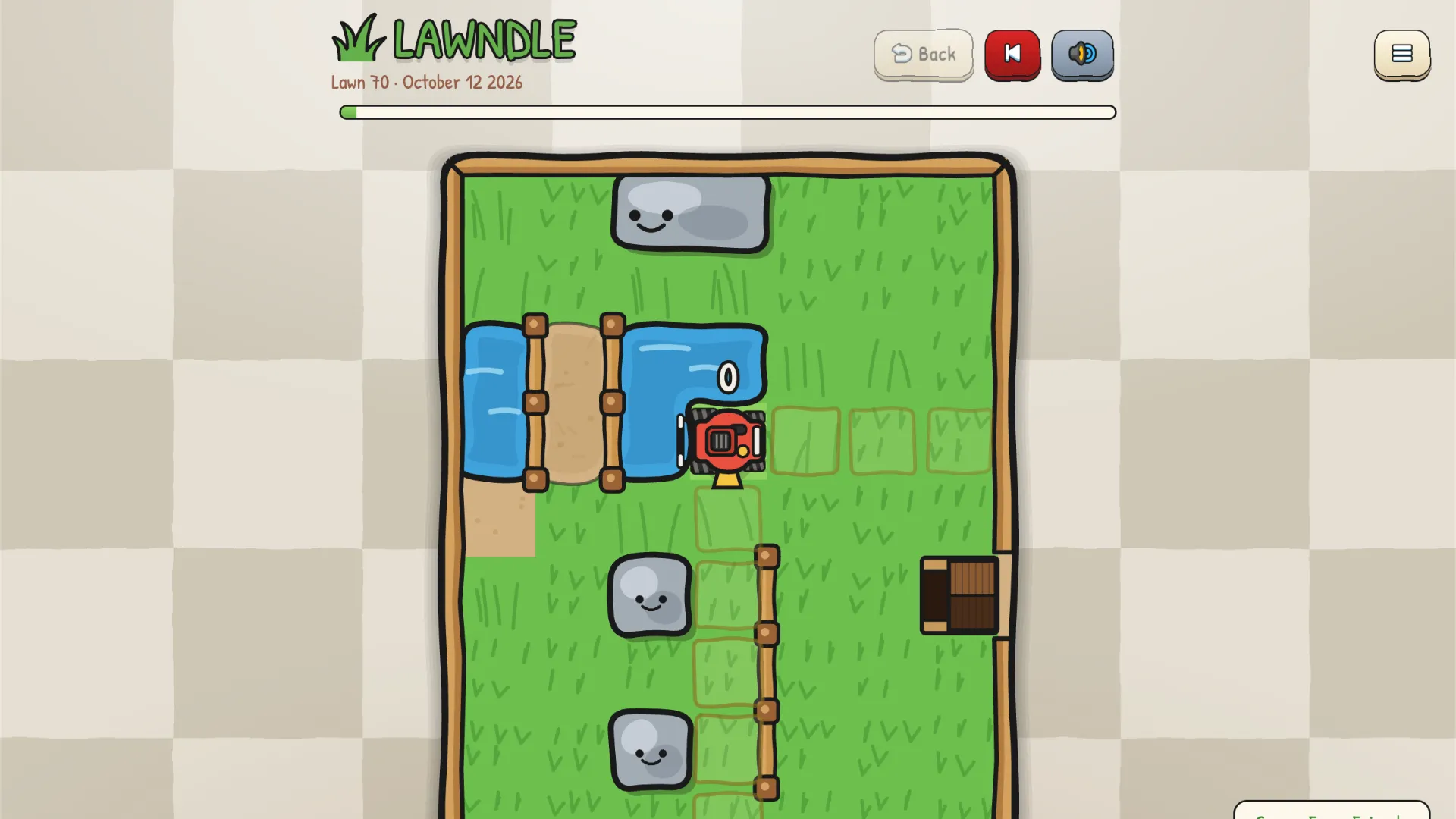
Lawndle is a free daily browser puzzle that turns mowing the lawn into a surprisingly clever pathfinding challenge. Created by James O'Halloran, the game asks you to drive a lawn mower around a grid, cut every grass tile, and finish inside the shed using as few steps as possible.
The idea sounds simple, but there's a catch: mowing efficiently isn't just about covering the shortest distance. Your mower throws grass clippings to its right, and those clippings can land in nearby ponds. Some lawns also contain movable balls, rocks, fences, and bare patches of earth that change how you should approach the route.
Every day brings a new lawn to solve. The puzzle rewards careful planning, spatial reasoning, and finding a route that avoids unnecessary movement and penalties.
Unlike Wordle, Lawndle doesn't ask you to guess letters or words. You're solving a miniature route-optimization problem, with a lawn mower as your puzzle piece.
Lawndle Rules: How Does the Game Work?
The objective is to mow every grass tile and return the mower to the shed with the lowest possible step count.
1. Mow every grass tile.
Drive across the lawn to cut all remaining grass. Every tile you travel costs one step, regardless of whether that tile has already been mowed. Revisiting the same area increases your total without cutting additional grass.
2. Finish in the shed.
Cutting the last grass tile isn't enough. You must navigate to the shed to complete the puzzle. A route that ends far from the shed may waste several extra steps.
3. Keep grass clippings out of ponds.
Whenever the mower cuts a grass tile, its right-hand chute sprays clippings up to two tiles away. If those clippings enter a pond, you receive a +2 step penalty.
This makes your direction of travel important. A path that is safe when approached from one direction might cause a penalty when approached from the opposite direction.
4. Avoid damaging balls.
Some puzzles include balls that move when the mower pushes them. Pushing a ball into a fence or pond adds a +2 step penalty. Think about where a ball will end up before driving into it.
5. Use bare earth wisely.
Bare patches contain no grass. You can drive across them, but they don't produce clippings. They still cost one step per tile, making them useful for crossing between ponds without triggering clipping penalties.
How to Play Lawndle
- Open today's lawn. Visit the official Lawndle website. Examine the starting position, the shed, grass tiles, ponds, rocks, and any movable balls before making your first move.
- Choose your first direction. Click or tap a tile directly above, below, left, or right of the mower. The mower travels in a straight line to that tile, cutting grass along the way. Alternatively, use the arrow keys or WASD to move one tile at a time.
- Plan around obstacles and penalties. Look ahead before cutting near ponds. Remember that clippings leave the mower on its right-hand side. Avoid pushing balls into dangerous positions and try not to revisit already-cut grass unnecessarily.
- Cut the remaining grass and park. Continue until every required grass tile has been mowed, then drive the mower into the shed. The puzzle finishes when both objectives are complete.
- Review and share your score. Compare your total steps against the best route. Use the Share button to copy a color-coded map showing your route, repeated tiles, and penalties.
The Back button lets you rewind your latest move if you notice a mistake while planning your route.
The Core Twist: Direction Matters
Lawndle's distinctive mechanic is its directional grass-clipping system.
Imagine the mower traveling east along a strip of grass beside a pond. When it faces east, its right-hand side points south. If the pond is within the chute's two-tile spray range on that side, cutting the grass can produce a penalty.
Approaching the same strip from the west changes the mower's right-hand side to north. That may allow you to cut the grass without spraying the pond.
For example:
- Route A: Mow east with a pond immediately south of the grass. The chute points toward the water, creating a penalty risk.
- Route B: Mow west along the same strip. The chute points north, potentially avoiding the pond entirely.
- Route C: Cross a nearby bare-earth corridor. This produces no grass clippings but may require additional travel steps.
The challenge is determining which route produces the lowest combined movement and penalty total.
A shorter physical route isn't always the better route. Taking a small detour can save steps overall if it prevents multiple +2 penalties.
How Lawndle Scoring Works
Lawndle scores your performance using the steps taken and penalties accumulated during your run. Fewer steps indicate a more efficient solution.
Every tile traveled costs one step. Turning doesn't cost an additional step, and clicking a distant tile in a straight line only reduces the number of clicks—not the distance counted.
For example, traveling across four tiles costs four steps whether you click the destination once or use four individual arrow-key movements.
After finishing, the shared result can show how far your performance was from the best route.
The shared map uses colors to explain your run:
- 🟩 Green: Grass cut in one clean pass.
- 🟨 Yellow: A tile visited more than once.
- 🟥 Red: A tile associated with a penalty.
- 🟪 Purple: The mower's starting position.
- 🟧 Orange: The shed.
- 🟦 Blue: A pond.
- ⬛ Black: A rock.
- 🟫 Brown: Bare earth.
A map with fewer yellow and red tiles generally indicates a cleaner, more efficient route.
Lawndle Strategy Tips
Plan backward from the shed. Identify where you need to finish before starting. Try to make your final mowing pass end near the shed rather than on the opposite side of the lawn.
Watch the right-hand chute. Near ponds, check which direction keeps the chute pointed away from the water. Reversing your route can sometimes eliminate a penalty without adding travel distance.
Minimize repeated tiles. Every return trip adds steps. Plan connected mowing passes that cover new grass whenever possible.
Treat bare earth as a safe crossing. Bare patches don't produce clippings, making them especially valuable between ponds. Compare their travel cost against the penalties they may help you avoid.
Think before pushing a ball. Make sure there's enough room to move it without forcing it into a fence or pond.
Use the Back button. If you notice that a move creates an avoidable penalty or awkward route, rewind and try another direction.
Optimize the whole route. Don't focus only on reaching the next uncut tile. Consider the remaining grass, obstacles, and final shed location together.
Daily Puzzles and the Lawndle Archive
Lawndle introduces a new lawn every day at 4:00 AM UTC. Players can tackle the current puzzle and compare their results with friends using the shareable score map.
Missed a day? Previous puzzles are available in the official archive, allowing you to revisit earlier lawns and improve your personal best scores.
This makes Lawndle appealing both as a quick daily brain teaser and as a collection of route-planning challenges you can revisit.
Is Lawndle Worth Playing?
Lawndle is an excellent choice for players who enjoy compact logic puzzles, spatial reasoning, and optimizing solutions rather than guessing answers.
Its appeal comes from the combination of simple controls and surprisingly thoughtful decisions. You don't need to learn complicated commands, but achieving an efficient route requires understanding how every movement affects the lawn.
The daily format keeps sessions manageable, while the archive provides additional puzzles for players who want more practice.
If you enjoy finding the shortest path through a grid, reducing wasted moves, or competing against an optimal solution, Lawndle offers an entertaining twist on the traditional daily puzzle.
Ready to mow? Open Lawndle, study today's lawn, and see how close you can get to the perfect route.