What Is Lettergrams?
Lettergrams is a free daily word-building puzzle from Waffle Studio, the creators of Waffle. It combines elements of Scrabble and crossword puzzles into a compact challenge where players arrange letter tiles to form connected words and maximize their score.
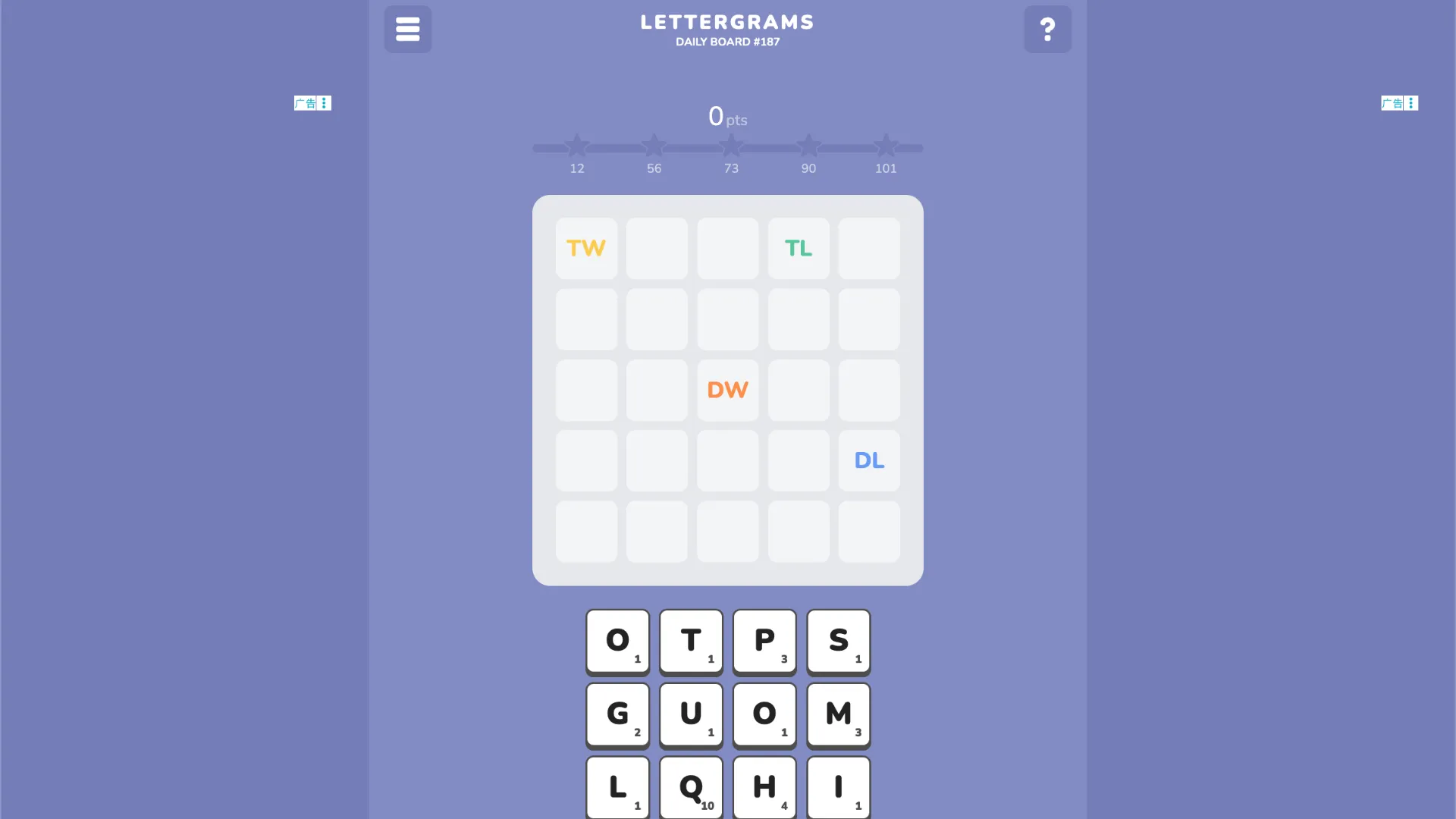
Each daily puzzle gives you 12 letter tiles and a 5×5 board containing special bonus squares. Your objective is to place every letter onto the board while creating valid, interconnected words.
Unlike Wordle, where players attempt to identify one secret word, Lettergrams is an open-ended word construction game. There can be multiple valid ways to arrange the letters, and some arrangements score significantly more points than others.
The challenge is not simply finding words. You must make every tile fit into one connected arrangement, use the available board space intelligently, and take advantage of score multipliers.
Lettergrams is ideal for players who enjoy vocabulary puzzles, Scrabble-style scoring, crossword construction, and daily games that reward both creativity and strategic planning.
Lettergrams Rules and Core Gameplay
Lettergrams uses a straightforward set of rules, but creating a high-scoring board requires careful thinking.
1. Start With 12 Letter Tiles
Every daily puzzle provides a rack containing 12 letters. Each letter has an associated point value, similar to traditional word-tile games.
Common letters generally have lower values, while less frequently used letters can be worth considerably more.
You must use all 12 letters to complete the puzzle successfully.
2. Build Words on a 5×5 Grid
Drag letters from your rack onto the board to spell words horizontally and vertically.
The board has 25 possible positions, but you only have 12 tiles, so choosing where to place them is part of the challenge.
Words must be valid according to the game's dictionary. If an arrangement produces an invalid word, the game highlights the problem.
3. Connect Every Word
This is one of Lettergrams' defining mechanics.
You cannot simply place several unrelated words in different areas of the board. Every word must belong to a connected arrangement.
Words can intersect by sharing letter tiles, just as they do in crossword puzzles.
For example, imagine placing these two words:
C A T . .
A . . . .
R . . . .
. . . . .
. . . . .
Here, CAT runs horizontally across the first row, while CAR runs vertically down the first column. Both words share the letter C.
This is an illustrative example of connected word construction, not an actual daily Lettergrams solution.
A good arrangement makes efficient use of shared letters while allowing additional words to fit around the existing structure.
4. Use Bonus Squares to Multiply Your Score
The board contains special scoring spaces inspired by Scrabble.
| Bonus | Meaning | Effect |
|---|---|---|
| DL | Double Letter | Doubles one letter's point value |
| TL | Triple Letter | Triples one letter's point value |
| DW | Double Word | Doubles the score of a word |
| TW | Triple Word | Triples the score of a word |
Bonus squares can dramatically affect your final result.
For example, a high-value letter placed on a Triple Letter square can earn substantially more points than the same tile placed on an ordinary square.
Similarly, a word crossing a Double Word or Triple Word square can receive a large scoring boost.
A particularly valuable move is placing a letter where two words intersect, allowing it to contribute to both words.
5. Complete the Board and Improve Your Score
Once every tile is placed and the words form a valid connected arrangement, the game recognizes that the puzzle can be completed.
However, you do not necessarily have to accept your first valid solution.
You can select KEEP PLAYING to experiment with different word combinations and improve your score before confirming your final arrangement with ALL DONE.
Your final performance can earn up to five stars, depending on the score achieved.
How to Play Lettergrams: Step-by-Step
- Open today's puzzle. Visit Lettergrams in your browser. Examine the 12 available letters, the 5×5 board, and the locations of the bonus squares.
- Find your first word. Look for a useful word among the letters in your rack. Drag the tiles onto the board to create a horizontal or vertical word, preferably near valuable scoring spaces.
- Build connecting words. Use letters already on the board as starting points or intersections for additional words. Continue arranging tiles while ensuring that all words remain connected and valid.
- Place every remaining tile. Adjust your existing words as necessary until all 12 letters have been used. Watch for invalid words highlighted by the game and correct them.
- Maximize your score. When your board is complete, consider selecting KEEP PLAYING to improve letter placement and bonus-square usage. Choose ALL DONE when you are satisfied with your final score and star rating.
A typical puzzle takes approximately 5–15 minutes, depending on your vocabulary, the available letters, and how long you spend optimizing your arrangement.
Lettergrams Scoring Explained
Lettergrams rewards both successful word construction and strategic use of bonus squares.
Every letter contributes points to the words it forms. Bonus squares can multiply the value of individual letters or entire words.
Consider a hypothetical example involving the word QUIZ.
In Scrabble-style scoring, these letters have different point values:
- Q: 10 points
- U: 1 point
- I: 1 point
- Z: 10 points
The combined base value would be 22 points.
If a high-value letter receives a bonus multiplier, the score increases. A word multiplier can increase the entire word's value further.
This is a scoring illustration rather than a verified arrangement from a particular daily puzzle.
Why Intersections Matter
When two words share a letter, that tile can contribute to the score of both words.
This creates an important strategic opportunity: a valuable tile positioned at an intersection may be worth more than the same tile used in only one word.
For the strongest results, combine high-value letters, intersecting words, and bonus squares whenever the available letter combinations allow it.
Lettergrams Strategy Tips
1. Examine Bonus Squares Before Placing Letters
Do not automatically begin in the first available corner. Look at the placement of Double Letter, Triple Letter, Double Word, and Triple Word squares.
Think about which available words could take advantage of those spaces while leaving room for future intersections.
2. Identify Your Most Difficult Letters
Letters such as Q, X, J, and Z can be harder to incorporate into connected arrangements.
If your rack contains an unusual letter, identify potential words containing it early. Waiting until the final few placements may leave you with no convenient way to connect it.
3. Create Intersections Whenever Possible
Crossing words is often more efficient than building a long chain of words connected only at their ends.
A shared letter can create additional scoring opportunities and help you use limited space more effectively.
4. Save Flexible Letters
Common letters and vowels can be useful for connecting several possible words.
Avoid using all your flexible letters in one long word unless you have a clear plan for placing the remaining tiles.
5. Watch for Accidental Invalid Words
As you connect words, you may unintentionally create another horizontal or vertical letter sequence that is not a valid word.
The game highlights invalid words in red. Use that feedback to identify where your arrangement needs adjustment.
6. Try Different Word Arrangements
A complete board is not necessarily the best-scoring board.
Once you have found a valid solution, consider whether rearranging a few tiles could position high-value letters on better bonus squares or create additional crossings.
7. Use KEEP PLAYING Strategically
The KEEP PLAYING option is valuable because it allows you to optimize a completed arrangement before accepting your result.
Rather than immediately finishing when all the tiles fit, experiment with alternatives. Even a small change can improve your score.
What Makes Lettergrams Different From Wordle and Waffle?
Lettergrams belongs to the daily word-game family, but its gameplay is different from both Wordle and Waffle.
| Feature | Lettergrams | Wordle | Waffle |
|---|---|---|---|
| Main objective | Build connected words for points | Guess a hidden word | Rearrange letters into correct words |
| Core mechanic | Drag letters onto a grid | Submit word guesses | Swap letter positions |
| Board | 5×5 grid | Guess rows | Waffle-shaped word grid |
| Scoring | Letter values and bonus multipliers | Guess efficiency | Remaining swaps |
| Puzzle type | Open-ended word construction | Word deduction | Word and position deduction |
| Daily challenge | Yes | Yes | Yes |
The biggest distinction is that Lettergrams does not require one predetermined arrangement.
Players can create different valid word combinations using the same letters, then compare how efficiently those arrangements use the available scoring opportunities.
This gives Lettergrams more of a miniature Scrabble feel than a conventional word-guessing puzzle.
Who Should Play Lettergrams?
Lettergrams is particularly well suited to:
- Scrabble enthusiasts: Enjoy letter values, strategic placement, and bonus squares in a shorter format.
- Crossword fans: Build intersecting words and solve spatial vocabulary challenges.
- Daily puzzle players: Return for a fresh word-building challenge each day.
- Vocabulary lovers: Experiment with unfamiliar word combinations and creative letter arrangements.
- Score-focused players: Optimize completed boards to pursue higher scores and better star ratings.
The basic rules are easy to understand, but consistently producing high-scoring arrangements requires a combination of vocabulary, spatial reasoning, and planning.
Frequently Asked Questions
What is Lettergrams?
Lettergrams is a daily word-building browser game created by Waffle Studio. Players arrange 12 letter tiles on a 5×5 board to form connected words and maximize their score using special bonus squares.
Is Lettergrams free to play?
Yes. Lettergrams is available as a free browser-based daily word puzzle at puzzlist.com/lettergrams. No separate game download is required.
How many letters are in Lettergrams?
Each daily puzzle starts with 12 letter tiles. Players must place all 12 tiles into a valid, connected arrangement to complete the challenge.
Can words overlap in Lettergrams?
Yes. Horizontal and vertical words can intersect and share letter tiles. These intersections are an important part of building a compact, connected board.
What do DL, TL, DW, and TW mean?
DL means Double Letter, TL means Triple Letter, DW means Double Word, and TW means Triple Word. These special squares increase the points earned from letters or complete words.
How do you get five stars in Lettergrams?
Lettergrams awards up to five stars based on your final score. To improve your chances, create valid interconnected words, use valuable bonus squares, and experiment with more efficient arrangements before finishing.
Can you change your words after completing the board?
Yes. When the board meets the completion requirements, you can choose KEEP PLAYING to refine your arrangement instead of immediately finalizing it. Use ALL DONE when you are ready to accept your score.
Is Lettergrams the same as Waffle?
No. Both games are associated with Waffle Studio, but they use different mechanics. Waffle requires players to rearrange existing letters into predetermined words with a limited number of swaps. Lettergrams asks players to construct their own connected words using a rack of tiles and score multipliers.
Does Lettergrams have a new puzzle every day?
Yes. Lettergrams is a daily word puzzle with a fresh challenge each day.
Conclusion
Lettergrams brings Scrabble-style word building into a compact daily puzzle. Its combination of a 12-letter rack, a 5×5 grid, connected words, and bonus scoring squares makes it an engaging alternative to traditional word-guessing games.
Finding a valid arrangement is satisfying, but the deeper challenge comes from discovering how to use the same letters more efficiently to achieve a higher score.
Whether you enjoy crossword puzzles, strategic vocabulary games, or chasing a perfect five-star finish, Lettergrams offers a rewarding daily challenge.
Ready to build your best word board? Play Lettergrams for free and see how many stars you can earn today.