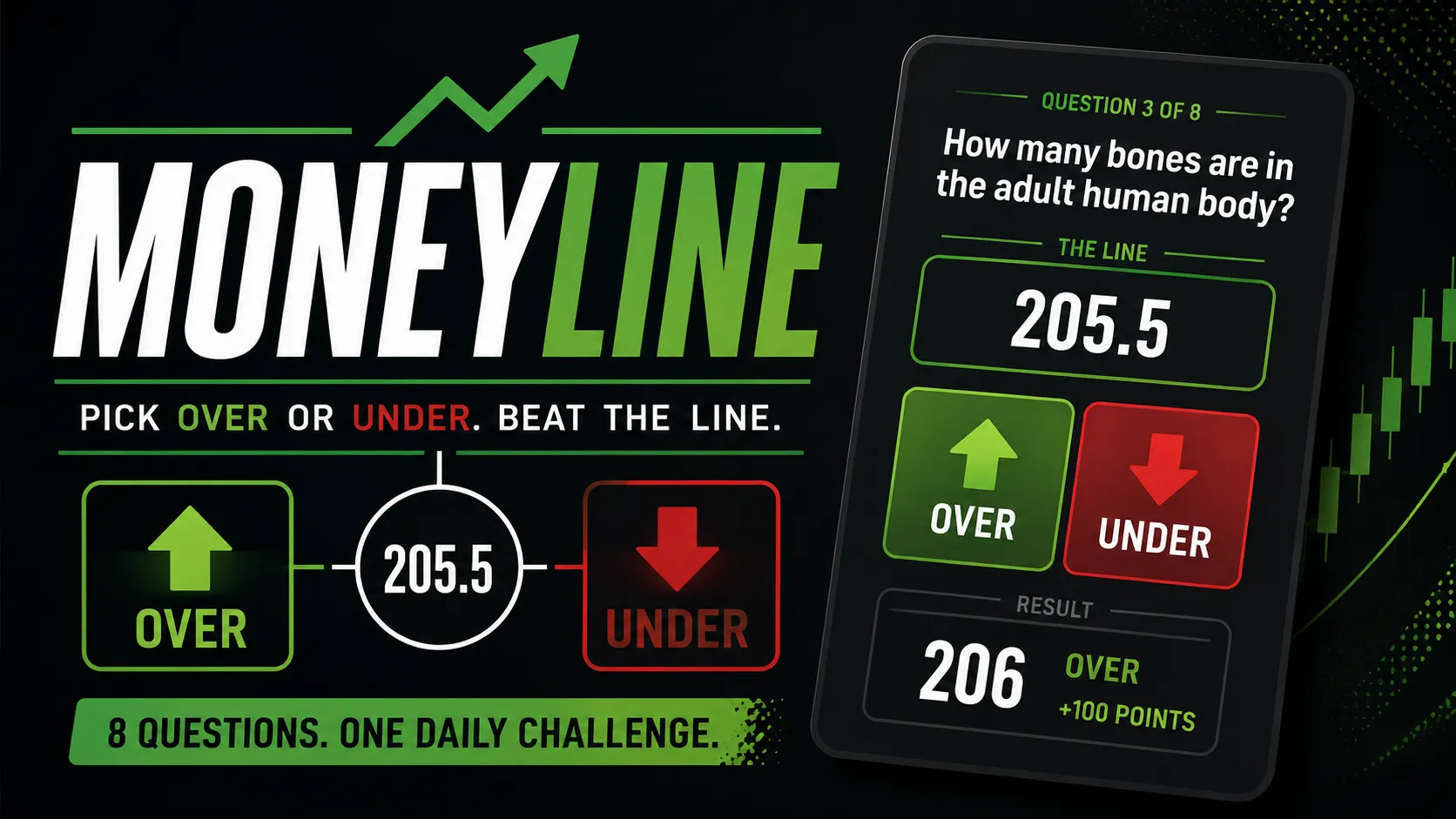

What is Moneyline?
Moneyline is a daily numerical trivia showdown built around one dangerous decision: OVER or UNDER? Each round presents a fact-based question alongside a posted number, and you must decide which side of that line holds the real answer.
There is no need to type an exact figure—but that does not make the game easy. A cleverly chosen threshold can turn something you vaguely know into a brutal fifty-fifty battle between knowledge, estimation, and nerve. Each daily game contains eight fast rounds covering facts and statistics from a mixture of subjects. ([moneyline.fromthethink.com][1])
Moneyline Game Rules (The Catch / The Trap)
Moneyline gives you an eight-question card:
QUESTION → POSTED LINE → OVER / UNDER → REVEAL
- Each round shows a question and a numerical threshold.
- You MUST choose OVER ⬆️ or UNDER ⬇️.
- Every posted line uses a half point, such as
205.5, so a tie or push CANNOT occur. - After your choice is locked in, the real answer is revealed.
- A correct pick is worth 100 points.
- Your strongest run of consecutive correct answers contributes to the game's streak scoring.
- Complete all eight lines to unlock your final results. ([moneyline.fromthethink.com][1])
The trap is the line itself. You may know the rough answer, but Moneyline places the threshold close enough to make hesitation feel dangerous.
How To Play Moneyline?
The line appears
Question: How many bones are in the adult human body?
Posted Line:
205.5Make the call
You remember the answer is probably just above 200, so you select:
⬆️ OVER 205.5Watch the reveal
Actual Answer:
206Result: Correct —
+100 pointsProtect the streak
A new question and line immediately replace the old one. Use your knowledge, estimate the scale, and choose again until all eight rounds are complete.
Moneyline Strategy & Tips
Do not waste time trying to recover an exact number when you only need its relationship to the line. Break each question into a plausible range first: if the answer is probably between 180 and 230, a line of 205.5 demands careful thought; a line of 150.5 should be an easier over.
Watch units closely. Years, percentages, kilometers, millions, and billions can turn a confident answer into an instant miss. When the posted number looks suspiciously precise, assume the game is testing a commonly confused statistic rather than offering a free point.