What Is Seedle?
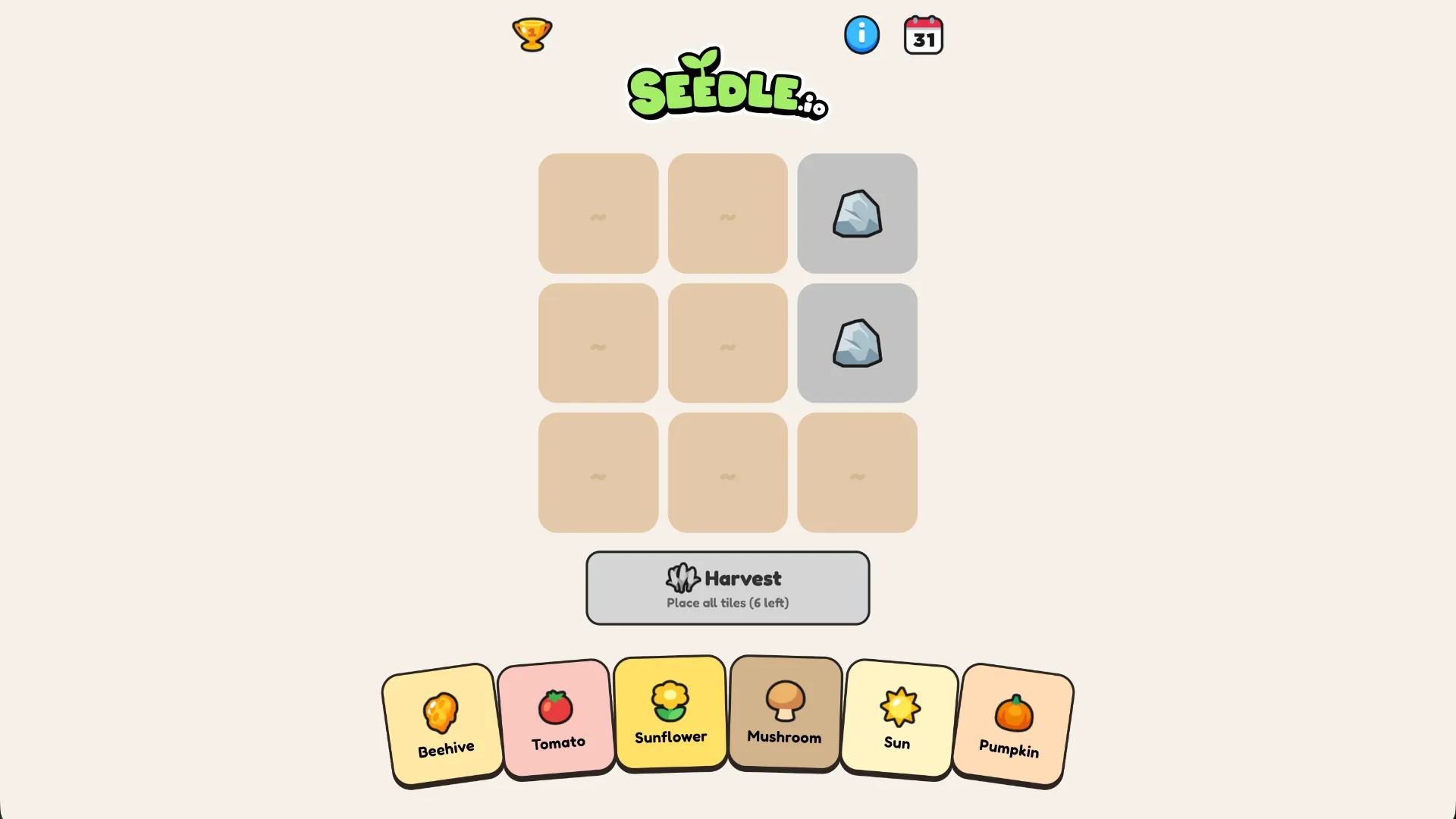
Seedle is a daily grid-based farming puzzle about optimizing a harvest rather than guessing a hidden answer. Each day gives you a board, a collection of crop and booster tiles, and blocked spaces such as rocks. Your job is to place every available tile while earning as many points as possible.
The important part is that tiles do not score independently. Crops can receive bonuses from their position, neighboring tiles, or boosters, while some boosters affect adjacent crops or an entire row. That turns a small farm into a compact optimization puzzle where moving one tile can change the value of several others.
A new puzzle is available each day, making Seedle well suited to players who enjoy short daily logic challenges but want something different from word guessing or trivia.
Seedle Rules and Core Twist
The basic objective is simple: place every required tile on the available spaces and maximize your final harvest score.
Key mechanics include:
- Every tile must be placed. You cannot simply ignore an awkward crop to protect your score.
- Rocks block spaces, reducing the number of useful arrangements available.
- Crops have different scoring rules. A crop may have a base value plus bonuses tied to its row, neighbors, or whether it receives a boost.
- Boosters modify other tiles. Some can multiply nearby crops, while others can affect crops across a row.
- Adjacency matters. Putting a valuable crop beside the right booster can be much stronger than placing either tile randomly.
- Not every boost is equally valuable. A multiplier beside a low-value crop may waste an opportunity that could have been used on a stronger scoring tile.
A typical interaction may look like this:
text [ Crop ] [ Booster ] [ Crop ] [ Crop ] [ Rock ] [ Crop ]
The rock cannot be used, while the booster may improve one or more crops around it. Rearranging the same pieces can therefore produce a very different total score.
Some daily tile sets also include crops whose value changes depending on whether they are boosted or where they are placed. This is the central twist of Seedle: the best board comes from combining several scoring conditions at once.
How to Play Seedle
Inspect the board and every available tile. Before placing anything, check which spaces are blocked by rocks and read the scoring effect shown for each crop or booster.
Identify your highest-value interactions. Look for crops that benefit strongly from boosters, adjacency, or particular rows. These should usually determine the structure of your farm.
Place boosters where they can affect multiple useful crops. For example, if a booster doubles adjacent crops, a central position can potentially improve more than one tile:
text [ Crop ] [ Crop ] [ Crop ] [ Boost ]
Compare that with putting the same booster against an edge or beside a rock, where some of its potential influence may be wasted.
Fit the remaining crops around your scoring core. Make sure every tile still has a legal space. A high-scoring arrangement is useless if your final piece cannot be placed effectively.
Review the total before settling on the layout. Try swapping crops that have different positional bonuses or moving a multiplier toward a more valuable target. Small changes can produce a noticeably better harvest.
Seedle Strategy Tips
Build Around Multipliers
Effects that multiply crop values can create much larger gains than small flat bonuses. Check which crop benefits most before deciding where a booster belongs.
Watch the Rocks
Rocks are not just unusable spaces. They also reduce adjacency opportunities. A booster next to a rock effectively loses one possible neighboring target, so blocked areas should influence your plan from the beginning.
Compare Base Value With Bonus Potential
The crop with the largest printed starting value is not always the best tile. A lower-value crop that receives several compatible bonuses may eventually score more.
Look for Overlapping Effects
The strongest placements often satisfy two conditions simultaneously. For example, a crop might occupy a favorable row while also sitting beside a booster. Search for these overlapping bonuses instead of optimizing each tile separately.
Plan Before Filling Empty Spaces
Seedle rewards planning more than speed. Treat the board as one connected scoring system and reserve important positions before filling convenient-looking gaps.
Because the puzzle changes daily, there is no single permanent best layout. The fun comes from understanding today's crops, discovering their strongest combinations, and seeing how efficiently you can turn a constrained little farm into a high-scoring harvest.