
What Is Stackdle?
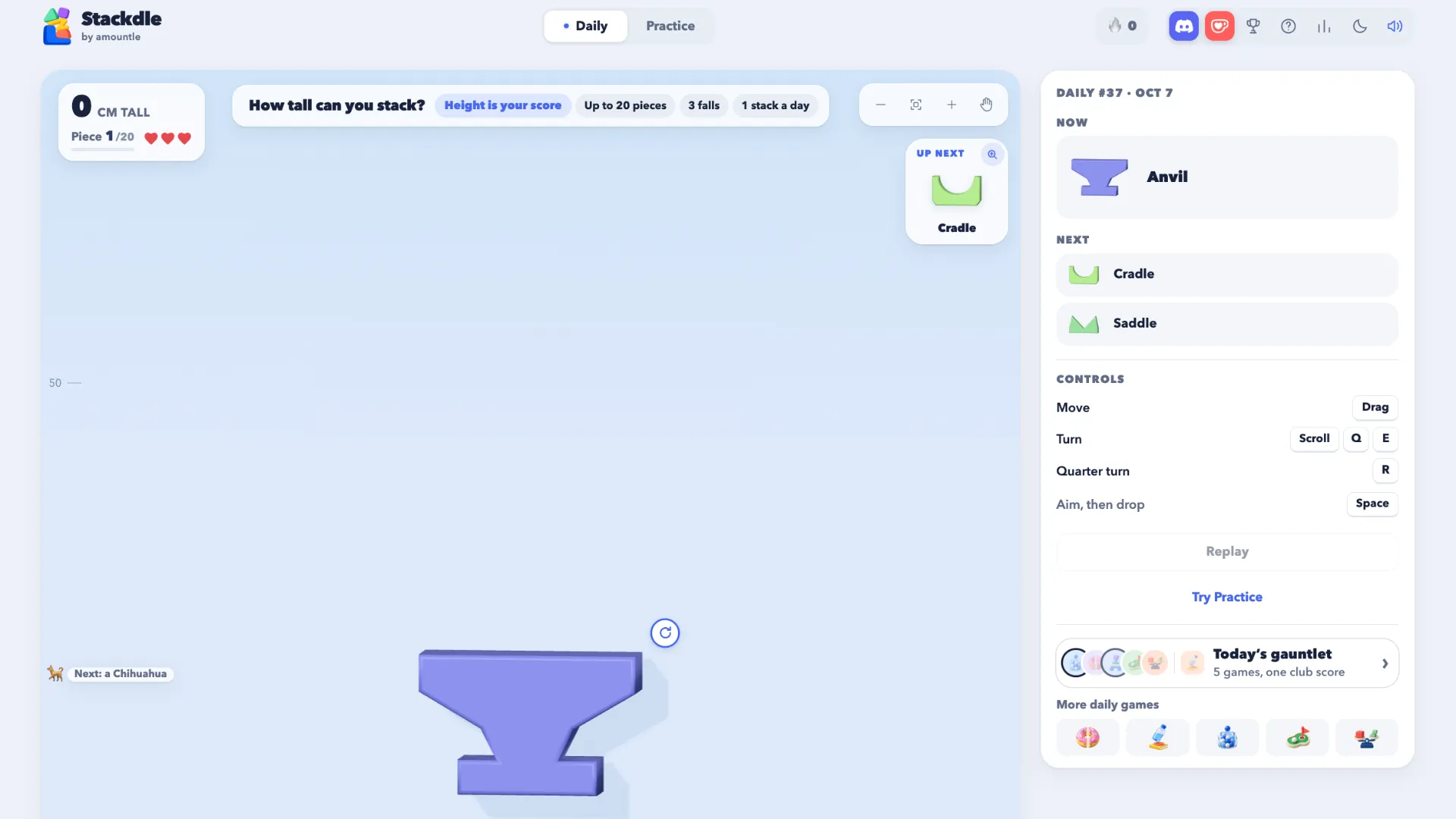
Stackdle is a daily physics-based stacking game from the creator of Amountle. Instead of guessing words or answering trivia, you build a tower from 20 irregular shapes, trying to make the finished stack as tall as possible without letting it collapse.
Every player receives the same daily sequence of pieces, making scores directly comparable. Your result is based on the height of the stable tower you manage to build.
The challenge is simple to understand but surprisingly tense: every new object changes the tower's balance, and a placement that looks safe can start wobbling once another piece lands on top.
Rules and Core Twist
Each daily Stackdle challenge gives you 20 shapes to place one at a time. Before dropping a piece, you can move it horizontally and rotate it to choose its landing position and orientation.
Once you commit, gravity takes over. The piece falls onto the existing tower and the physics simulation determines whether it settles securely, slides into a gap, tips another piece, or sends part of the tower falling.
A simplified sequence might look like this:
wide block → triangle → long bar → curved piece → small block
There is no single predetermined solution. A long bar might work horizontally as a safe platform, vertically for extra height, or diagonally as a risky bridge depending on the shapes already underneath it.
Important rules include:
- The daily challenge contains 20 shapes.
- Players receive the same daily shape sequence.
- You can reposition and rotate a shape before dropping it.
- The next pieces are previewed, allowing some advance planning.
- A tower's height counts after it settles and becomes stable.
- You are allowed three falls during the daily run.
- After a fall, play resumes from the last stable tower rather than forcing you to rebuild everything from the beginning.
The result is a mixture of spatial reasoning, planning, and unpredictable physics rather than a conventional puzzle with one correct answer.
How to Play Stackdle
- Inspect the current shape and upcoming pieces. Look at its flat edges, awkward corners, and possible orientations before deciding where it belongs.
- Position and rotate the piece. Move it above the tower and turn it until you find a landing angle that looks stable or gives you useful extra height.
- Drop the shape. Commit to the placement and let the physics simulation take over. Wait for the tower to stop moving before assuming the landing is safe.
- Continue building through the 20-piece sequence. Use upcoming pieces to decide whether to create a wide platform, fill a gap, bridge an opening, or push upward aggressively.
- Protect your three falls. If the tower collapses, one fall is used and you return to the last stable state. Finish with the tallest stable tower you can manage.
For example, if the current piece is a long narrow rectangle and the next piece is bulky, placing the rectangle flat may sacrifice immediate height but create a much safer platform for the heavy piece. Turning it upright could produce a taller score quickly, but the narrow contact point makes the next landing considerably more dangerous.
Stackdle Strategy Tips
Stackdle rewards stability, but simply making every piece as safe as possible is not always enough to produce a competitive score.
- Build a strong base early. Wide contact points give later pieces more usable landing space and reduce catastrophic movement near the bottom of the tower.
- Watch the center of mass. Pieces extending too far from one side create leverage that can pull the entire stack over when another object lands.
- Use the piece preview. Do not optimize only for the shape currently in your hands. A slightly lower placement may create the perfect surface for one of the next pieces.
- Rotate awkward pieces before committing. Irregular shapes often have one orientation that creates a much larger contact area than the obvious upright position.
- Let the tower settle. A stack that appears safe immediately after impact may still be moving. Wait to see its final position before planning around it.
- Know when to chase height. Vertical placements can rapidly increase your score but create narrow, unstable towers. They make more sense when the remaining pieces are easy to balance or when you can afford the risk.
- Use Practice mode to learn the physics. Stackdle also offers an endless practice option, making it useful for experimenting with rotations and balance without spending your daily falls.
Why Stackdle Is Different
Stackdle stands out among daily browser games because success is visible and physical. There are no hidden words or facts to uncover; the puzzle emerges from the interaction between shapes, gravity, balance, and the decisions made before each drop.
Because everyone faces the same set of pieces, the daily challenge also creates a natural comparison: one player may construct a careful, compact tower while another uses aggressive vertical placements to reach a much greater height. The shared sequence makes those different approaches part of the appeal.