What Is Tic Tac Gone?
Tic Tac Gone is a free browser-based strategy game created by bro_skito that puts a clever twist on classic tic-tac-toe. Instead of keeping every X and O on the board until someone wins or the grid fills up, each player can have only three pieces in play at once.
Place a fourth piece, and your oldest piece disappears automatically. This simple change transforms familiar tic-tac-toe into a moving battle of timing, memory, and tactical positioning.
A defensive move that looks safe now might become dangerous when one of your pieces vanishes. Likewise, an opponent's apparently secure position can suddenly fall apart when their oldest mark disappears.
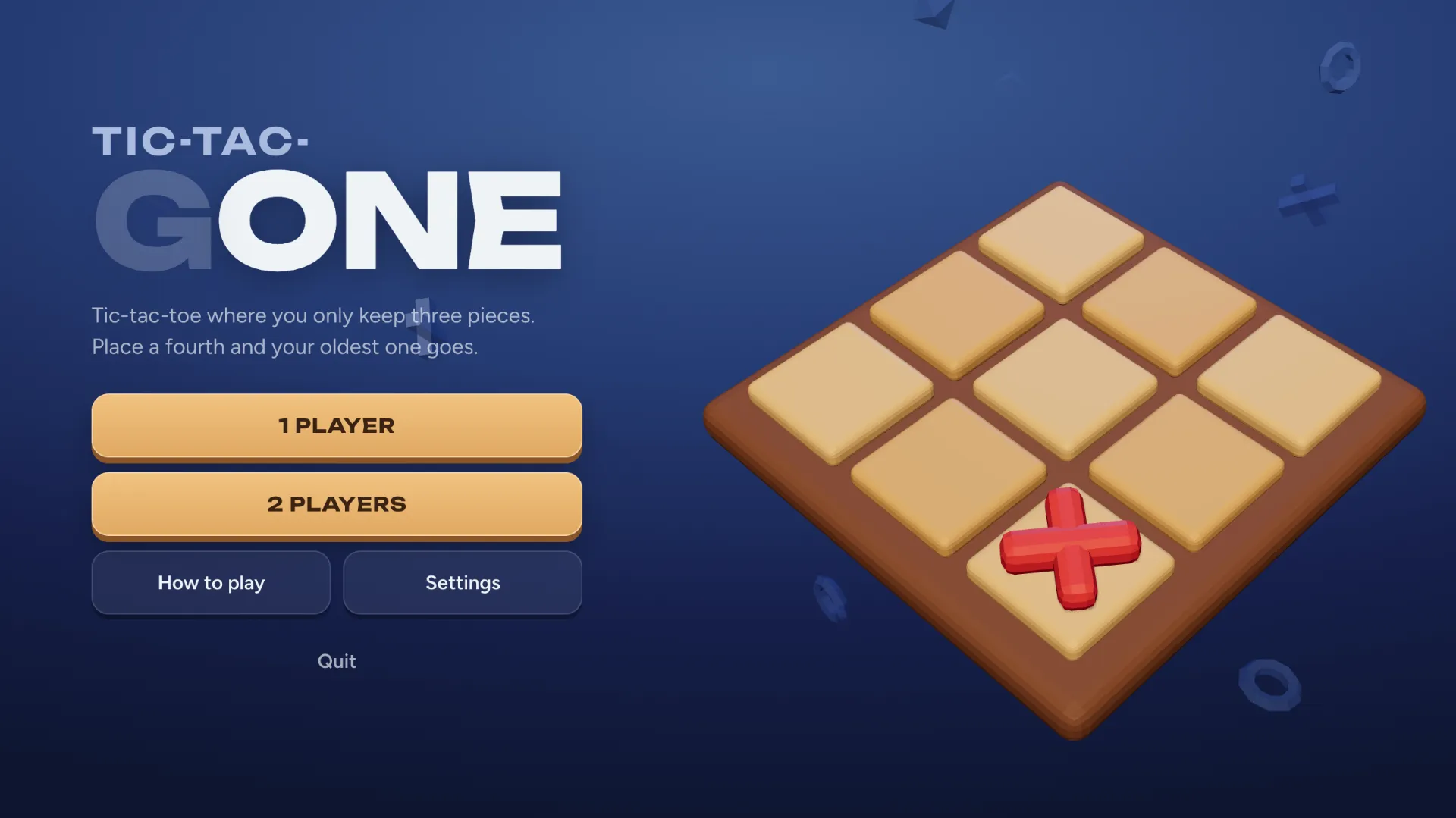
The game features a minimalist 3D board, single-player computer opponents, local two-player matches, optional turn timers, and controls designed for both desktop and mobile browsers.
Tic Tac Gone Rules: How Does It Work?
Tic Tac Gone uses the familiar 3×3 tic-tac-toe grid. Two players alternate placing their marks, traditionally X and O, attempting to complete three in a row horizontally, vertically, or diagonally.
The important difference is the three-piece limit.
- Three pieces maximum: Each player can keep only three of their own marks on the board.
- Oldest piece disappears: When you place a fourth mark, your earliest remaining mark vanishes.
- Pieces have an order: Your marks effectively form a queue, with the oldest mark scheduled to disappear first.
- Visual warning: The piece that will disappear next is faded and pulsing, so you can identify it before committing to a move.
- Three in a row wins: Complete a horizontal, vertical, or diagonal line of your own marks to win the round.
Unlike ordinary tic-tac-toe, the grid never becomes permanently full. The developer describes this design as eliminating the usual full-board draw and keeping matches moving toward a winner.
Example: How Disappearing Pieces Change the Board
Imagine you are playing X and have already placed three pieces. Your oldest X occupies the top-left corner:
X¹ | X | ·
---+---+---
 · | · | O
---+---+---
 · | · | X
The superscript 1 identifies your oldest piece.
You now place another X in the center. Because this is your fourth piece, the oldest X disappears:
 · | X | ·
---+---+---
 · | X | O
---+---+---
 · | · | X
You still have three X marks, but their positions have changed. The top-left corner is now available again, and the board presents new attacking and defensive possibilities.
This is the game's central challenge: every new move can also remove part of your existing strategy.
How to Play Tic Tac Gone
- Open the game: Visit Tic Tac Gone on itch.io and launch the browser game.
- Choose your opponent: Select the single-player option to challenge the computer or choose the two-player option to play with someone on the same device. Computer opponents offer Easy, Normal, and Hard difficulties.
- Place your marks: Take turns selecting empty squares on the 3×3 grid. On desktop, click a square or use the number keys 1–9, arranged from top-left to bottom-right. Arrow keys and Enter are also supported.
- Watch for disappearing pieces: Once you have three marks on the board, inspect the faded, pulsing mark before placing another. Your fourth placement removes that oldest mark, potentially opening a square or breaking a defensive line.
- Complete three in a row: Keep planning around both players' disappearing marks until you create a winning line. After the round, start a rematch and continue your running score.
On a phone, press a tile to preview your move and lift your finger to place it. Sliding away cancels the placement, making it easier to avoid accidental taps.
Single-Player and Two-Player Modes
Play Against the Computer
Tic Tac Gone offers three computer difficulty settings:
- Easy: A more approachable opponent for learning the disappearing-piece mechanic.
- Normal: A useful challenge once you understand the basic rules.
- Hard: A more demanding opponent that searches up to nine moves ahead, according to the developer.
Hard mode is particularly interesting because planning ahead requires considering not just new placements but also which existing pieces will disappear in future turns.
Play With a Friend
The local two-player mode allows two people to compete on the same device. Players alternate turns on the shared board, making it suitable for quick matches with friends or family.
The game keeps scores between rematches, so you can play several rounds and see who wins more often.
Optional Timers and Controls
Players can enable a per-turn timer to make matches faster and more intense.
Available turn limits include:
- 5 seconds
- 10 seconds
- 20 seconds
- 30 seconds
The game settings also let players decide what happens when time expires: a random move is made, or the player loses the turn.
Other controls and presentation features include:
- Mouse clicks and touch controls for placing pieces.
- Number keys 1–9 for directly choosing board positions.
- Arrow keys and Enter as alternative keyboard controls.
- Dragging to tilt the 3D board.
- Esc, P, or the pause button to pause gameplay.
- Separate volume controls for browser-generated music and sound effects.
These options make the game flexible enough for relaxed matches or quick, time-pressured challenges.
Tic Tac Gone Strategy Tips
1. Track Your Oldest Piece
The biggest beginner mistake is focusing only on where to place the next mark.
Before each move, look at the faded piece that is about to disappear. Ask whether losing it will weaken your position, expose a winning line, or create an opportunity.
A move that seems strong on a traditional tic-tac-toe board may be much weaker once the disappearing-piece rule is applied.
2. Think One Full Turn Ahead
Do not evaluate only your next placement. Consider what your opponent can do afterward and which mark they will lose on their next placement.
For example, an opponent may currently have two marks in a threatening line, but one of those marks might be scheduled to disappear. That threat may be less urgent than another line that will remain intact.
3. Use Expiring Marks to Your Advantage
Sometimes it is beneficial to let an old defensive piece disappear, especially if doing so makes another square available for a better attack.
Think of your three pieces as temporary resources rather than permanent territory. Their order matters as much as their location.
4. Watch Your Opponent's Piece Order
The disappearing rule affects both players. Pay attention to the faded, pulsing mark on your opponent's side of the board.
If their next move removes a crucial blocker, you may be able to prepare a winning opportunity without forcing them to make an obvious mistake.
5. Build Threats That Survive the Next Move
A potential winning line is only valuable if the necessary pieces remain on the board long enough to finish it.
Before setting up two marks in a row, check whether either mark will disappear when you attempt to place the third.
6. Practice Without a Timer First
Use untimed games while learning how the piece queue behaves. Once you can anticipate disappearing marks consistently, enable a short turn timer for an additional challenge.
Tic Tac Gone vs. Classic Tic-Tac-Toe
| Feature | Classic Tic-Tac-Toe | Tic Tac Gone |
|---|---|---|
| Board | 3×3 grid | 3×3 grid |
| Objective | Three in a row | Three in a row |
| Piece limit | Up to nine marks total | Three marks per player |
| Old pieces | Stay in place | Disappear after a fourth placement |
| Full-board draw | Possible | Board does not fill permanently |
| Main challenge | Positioning and blocking | Positioning, timing, and piece order |
The appeal of Tic Tac Gone is that it retains the simple objective of tic-tac-toe while making the position less predictable. Winning requires understanding how the board will change, not merely what it looks like right now.
Is Tic Tac Gone Free?
Yes. Tic Tac Gone is available as a browser-playable HTML5 game on itch.io. It can be launched directly from its official game page without downloading a separate application.
The game supports desktop and phone browsers and offers both computer opponents and local multiplayer.
Who Should Play Tic Tac Gone?
Tic Tac Gone is especially suitable for:
- Classic tic-tac-toe fans looking for a variation with more changing positions.
- Strategy-game players who enjoy anticipating several turns ahead.
- Friends and families who want a simple two-player game on one device.
- Casual puzzle players who prefer short, understandable games with surprising tactical decisions.
- Competitive players who want to test themselves against harder computer opponents or short turn timers.
The familiar three-in-a-row objective makes the game easy to understand, but the disappearing-piece mechanic gives experienced players more to think about.
Final Verdict
Tic Tac Gone offers a distinctive take on one of the simplest traditional board games. Limiting each player to three active pieces creates constantly changing positions, while the visual warning on expiring marks makes the unusual rules easier to follow.
Its combination of three computer difficulties, local multiplayer, optional timers, and straightforward browser controls makes it a strong choice for quick strategy sessions.
Ready for tic-tac-toe where nothing stays put? Play Tic Tac Gone and see whether you can stay one move ahead as your pieces disappear.