Meowdoku: Why This Cat Sudoku Puzzle Feels So Easy to Start and Hard to Stop
A deep player-focused look at Meowdoku, its cat Sudoku design, challenge, tips, and why its cozy puzzle loop works.
Key Takeaways
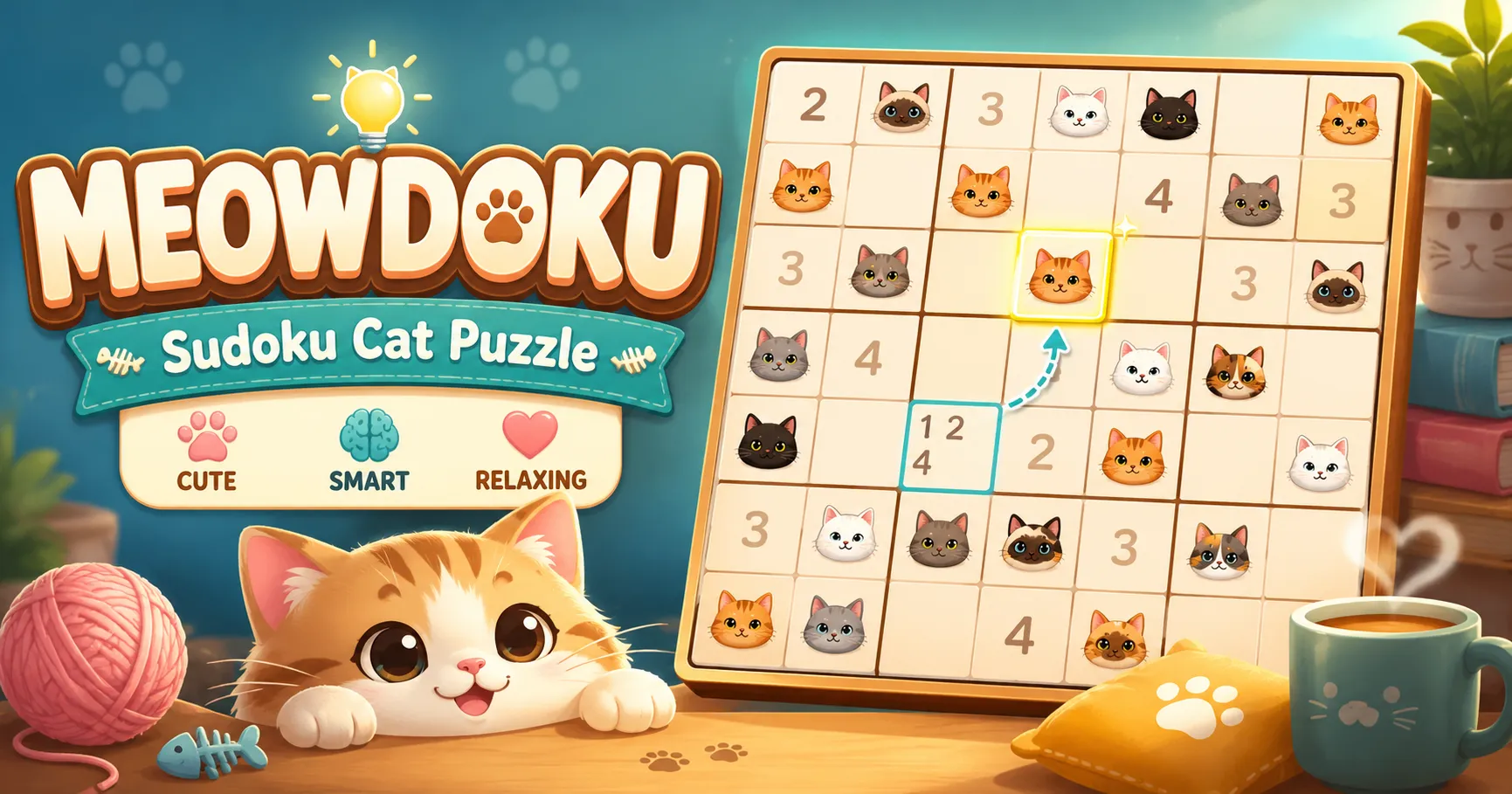
Meowdoku: Sudoku Cat Puzzle works because it takes the familiar logic of Sudoku and wraps it in a softer, more approachable cat-themed format.
Instead of presenting Sudoku as a dry number grid, it turns the experience into a cozy daily brain exercise with cute visual feedback, collectible-style charm, and a lower-pressure atmosphere.
The best parts of Meowdoku are:
- Classic Sudoku logic with a friendlier theme.
- Cat tiles or cat companions that make the grid feel less intimidating.
- Notes, hints, and difficulty options that help both beginners and regular Sudoku players.
- A relaxing puzzle rhythm suited for short daily sessions.
- Enough logic depth to stay satisfying beyond the cute presentation.
The important thing to understand is that Meowdoku is not trying to reinvent Sudoku completely. Its strength is in making Sudoku feel more inviting, more personal, and easier to return to.
What Is Meowdoku?
Meowdoku is a cat-themed Sudoku puzzle game. At its core, it follows the same satisfying rule structure that makes Sudoku timeless: place the correct symbols so every row, column, and box follows the puzzle’s constraints.
Depending on the version or mode, the game may present the puzzle with numbers, cat-themed tiles, notes, hints, daily challenges, or cozy visual themes. The cat layer does not remove the logic; it changes the mood around the logic.
That distinction matters.
A standard Sudoku app can feel like a test. Meowdoku feels more like a calm puzzle ritual. The cats create emotional softness around a game that can otherwise become tense, repetitive, or visually plain.
For many players, that is enough to make them solve one more puzzle.
What Makes It Different?
Meowdoku stands out because it understands a simple player truth: presentation changes persistence.
Sudoku is already a strong puzzle format. It has clear rules, no randomness in the solution, and a satisfying sense of progress. But many players bounce off Sudoku because it looks severe: empty cells, numbers, mistakes, and pressure.
Meowdoku changes that first impression.
Cats make the grid feel warmer.
A cute theme lowers the mental barrier before the puzzle even begins.Visual personality makes repetition less dry.
Sudoku involves scanning, testing, and eliminating possibilities. Cat visuals make those repeated actions feel less mechanical.A cozy tone reduces failure anxiety.
Players are more willing to experiment when the game feels forgiving rather than clinical.Daily play feels more like a habit.
The cat theme gives the game a small emotional hook, which helps turn a puzzle into a routine.
This is why Meowdoku can appeal to players who normally find Sudoku too serious. It keeps the logic but changes the emotional packaging.
The Puzzle Format: Familiar Logic, Softer Skin
The genius of Sudoku is that it gives players a small set of rules and a large number of consequences.
A typical puzzle asks you to think through questions like:
- Which symbol can fit in this row?
- Which column already blocks this option?
- Which box has only one possible missing value?
- What happens if this cell must be a specific cat or number?
- Can I eliminate a possibility without guessing?
Meowdoku benefits from this structure because the logic is already proven. The cat theme does not need to carry the whole game by itself. It only needs to make the existing loop more pleasant.
That loop is powerful:
- You scan the grid.
- You find a constraint.
- You eliminate options.
- You place a confident answer.
- The board opens up.
- You repeat until the solution clicks together.
The satisfaction comes from the moment when scattered clues suddenly become obvious. Meowdoku keeps that exact feeling, then adds a more playful surface.
Why It Feels Challenging
Meowdoku can look cute, but the challenge is still real.
Sudoku difficulty does not come from speed or reflexes. It comes from managing information. The player has to hold several constraints in mind at once, often while resisting the temptation to guess.
Meowdoku feels challenging because of four main pressures.
1. The Grid Looks Simple Until It Does Not
At the start, players usually find a few easy placements. These are satisfying and create early momentum.
Then the board slows down.
Suddenly, every empty cell seems to have two or three possible options. This is where Meowdoku becomes a real deduction puzzle rather than a simple matching game.
The challenge shifts from “what can I place?” to “what can I prove?”
2. Cute Symbols Can Change How You Read the Board
If Meowdoku uses cat tiles instead of numbers, the puzzle can feel more charming but also slightly harder to scan.
Numbers are abstract and familiar. Cat faces, colors, or icons require visual recognition. Some players love this because it makes the game feel fresh. Others may prefer switching back to numbers if available.
This creates an interesting tradeoff:
- Numbers are cleaner for pure logic.
- Cats are more fun and memorable.
- Cat tiles can make pattern recognition feel more visual.
That small change can alter the way players think. Instead of reading “5 cannot go here,” the player may think “the orange cat cannot go here.” It is the same logic, but with a more playful mental texture.
3. Mistakes Are Easy When You Rush
Meowdoku’s cozy design can make players feel relaxed, but Sudoku still punishes careless assumptions.
Common mistakes include:
- Filling a cell because it “feels right” instead of proving it.
- Ignoring one column while focusing on a row.
- Forgetting to update notes after placing a tile.
- Guessing too early when the puzzle still has logical paths.
- Confusing similar-looking symbols if playing with cat tiles.
The cute theme does not remove the need for discipline. The best Meowdoku players still slow down at key moments.
4. The Hardest Part Is Often Patience
Most Sudoku puzzles are not solved by one brilliant move. They are solved through steady accumulation.
Meowdoku rewards players who can:
- Scan the whole board instead of staring at one stuck area.
- Use notes carefully.
- Look for singles and hidden singles.
- Re-check boxes after every placement.
- Avoid turning the puzzle into a guessing game.
That patience is what makes the final solve satisfying. You are not just filling a grid; you are untangling a small logic system.
Why the Cat Theme Works
The cat theme is not just decoration. It changes how players emotionally experience the puzzle.
Sudoku can sometimes feel cold. Meowdoku makes it feel companionable.
That matters because many casual puzzle players do not only play for challenge. They play for mood. They want something that fits into a morning routine, a break between tasks, or a quiet evening session.
Cats fit that use case well:
- They suggest comfort and playfulness.
- They make the app feel less competitive.
- They soften the frustration of being stuck.
- They give the puzzle a recognizable identity.
- They make screenshots and app icons more appealing.
This is similar to why many successful puzzle games use gardens, animals, cozy rooms, or soft color palettes. The puzzle provides the brain work. The theme provides the emotional permission to stay.
Player Habits: Why People Come Back
Meowdoku is the kind of game that fits naturally into repeat play.
Players often return for reasons that are slightly different from why they started.
At first, they may try it because it looks cute. Later, they return because it gives them a reliable puzzle rhythm.
Common player habits include:
- One puzzle before bed as a low-stress wind-down.
- Daily challenge sessions for routine and streak satisfaction.
- Short breaks when players want mental focus without a long game commitment.
- Difficulty climbing from easy puzzles to harder grids.
- Note-taking practice to become more confident at solving without hints.
The best daily puzzle games succeed because they become a small ritual. Meowdoku has the right ingredients for that: clear rules, short sessions, cozy identity, and gradual improvement.
How It Compares to Classic Sudoku
Compared with a standard Sudoku app, Meowdoku is usually more approachable.
Classic Sudoku is ideal for players who want a clean, distraction-free logic grid. Meowdoku is better for players who want the same logic with more personality.
Classic Sudoku strengths:
- Faster scanning with numbers.
- Minimal visual distraction.
- Better for serious solvers.
- More traditional puzzle feel.
Meowdoku strengths:
- More inviting for casual players.
- Cuter and more memorable.
- Better emotional tone for relaxed sessions.
- Easier to recommend to cat lovers or cozy game fans.
The tradeoff is simple: Meowdoku may be less austere than a pure Sudoku app, but it can be more enjoyable for players who care about atmosphere.
How It Compares to Other Cat Puzzle Games
Meowdoku sits in a broader category of cozy animal puzzle games, but it has a stronger logic backbone than many of them.
Some cat-themed games rely mostly on collection, decoration, idle progression, or cute reactions. Those can be relaxing, but they may not challenge the player deeply.
Meowdoku has a clearer puzzle identity because Sudoku gives it structure.
That makes it different from games where the cat theme is the main attraction. In Meowdoku, the cats are the doorway, but the logic is what keeps the session meaningful.
It is best understood as:
- More thoughtful than a simple cat collection game.
- Warmer than a plain Sudoku app.
- Less chaotic than arcade puzzle games.
- More routine-friendly than long-form puzzle adventures.
This middle position is its advantage.
Tips for Playing Better
Meowdoku becomes more satisfying when you treat it as a deduction game, not a guessing game.
Use these habits to improve:
Start with the most filled rows, columns, or boxes.
Areas with more clues usually reveal the easiest placements.Use notes early, but clean them often.
Notes are useful only if they stay accurate. After every confirmed placement, remove impossible options nearby.Look for forced cells.
If a cat or number can only go in one cell within a row, column, or box, that is your next move.Do not over-focus on one empty cell.
If you are stuck, scan another part of the board. Sudoku often unlocks from the opposite side.Avoid guessing unless the mode allows it casually.
Guessing can break the logic chain and make the puzzle less satisfying.Switch visual modes if needed.
If cat tiles make a hard puzzle harder to read, use numbers when available. You can still enjoy the theme without sacrificing clarity.Play easier puzzles to build pattern recognition.
Difficulty climbing works better when you understand why each placement is valid.
The goal is not just to finish. The goal is to finish with confidence.
What Makes the Challenge Satisfying
Meowdoku is satisfying because it turns uncertainty into order.
At the beginning of a puzzle, the board looks open and ambiguous. By the end, every row, column, and box has a clear answer. The player gets to feel that they personally restored structure to the grid.
That is the core pleasure of Sudoku.
Meowdoku adds a layer of charm to that pleasure. The final board does not just look complete; it feels cheerful. The cats make success feel a little more expressive than a normal number grid.
The best moments are when:
- A note pattern reveals a hidden placement.
- One correct move unlocks several others.
- A difficult grid suddenly starts flowing.
- You finish without using a hint.
- You realize you are solving faster than before.
That sense of improvement is why Sudoku has lasted for so long, and why Meowdoku’s themed version can work so well.
Who Will Enjoy It?
Meowdoku is a strong fit for players who like logic puzzles but want a softer presentation.
You will probably enjoy it if you like:
- Sudoku and number-placement puzzles.
- Cat-themed games.
- Cozy mobile puzzle sessions.
- Daily brain training routines.
- Games with notes, hints, and gradual difficulty.
- Calm puzzles that still require real thinking.
It is especially good for players who want a puzzle game that feels friendly without becoming shallow.
Who Might Not Like It?
Meowdoku is not for everyone.
You may not enjoy it if you want:
- Fast action or reflex-based gameplay.
- Competitive multiplayer.
- A completely new puzzle system.
- Minimalist Sudoku with no theme.
- Very hard expert-only logic from the start.
Players who dislike visual themes in logic puzzles may prefer a traditional Sudoku app. Players who want a pure cat game may find the Sudoku structure more demanding than expected.
Final Thoughts
Meowdoku: Sudoku Cat Puzzle succeeds because it does not overcomplicate a proven formula.
It understands that Sudoku already works. The rows, columns, boxes, notes, and deductions are enough to create deep satisfaction. What Meowdoku adds is warmth: cats, cozy presentation, and a friendlier reason to open the puzzle again tomorrow.
That makes it more than a simple reskin. A good theme changes how a game feels, and Meowdoku’s cat identity makes Sudoku feel less like homework and more like a small daily ritual.
If you enjoy Sudoku but want a cuter, calmer version, Meowdoku is easy to recommend. If you want a brand-new puzzle genre, it may feel familiar — but for many players, that familiarity is exactly the point.