
What Is Dugtong?
Dugtong: Hanapin ang Salita is a daily Filipino word-search puzzle that challenges players to discover hidden words by connecting neighboring letters on a 4×4 grid. Each day's puzzle revolves around a particular theme, making vocabulary knowledge just as important as recognizing letter patterns.
Available at dugtong.bugtong.online, the game combines the familiar letter-connecting mechanics of word-hunt games with Filipino language and cultural themes.
Rather than guessing a secret word one letter at a time, players trace continuous paths through neighboring letter tiles to uncover multiple themed words.
Dugtong is developed by John Mark Delima, who also created Bugtong Cryptic, another Filipino language puzzle game.
How Does Dugtong Work?
Every Dugtong puzzle presents a grid of letters and a theme that connects the hidden answers.
The main gameplay elements include:
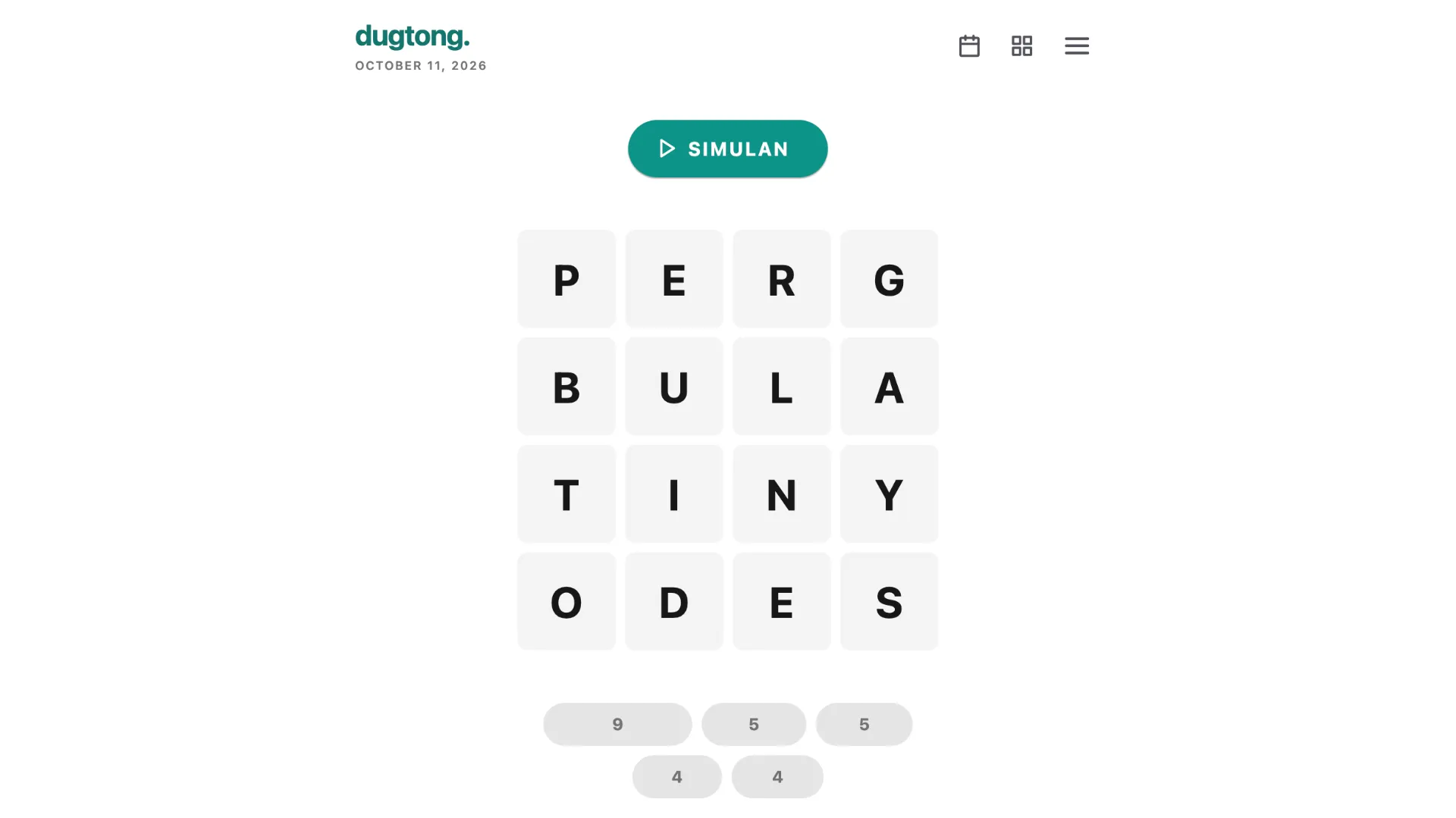
- 4×4 Letter Grid: Search an arrangement of 16 letters for hidden words.
- Daily Theme: Each puzzle focuses on a particular subject or vocabulary category.
- Connected Letter Paths: Form words by tracing neighboring letters horizontally, vertically, or diagonally.
- Word-Length Clues: The puzzle displays the lengths of its target words to help guide your search.
- Multiple Hidden Words: Find all required words to complete the puzzle.
- Forgiving Guesses: Incorrect attempts do not deduct points, allowing players to experiment without punishment.
The central challenge is finding vocabulary that matches the theme and discovering how each word fits into the grid.
How to Play Dugtong Online
Getting started takes only a few steps.
Step 1: Open the Daily Puzzle
Visit Dugtong Online and start the available puzzle. The game runs directly in your browser.
Step 2: Read the Theme
Look at the displayed theme before searching the letters.
For example, a theme about the sky might suggest Filipino words describing clouds, stars, or other objects found above the Earth.
Step 3: Examine the Letter Grid
Study the 4×4 grid and look for possible words matching the theme and the available word-length clues.
Here is an illustrative example of a letter grid: